The trucking school has been gone for nearly years. The website, russiantruckingschool.com, has been dead since investigators shut it down. The federal convictions are on the record. The prison sentences were served.
So why is Ellariy Medvednik, the man prosecutors called “the boss” of one of the most brazen CDL fraud operations in American history, now listed as the primary officer of an active, federally registered motor carrier?
The Tea is a reader-supported publication. To receive new posts and support my work, consider becoming a free or paid subscriber.
That’s what we found. The network we uncovered around him is more extensive than a single new LLC.
The Original Crime
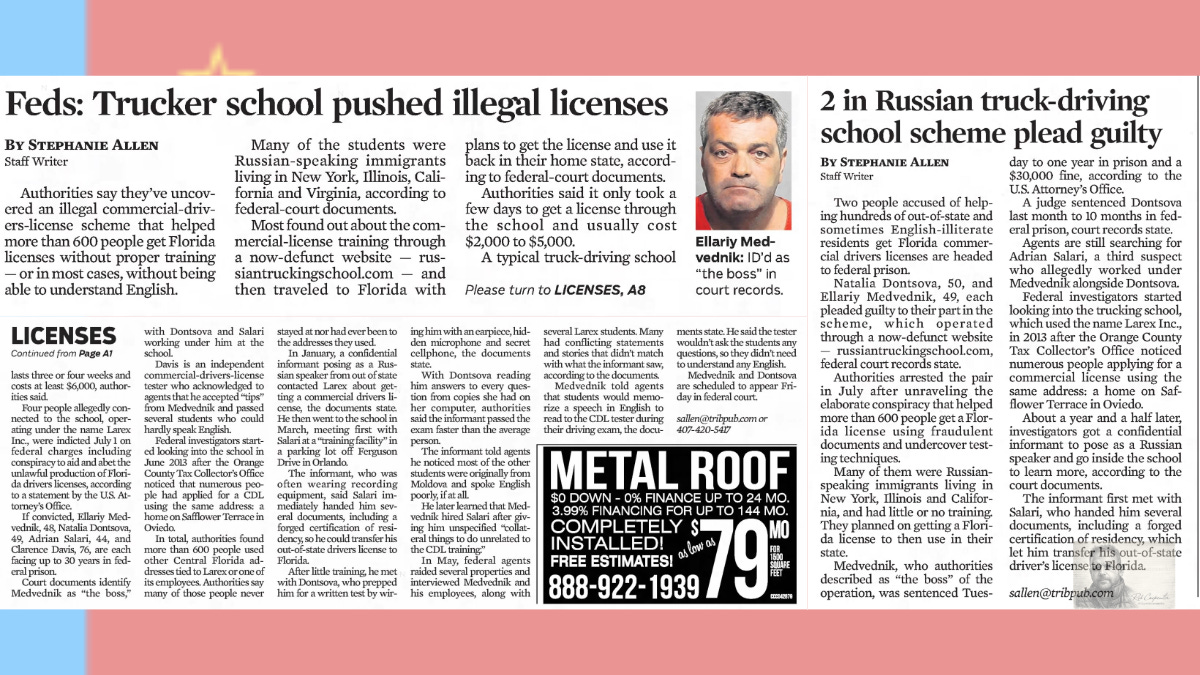
In 2015, federal agents unraveled a sophisticated fraud operation based in Oviedo, Florida, under the name Larex Incorporated. It was marketed as a truck-driving school, but it was something else entirely.
For $1,800 to $5,000, Larex promised Russian-speaking immigrants from New York, Illinois, California, and Virginia one thing: a guaranteed Florida commercial driver’s license. No matter what.
They delivered. Hundreds of times.
The operation had four moving parts working in concert:
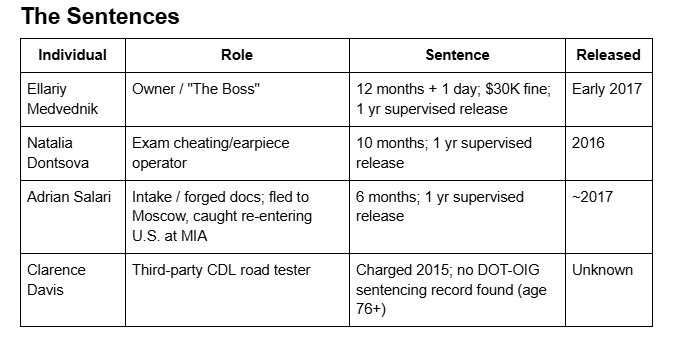
Ellariy Medvednik (”the boss”) ran the school, recruited clients, and coordinated the scheme
Natalia Dontsova used covert wireless earpieces to feed answers to applicants during the written CDL exam, and was paid $1,000 per student she helped pass
Adrian Salari handled intake, forged residency documents, and recruited clients
Clarence Davis, a 76-year-old state-authorized third-party CDL tester, passed every Larex student on the road skills and vehicle inspection tests, regardless of actual ability, for an extra $75 per head
Many applicants had never driven a commercial vehicle. Some couldn’t understand English. Medvednik told investigators that students would memorize a scripted English phrase to recite to the tester, because, as he explained, the tester “wouldn’t ask them any questions.”
The Orange County Tax Collector’s Office caught it the old-fashioned way: hundreds of CDL applications were using the same residential address in Seminole County. By the time DOT-OIG, FBI, and Homeland Security Investigations finished their work, at least 600 fraudulent CDLs had been issued. Florida sent warning letters to more than 2,000 CDL holders, requiring them to retest within 60 days or face license revocation.
There is no public data on how many of those 2,000 drivers actually retested, how many walked away, and how many are still driving right now.
Medvednik served his time. Supervised release ended around early 2018. Then he disappeared from the public record.
Until October 2025.
What We Found: A Carrier Network Built on Familiar Names and Addresses
Using FMCSA carrier data and THE TEA carrier intelligence platform, we mapped a web of motor carrier registrations linked to the same individuals, the same address, and, in one case, the same name as the original criminal enterprise.
18440 Hatteras Street, #32, Tarzana, California
This is a residential apartment in the Tarzana Tennis Club Apartments, an 89-unit complex in the San Fernando Valley. It is not a terminal. It is not a commercial address. It cannot support a trucking operation.
It is the listed address on at least three separate FMCSA carrier registrations connected to this network.
The Red Flags
1. The Name That Should Have Triggered an Alarm
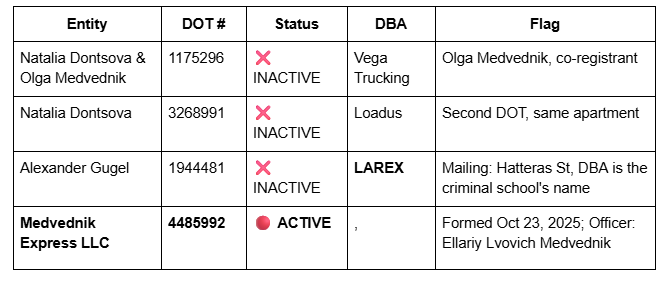
Alexander Gugel registered a carrier in Henderson, Nevada, with a mailing address at the same Tarzana apartment as Natalia Dontsova. His DBA name: LAREX.
Larex is not a common word. It is not a coincidence. It is the name of a federal criminal enterprise. Someone either didn’t check or didn’t care.
2. Olga Medvednik, The Family Connection
The first Dontsova carrier registration lists “Natalia Dontsova and Olga Medvednik” as co-registrants. Olga Medvednik shares a surname with the convicted ringleader, an apparent nominee extension designed to put distance between the convicted name and an active federal authority.
3. The Active LLC, With an Orlando Phone Number
Medvednik Express LLC was formed on October 23, 2025. The primary officer is listed as Ellariy Lvovich Medvednik, no ambiguity, no alias.
The contact phone on the FMCSA filing: 407-960-0014. That is a Central Florida area code. Orlando metro. Where Larex operated. Medvednik was indicted, prosecuted, and sentenced.
A federally convicted CDL fraud operator, eight years out of federal prison, has registered an active motor carrier under his own name in Los Angeles, using an Orlando phone number. FMCSA processed it without issue.
4. The Timing Pattern
The chronology suggests a deliberate, staged return:
Post-2017: Carriers emerge using family names, nominees, and the Tarzana hub
Carriers go inactive, possibly after insurance failures or scrutiny
October 2025: Fresh LLC, new city, new DOT number, clean slate, no inspection history, no violations, invisible in network analysis tools
The System That Let This Happen
There is no federal database that tracks individuals convicted of transportation fraud. FMCSA’s Drug and Alcohol Clearinghouse monitors drivers with substance violations, but it does not cover school operators, CDL testers, or convicted fraudsters.
A convicted CDL fraudster who served time in Florida can walk out of federal prison, move to California, register a new LLC, and file for motor carrier authority; the FMCSA will process it. No flag. No cross-check. No denial.
That is not a loophole. That is an architectural gap in federal oversight that this network appears to have exploited systematically.
“Ellariy Medvednik: Released 2017; unknown whereabouts.” That’s what the most comprehensive public accounting of the Larex case concluded as recently as late 2025. We found him. He’s running an active carrier.
What Needs to Happen Now
DOT-OIG and the Middle District of Florida U.S. Attorney’s Office should be notified that Medvednik has registered an active carrier authority
FMCSA should review whether Medvednik’s prior federal conviction triggers any disqualification review
The supervised release conditions from Medvednik’s 2016 sentence should be reviewed; operating in the motor carrier industry may have been a prohibited activity
California Secretary of State records on Medvednik Express LLC should be pulled and cross-referenced for additional members, managers, or registered agents
The LAREX DBA carrier (DOT 1944481, Alexander Gugel) warrants separate investigation, using the name of a federally convicted fraud operation as a DBA is not an accident
Olga Medvednik’s role as co-registrant on DOT 1175296 should be investigated to determine whether she was a nominee during Ellariy’s incarceration or supervised release
The Bigger Pattern: This Is Not an Isolated Case
Medvednik’s network is striking. But here’s what’s more striking: it is not unusual.
In the course of investigating chameleon carriers and high-risk motor carrier networks over the past several years, I have reviewed dozens of entities that received an imminent hazard out-of-service order, had their operating authority revoked, or had their principals convicted of federal crimes related to transportation.
Every single one reopened. Some under new names. Some under-nominee owners. Some under family members. Some , like Medvednik , openly, under their own names. Several were reopened after serving federal prison time.
Not some. Not most. Every single one I checked.
This is not a series of isolated compliance failures. This is the predictable output of a regulatory architecture that was never designed to track people, only entities. When the entity dies, the person walks away clean. There is no federal record of a human being who has demonstrated they will defraud the public when given access to the transportation system.
The Fix: A Bad Actor Clearinghouse for Transportation
The Drug and Alcohol Clearinghouse was a generational shift in how FMCSA tracks driver-level violations. Before it existed, a driver with a failed drug test in Texas could simply apply for a CDL in Oklahoma. The loophole was obvious. The political will to close it took decades. When it finally happened, the results were immediate: tens of thousands of unqualified drivers were flagged in the first year alone.
We need the same thing for bad actors at the business and ownership level. Call it what it is: a Transportation Bad Actor Clearinghouse.
Here is what it needs to cover and how it needs to work:
Who Gets Entered
Mandatory entry for any individual who is a principal, officer, owner, or named operator of an entity that experiences any of the following:
Federal or state conviction for any offense related to CDL fraud, insurance fraud, transportation fraud, or falsification of federal records
FMCSA Imminent Hazard Out-of-Service Order, not the company, the humans behind it
Operating Authority Revocation for cause (not voluntary surrender) within the preceding 10 years
Final unsatisfied civil penalty of $10,000 or more from FMCSA
Debarment from federal contracting related to transportation
State-level CDL school shutdown for cause, fraud, or misconduct
Administrative determination of chameleon carrier relationship, when FMCSA formally finds that a new entity is a continuation of a revoked one
Optional but recommended entry for individuals associated with carriers that received:
Unsatisfactory safety ratings without subsequent remediation
Pattern of OOS violations exceeding national thresholds across multiple entities
Multiple imminent hazard orders across different corporate structures
What the Record Contains
Each entry in the clearinghouse would contain:
Full legal name, date of birth, and any known aliases
Social Security Number or EIN (access-restricted, not public-facing)
Nature and date of the triggering event
Federal case number, FMCSA enforcement action number, or state action reference
All known associated entities (current and historical DOT numbers, MC numbers, legal names, DBAs)
Known associated addresses, phone numbers, and email addresses used in FMCSA filings
Current clearinghouse status: Restricted, Conditional, or Cleared
How It Integrates with the Registration Process
This is the critical piece that transforms a database into an actual deterrent.
When any individual or entity applies for a new FMCSA operating authority, the Unified Registration System (URS) must perform a clearinghouse query for every named principal, officer, and owner, not just the entity name.
If a match is returned:
Restricted status: Application is automatically flagged for manual review; cannot be approved without regional FMCSA office sign-off
Conditional status: Application proceeds but triggers an automatic 90-day enhanced monitoring period, including mandatory insurance verification and roadside inspection priority
Cleared status: Individual has completed all remediation requirements and may proceed normally
The query must also check against associated addresses, phone numbers, and EIN/SSN records, because the entire point of the nominee and shell company structure is to ensure the individual’s name doesn’t appear on the new application. A phone number match or address match against a restricted record should trigger the same flag as a name match.
The Lifetime Bar Provision
For the most serious offenses, federal conviction for transportation fraud, imminent hazard orders resulting in fatalities, or documented repeat chameleon carrier patterns, the clearinghouse should support a lifetime industry bar. Not a 10-year cooling-off period. Not supervised re-entry. A permanent prohibition on holding or being a named officer of any FMCSA-registered entity.
This already exists in other federally regulated industries:
The banking industry bans convicted felons from certain roles under FDIC regulations
The securities industry maintains lifetime bars through FINRA for serious violations
The healthcare industry maintains the HHS Office of Inspector General exclusion list; any provider on that list cannot bill federal healthcare programs, period, regardless of what state they’re in or what new entity they’ve created
Transportation is one of the few federally regulated industries where you can serve federal time for defrauding the licensing system, the system that certifies who is safe to operate 80,000-pound vehicles on public roads, and face zero permanent consequences to your future ability to operate in that same system.
A person convicted of Medicare fraud cannot bill Medicaid under a new LLC. A person convicted of CDL fraud can register a new motor carrier the day after supervised release ends. That asymmetry is indefensible.
The Whistleblower and Reporting Integration
The clearinghouse should have a public-facing tip portal, modeled on the SEC whistleblower program, where industry participants can submit information about suspected clearinghouse violations. Carriers, shippers, brokers, and members of the public who identify a restricted individual operating in an active entity should have a direct, structured channel to report it with legal protections against retaliation.
This is how the Drug and Alcohol Clearinghouse works at the driver level. Employers query it. Violations get reported back into it. It’s a closed loop.
The Transportation Bad Actor Clearinghouse should function the same way, with the insurance industry, state DMVs, and freight brokers all integrated as both data contributors and mandatory query participants.
Who Has the Authority to Build This
FMCSA already has statutory authority to deny operating authority to applicants with safety-fitness concerns. The agency has existing debarment and disqualification frameworks. What doesn’t exist is the cross-entity, individual-level tracking infrastructure to make those frameworks meaningful when bad actors simply change their LLC.
Legislation would likely be required to mandate the clearinghouse and establish the lifetime bar provision. But the FMCSA could implement a significant portion of this, particularly the voluntary flagging and enhanced monitoring components, through rulemaking under existing authority.
The model already exists in FMCSA’s own house: the Drug and Alcohol Clearinghouse required congressional action (FAST Act, 2015) and took years to implement. Someone needs to start the clock. The Medvednik case, a federally convicted CDL fraud operator running an active carrier under his own name, eight years after release, with no system capable of detecting it, is as good a catalyst as any.
The 600 Nobody Tracked
Before closing, a note on the real victims, the public.
Six hundred people received fraudulent Florida CDLs through Larex. Many couldn’t speak English. Many had never driven a commercial vehicle. Florida sent warning letters to 2,000+ CDL holders and gave them 60 days to retest.
There has been no public accounting of what happened next. How many retested? How many passed? How many continued driving without a valid license? How many are on the road today, because a $75 kickback got them a passing grade from a state-authorized tester?
We don’t know. Nobody tracked it.
That’s the real scandal underneath this one.
If you have additional information about this network: theteaintel.co