

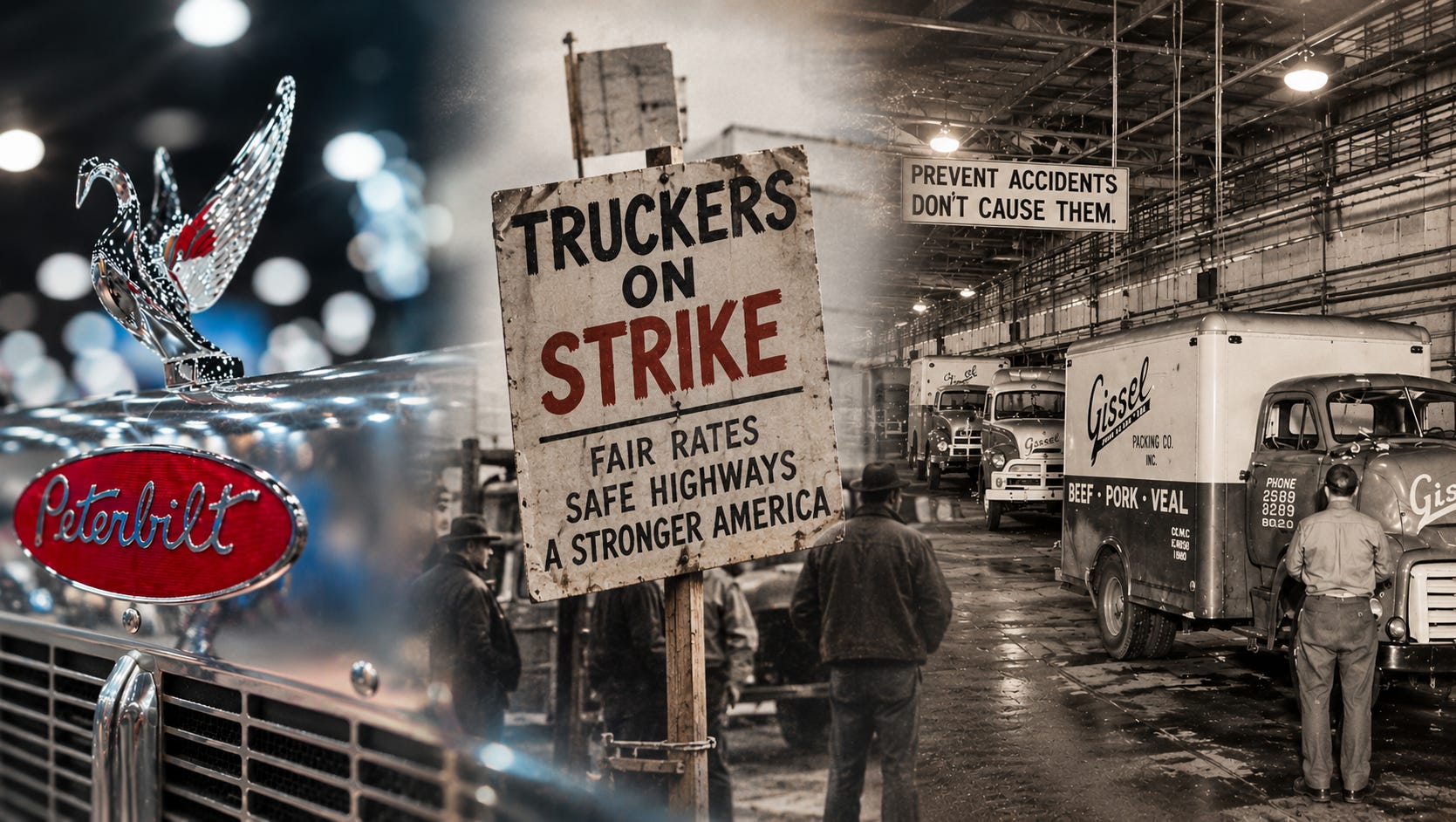
Park it Oct. 1. Stand together. Don’t move until diesel comes down. You’ve seen it in your feed, and if you’re a driver, you’ve heard it at the fuel island. People are talking about it every day now, and some of them mean it.
Diesel hit a record $6.285 a gallon on Sept. 14, so I understand why. The call took off after a Sept. 15 video and a wave of flyers across Facebook, Instagram and X. When Snopes checked, it found no organization behind it. The Owner-Operator Independent Drivers Association and the International Brotherhood of Teamsters both said they knew nothing about a strike. That doesn’t make the anger fake, and it doesn’t mean nobody will park. It means nobody’s in charge.
I’ve watched a lot of these come and go. I was a member of For Truckers By Truckers, and George Berry led a few good ones that brought a lot of people out. Getting drivers out was never the hard part. Keeping them organized and focused on the ball was, and I don’t see Oct. 1 going any differently. What I want to explain is why there’s no organization in America that can lawfully call the shutdown drivers are talking about, at least not for the owner-operators most likely to want it, and why the drivers themselves stopped being the kind of workforce that could hold one together.
What Hoffa had
If you know me, you know I’m not a pro-union guy. If you follow me, you know my great-grandfather, Roman Gissel, an Eastern European immigrant meat packer, shut his business down at Gissel Packing before he ever let someone dictate what he could or couldn’t do with his business. The NLRB v. Gissel Packing remains the law of the land ot this day.
But…
Start with what the old days looked like, because it wasn’t magic. It was structure.
From 1935 to 1980, the Interstate Commerce Commission regulated who could haul freight across state lines and what they could charge. Getting operating authority was hard. Rates were filed and approved. The law limited price competition. That system had real costs for shippers and consumers, and it also did something for drivers. When prices are fixed, and new competitors are kept out, a union that organizes existing carriers organizes the market.
Jimmy Hoffa understood that better than anyone. He ran the Teamsters from 1957 to 1971, and in 1964 he negotiated the first National Master Freight Agreement, one contract that set wages and working conditions for about 450,000 drivers at roughly 16,000 companies. Economist Michael Belzer’s research puts union membership among truck drivers at about 60% in the mid-1970s. When Hoffa’s union threatened to strike, the threat covered a real share of the nation’s freight under a single signature.
Those drivers were employees. That matters, because it’s the legal line the rest of this story turns on.
What 1980 changed
President Jimmy Carter signed the Motor Carrier Act of 1980 on July 1, 1980. It stripped the ICC of most control over entry and rates. Economists broadly credit it with lowering shipping costs, and it did. It also broke the union’s grip on the market, because anyone who could buy or lease a truck could now compete, and the new entrants were overwhelmingly nonunion.
By 1985, unionized workers were about 28% of the trucking workforce. By 2000, Belzer found, union membership among drivers had fallen to about 25%, and it has kept falling. Fewer than 20,000 interstate carriers were registered in 1980. Today there are more than half a million. When the Teamsters struck the carriers under the Master Freight Agreement in 1994, the Los Angeles Times reported the public hardly noticed. Most of those carriers were less-than-truckload companies by then, and the full-truckload market, where most freight moves now, was nonunion.
The union that survives is concentrated at UPS and a handful of LTL carriers. The Teamsters told the House Transportation Committee’s Democrats in written testimony that turnover at large truckload carriers has long run 80% to 90% a year, compared with 10% to 15% at Teamster LTL carriers. Whatever you think of unions, that gap is a fact about which jobs people stay in.
Who can strike today, and who can’t
This section is not legal advice. It’s the general framework, and a driver or carrier facing a real decision should talk to a labor or antitrust lawyer.
A company driver is an employee, and employees have a federal right to act together. Section 7 of the National Labor Relations Act protects employees who organize, bargain collectively, and engage in “concerted activities” for mutual aid or protection, and that protection covers a group of nonunion employees who walk off together over pay or safety. The catch is practical, not legal. Under a 1938 Supreme Court decision, an employer can hire permanent replacements for workers on an economic strike, and in a market with high turnover and a waiting line of new CDL holders, that’s a powerful threat.
An owner-operator is a different animal, and the statute reflects that difference. When Congress passed the National Labor Relations Act in 1935, it left the word “employee” undefined, and in 1944 the Supreme Court let a group of newspaper sellers organize as employees. Congress responded with the Taft-Hartley Act of 1947 by intentionally excluding independent contractors from the law. An owner-operator running under his own authority, or leased to a carrier as a genuine independent contractor, has no NLRA right to organize and no National Labor Relations Board to go to.
That by itself would only mean owner-operators have no special protection. Antitrust law is what makes a coordinated strike dangerous. The Sherman Act of 1890 prohibits agreements in restraint of trade, and courts treat agreements among competitors to fix prices or to refuse to deal together as illegal on their face, without any inquiry into whether the price was fair. An owner-operator is a business. Two owner-operators who agree to park their trucks until rates go up are two competitors agreeing on price and agreeing on a boycott.
Unions escaped that trap through the labor exemption, carved out by the Clayton Act in 1914 and the Norris-LaGuardia Act in 1932, which protects workers’ collective action over wages and working conditions. The Supreme Court has kept that exemption narrow. In 1942, it refused to extend it to independent fishermen who sold their catch collectively. In 1962, in a case involving drivers, it held that a union violated the Sherman Act by bringing in independent businessmen who collected and sold used restaurant grease. In 1990, in FTC v. Superior Court Trial Lawyers Association, it held that a group of independent lawyers who stopped taking court appointments together to force a fee increase had run an illegal boycott, even though their cause was sympathetic and the buyer was the government.
Put those together, and you get the trap at the center of every trucker shutdown. The thing that would make Oct. 1 work, a real organization with members, a list, a rate target and a promise not to haul below it, is the same thing that would expose its organizers and the drivers who signed on to antitrust liability. Whether a leaderless call on social media adds up to an “agreement” under the Sherman Act is a harder question than it looks, and it’s one for a lawyer, not a Facebook group. What’s clear is that the more organized it gets, the more exposed it gets. That’s the settled framework, and it’s the backdrop for the way OOIDA, the largest owner-operator organization in the country, operates: it lobbies and litigates, and it doesn’t call strikes.
The line between a protest and a boycott
Owner-operators are not powerless under the law, and it’s worth knowing what they can do. Any one of them can refuse any load at any rate, for any reason, and park the truck. That’s his business decision, and it’s completely legal. What turns legal into illegal is the agreement: I’ll park if you park, and neither of us hauls until the rate hits a number.
They can petition the government, which is a different thing under the law. The First Amendment and a line of Supreme Court cases protect joint efforts to lobby, rally, and persuade officials, even when the goal is to change what drivers get paid. A convoy to Washington, a rally at a statehouse, a flood of calls to Congress about the diesel tax all of that is protected speech and petitioning, subject to the traffic laws. The trial lawyers’ case teaches that a collective refusal to work doesn’t become protected just because the complaint targets the government.
The history shows both sides of that line. In February 1974, independent truckers shut down for 11 days over diesel prices and the new 55 mph limit. In 1979, after the Iranian revolution sent fuel prices soaring, thousands of independents parked again, and the Washington Post reported drivers who kept rolling were shot at and hit with rocks in 20 states. Those shutdowns got Washington’s attention. They also hurt people, and that’s part of why a trucker shutdown still reads to lawmakers as a public safety problem rather than a labor dispute.
The cracks in the wall
In 2022, a federal appeals court in Boston held that a group of Puerto Rico jockeys who refused to race over pay weren’t automatically shut out of the labor exemption just because they were independent contractors. The Federal Trade Commission issued a policy statement in January 2025 describing when it would treat collective action by workers classified as contractors as protected labor activity. Neither of those gives an owner-operator a green light, and the FTC’s view can change with the commission.
Misclassification is the other crack. A driver who’s called an independent contractor but controlled like an employee may legally be an employee, and California’s ABC test has pushed exactly that question into port drayage and leased operations. A driver who is an employee in fact has Section 7 rights regardless of what his lease says.
I came out of farming before I came into trucking. Since the Capper-Volstead Act of 1922, farmers have been allowed to join together in cooperatives and market their crops collectively, including on price, with a statutory shield from antitrust law. A farmer who owns his tractor and his land can bargain collectively over what his corn sells for. A trucker who owns his tractor and his authority can’t do the same over what his miles sell for. Congress decided a century ago that small farmers needed that protection against big buyers. It has never made the same call for the small carrier.
One more irony. For decades after 1948, motor carriers could set rates collectively through rate bureaus with antitrust immunity. Regulators ended that immunity for trucking in 2007. Carriers once had a legal way to agree on price together, and drivers who own trucks never did.
What happened to the brotherhood
When I started driving, the truck stop was a community. You knew the guys who ran your lane. The CB was a party line, a warning system, and a counseling service. If you broke down, somebody pulled over. If a guy was in trouble, the word went down the road. That wasn’t sentimentality. It was a workforce that stayed long enough to know each other, doing the same runs for the same companies for years, many under the same contract.
Now we have a market that pits drivers against each other every hour of the day. A spot load is an auction on a load board, and the driver who takes it for less gets it. The truck stop at 5 p.m. is a fight for the last parking space. The carrier on the other end of a load might be a stolen identity or a double broker, so the default posture toward another trucking company is suspicion. With 80% to 90% turnover at big truckload fleets, many drivers never stay anywhere long enough to belong to anything. The phone replaced the CB, and social media replaced the coffee counter with a comments section where drivers tear each other apart for views.
Some of that is technology and some of it is economics, but most of it traces back to structure. Sociologist Steve Viscelli’s book “The Big Rig” argues that after deregulation, the industry sold drivers independence as the answer to low pay: don’t organize, buy your own truck, and be your own boss. Belzer called the result “sweatshops on wheels.” A workforce built on the idea that every man is his own business competes by instinct and cooperates only in a crisis. That’s not a character flaw in today’s drivers. It’s what the market was designed to reward.
Every driver who’s been around a while knows how this plays out. Say every driver in the country agreed, 100%, to sit out on Oct. 1. Maybe 40% would stay home. The other 60% would go haul the freight the 40% left sitting, at the higher rates the missing trucks created. That isn’t a guess about human nature. It’s the math of the spot market: every truck that parks raises the rate for every truck that doesn’t, so the payoff for breaking ranks goes up with every driver who keeps his word. Economists have a name for it: the cartel problem, and it’s why farmers needed a law to hold their cooperatives together. Truckers don’t have one, and the market punishes those who stand together and pays those who don’t.
That’s what I mean when I say the industry is fragmented, fractured, and disloyal. It’s not a moral judgment on any one driver. It’s a workforce with no institution, no contract, and no reason to trust the next truck over, operating in a market that pays you to undercut him. Nearly every driver in the country shares the anger over $6 diesel. What’s missing is what turns shared anger into shared action: trust, continuity, and an institution with the standing to speak for more than one truck. A viral video can find the anger. It can’t supply the brotherhood.
I’m not going to romanticize the Hoffa years, and nobody who remembers them should. Hoffa went to federal prison for jury tampering and fraud. The Teamsters were expelled from the AFL-CIO in 1957 over corruption, and the union’s Central States Pension Fund became a byword for mob lending. The brotherhood wasn’t open to everyone, either. In 1977, the Supreme Court found in International Brotherhood of Teamsters v. United States that a trucking company had engaged in a pattern of discrimination keeping Black and Hispanic workers out of the better-paid line driver jobs. The 1974 and 1979 shutdowns involved real violence against drivers who chose to keep working. Everyone who bought anything paid the regulated era’s high freight rates.
Deregulation also brought real benefits: lower shipping costs, more service to small towns, and a path into owning a business for hundreds of thousands of people who would never have gotten ICC authority under the old system. The old brotherhood had a lot going for it. It also had a door, and plenty of people were on the wrong side of it.
What would give drivers leverage?
If the goal is power at the rate table rather than a shutdown nobody can lawfully organize, three things would matter more than any video. The first is a legal change that gives small owner-operators what Capper-Volstead gives farmers: a narrow, statutory right to bargain collectively with the shippers and brokers who buy their capacity, with limits on size so it doesn’t become a shield for large fleets. Antitrust scholars published a detailed proposal for that kind of exemption for independent contractors in January. Congress would have to act, and it hasn’t come close.
The second is enforcement of the rules that already exist. Unpaid detention time, lease terms that shift every cost to the driver, and misclassification of drivers who are employees in everything but name are all areas where existing law gives drivers something, and where enforcement has been thin.
The third doesn’t need a statute. Legal cooperatives for buying fuel, insurance, tires, and parking are available to owner-operators now, and a few do exist. Buying together is generally lawful even where selling together isn’t. It’s not a strike. It’s how the farmers started, too.
Some trucks will park on Oct. 1. Most won’t, and the ones that keep rolling will haul what the parked ones left behind. The fuel bill is already here, and the drivers paying it are more alone with it than drivers were 50 years ago.