

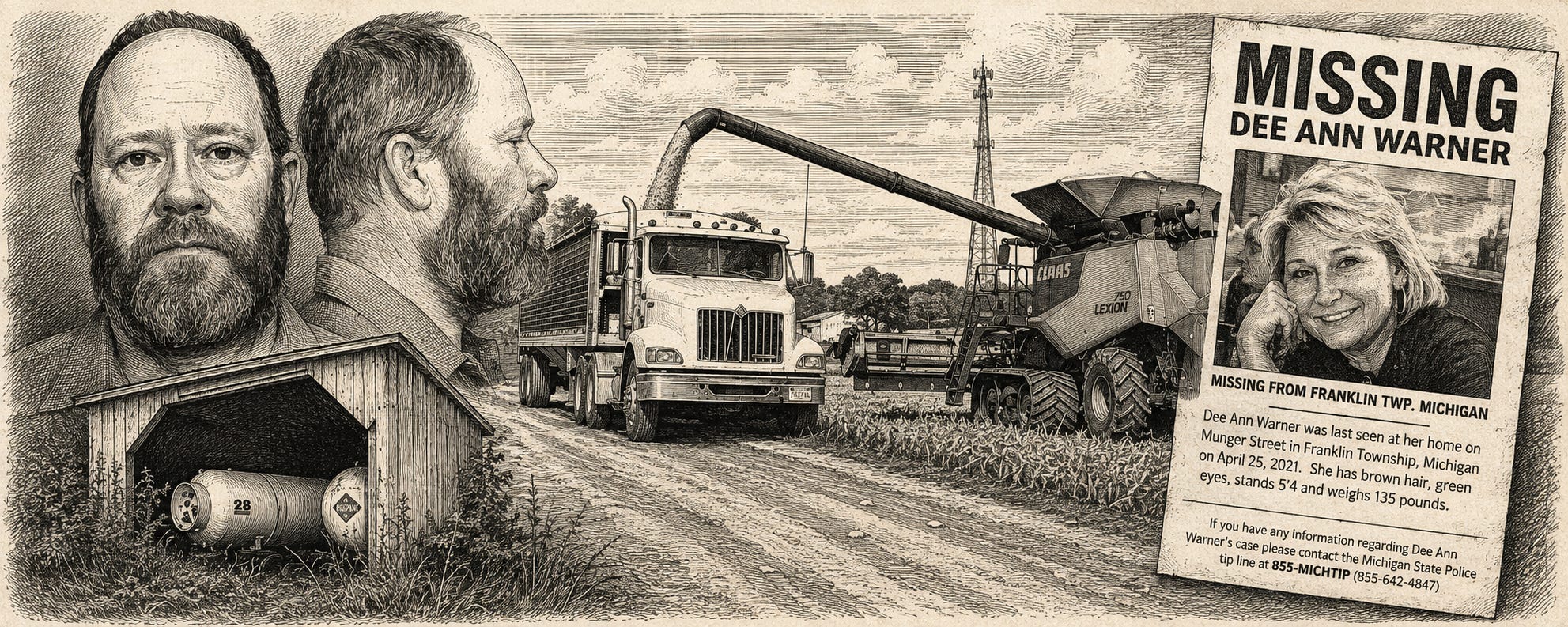
For a few years, I’ve written about the truck drivers who kill with trucks and bad decisions, and then a few years ago I got wrapped up in the FBI’s Highway Serial Killer Initiative. FBI has tracked more than 850 murdered women along the interstates since 2004, most of them last seen at truck stops, most of the suspects long-haul drivers who understood that a body in one state and a killer four states away is a case that never closes. The road is the weapon in those stories. The anonymity is the accomplice. I’ve spent a book and a career on highway predators and the bad apples of the industry. This story goes along the same lines but takes a turn to an isolated murder of a trucking company owner, Dee Warner, by her husband, Dale Warner. He’s essentially doing time right now for killing her and welding her body in an anhydrous storage tank.
Dee Warner wasn’t some woman who climbed into the wrong cab. She owned the trucks. She ran a fleet in Lenawee County, Michigan, held her own authority, and signed the paychecks. The man who killed her wasn’t a stranger passing through on I-90. He was her husband, and he farmed and drove on the same ground where he sealed her body into a fertilizer tank and told everyone she’d walked out.
Dee Warner disappeared the night of April 25, 2021, from the couple’s farm in Franklin Township, outside Tecumseh. She was 52. For three years, her family looked for a living woman. Her husband, Dale Warner, told them she’d left him without a word, cut off contact between Dee’s youngest child and the rest of the family, and let them believe she’d started over somewhere else. On August 17, 2024, Michigan State Police found what was left of her welded inside an anhydrous ammonia tank on property Dale owned. An autopsy ruled the death a homicide: strangulation and blunt force trauma to the face and head, both wrapped in duct tape. She was dressed in pajamas, wrapped in a tarp, and sealed in the steel.
A Lenawee County jury convicted Dale Warner of second-degree murder and tampering with evidence on March 10, 2026. On May 7, Judge Michael Olsaver sentenced him to 31 and a quarter to 60 years for the murder and a consecutive 17 months to 10 years for the tampering, up to 70 years all told. He’ll be eligible for parole in 33 years. He signed his appeal paperwork on the record the same day.
What the trucking company had to do with it
The reason this belongs in a trucking column and not just a true-crime one is what the prosecutors said set the last weekend in motion. Assistant prosecutor David McCreedy told the jury that tensions between Dale and Dee peaked the weekend of April 24 and 25, 2021, over a dispute involving employees of their trucking company, DDW. Dee had told family she planned to file for divorce and sell the business. She went missing that night.
The couple had met years earlier working at Crop Production Services and built the fleet together. McCreedy described a marriage run on surveillance rather than trust. Jurors were told Dale tracked Dee’s vehicle more than 2,000 times through OnStar, put a tracking device in her Hummer, photographed her text messages, and tried to have her phone cloned. “This marriage had no intimacy, just secrecy,” McCreedy said. Days before she vanished, Dee wrote that she and Dale didn’t even talk anymore, that they were just roommates, and that things had gotten much worse.
Prosecutors walked the jury through that final morning using the farm’s own surveillance footage. A front-end loader was seen driving up to the house around 7 a.m. on April 25, tire tracks leading to the porch. Dee’s vehicle stayed parked at home and was unlocked by Dale around 7:08 a.m. Minutes later, the loader moved toward the northeast corner of the property. Later that morning, McCreedy said, Dale remarked that Dee had left her wedding ring behind. He resisted calling police, and his children were the ones who eventually contacted authorities.
According to the prosecution, Warner kept farming and moved a tank while police were on the property, searched online for how to get rid of a large propane tank, and gathered welding supplies. Three years later, the tank he’d sealed gave back.
The defense, and what the jury did with it
Dale Warner’s attorney, Mary Chartier, told jurors the state had a theory and no proof. She argued the case was built on speculation and circumstantial evidence, that prosecutors couldn’t establish what happened during the overnight hours of April 24 into 25, and that others were on the farm that morning the investigation chose to look past. “The government has a theory, but there is no evidence to support that theory,” she said, and she accused investigators of focusing too narrowly on Dale.
The jury split the difference in a way worth noticing. It convicted, but on second-degree murder, not first. In finding him guilty of the lesser charge, jurors rejected the prosecution’s request for a first-degree conviction, which means they were not persuaded of premeditation. He killed her, the verdict says, but the panel would not sign its name to the idea that he planned it in advance. That distinction is now part of the record he’s appealing from, and it’s worth holding onto as this moves up.
The company she was going to sell
What everyone agrees on, because the prosecutor put it in front of the jury, is that Dee intended to sell DDW. What happened to the company after she was gone is not part of the criminal case. The murder trial was about how she died and how her body was hidden, not about who ended up with the trucks.
That story lives in the civil files. Dale Warner is a counter-plaintiff in a still-open commercial case involving DDW Investments that isn’t set for final pretrial until 2027. Separately, the personal representative of Dee’s estate has a civil action running against Dale that has been stayed and extended repeatedly through 2026. Those are the places where the question of the assets, the authority, and where the fleet went gets litigated on the record. Until it does, anything about the disposition of the company is a lead, not a finding, and I’ll report it when it’s papered and not before.
A trucking business is an asset that can move faster than a missing-person case. Authority, equipment, and contracts can change hands while a family is still putting up flyers. Dee Warner told the people close to her that she wanted out and wanted to sell. She didn’t get the chance to do either. The last decision she made about her own company was the one that, according to the state, got her killed for it.
The highway serial killings are a story about distance, a predator putting three states between himself and the body. This one is the opposite. Dale Warner didn’t need the interstate. He had a tank in his own yard and three years of telling his wife’s children she’d chosen to disappear. The trucks that were supposed to be Dee’s way out became the fight that ended her, and the farm that was supposed to be a life became the place she was hidden. Eight hundred and fifty women are dead along the roads, and most of their killers are still driving. Dee Warner isn’t one of those numbers. She was the owner, not the hitchhiker, and she was killed at home by the man who shared her name and her authority. Sometimes the most dangerous person in trucking isn’t the stranger behind the wheel. It’s the one who already has the keys.
A tale from the Detective magazines of my younger days!
TYPO = plain site
SUGGEST = plain sight