

On September 11, 2020, an Indiana insurer called American Inter-Fidelity Exchange filed a complaint in the Northern District of Illinois asking a federal judge to rescind a trucker’s physical damage policy it had issued to a man named Aleksandar Mimic. Rescission is the insurance-law word for unwinding the contract as if it never existed, on the theory that the application it was built on was false. AIFE’s complaint, Case No. 1:20-cv-05394, alleged four material misrepresentations. Mimic answered “no” when asked if he had ever operated under another name; AIFE alleged he operated under Windy City Trans Inc., Rex Trucking Inc., Rex Trucking Freight Inc., Super Ego Holding LLC, Kordun Express Inc., Floyd Inc., and Time Logistics Inc. Asked which carriers he leased equipment to, he named none; AIFE alleged he leased, lent, and exchanged trucks with at least five of those carriers. He said he’d never held truck insurance under another name. The loss history he submitted, AIFE alleged, was incomplete. The equipment schedule attached to the application ran past a hundred tractors with stated values from $31,000 to $90,000 a unit, which is not the equipment list of a confused owner-operator who forgot a detail on a form. It’s the asset base of a fleet, stated one truck at a time.
Seventy-three days later, on November 23, 2020, AIFE voluntarily dismissed the case with prejudice under Rule 41(a)(1)(A)(i). One page, no explanation, no settlement terms on the docket, no referral to any regulator or prosecutor that appears anywhere in the public record. With prejudice means AIFE can never bring those claims again. It also means no court ever ruled on whether the allegations were true, so I’m not going to tell you they were. What I can tell you is what happened next, because the next insurer in line had a similar issue.
On February 3, 2023, The North River Insurance Company, a Crum & Forster group company under Fairfax Financial, filed suit in DuPage County, Illinois, Case No. 2023LA000108, against Super Ego Holding LLC and United Ego LLC. Three counts: statutory insurance fraud under 720 ILCS 5/17-10.5, common-law fraud, and a declaratory judgment that four commercial auto policies, Nos. 1337482269, 1337505534, and 1337526027 issued to Super Ego and No. 1337516424 issued to United Ego, are void. The alleged mechanics are worth reading slowly because they describe a system, not a claim. North River alleges the defendant’s activated coverage on previously uninsured trucks and trailers after the date of loss but before reporting the loss, so the equipment got hurt first and got insured second. It alleges falsely inflated repair and towing amounts. It alleges claims submitted after repairs were supposedly already performed, with no adequate evidence the damage ever existed. The exhibits put texture on the theory. A Super Ego Freightliner, VIN 3HSDZAPR5KN047947, sideswipes another vehicle on I-81 near Grantville, Pennsylvania on December 15, 2022, driver Phillip Williams of Lithonia, Georgia, cited for careless lane change per the Pennsylvania State Police report, and the notice of loss for claim NJU00259991 goes in the same day from an insured contact named “George Milinkovic” at george.claims21@gmail.com. Another loss, a trailer roof strike dated May 20, 2022, gets reported on June 29, 2022, thirty-nine days later, by a contact named “Gordon Pavlov” at claims.gordon@gmail.com. A fleet running hundreds of units whose claims function operates through numbered Gmail accounts is a detail an underwriter never sees and a fraud investigator never forgets. Seven weeks after filing, on February 6, 2023, North River declared the policies void, and the coverage fight has run ever since.
This case is not resolved. Super Ego and United Ego answered in April 2023 and counter-sued for declaratory judgment, breach of contract, and bad faith, eventually claiming at least $4,234,340 in damages built on the premiums North River collected before voiding the policies. Every allegation on both sides remains an allegation; three and a half years in, no court has ruled on the fraud counts, and Kennedys CMK is still billing the file for North River against Kurt E. Vragel Jr.’s office for the defendants. What the docket has produced instead is a discovery record, and the discovery record is where these two cases start defining who Super Ego is.
In August 2025, North River served supplemental discovery asking two things any legitimate carrier answers in a week: who handled your insurance claims, and who maintained the equipment inventory on the CBA software that determined what was covered. The October 2025 responses produced not a single document. United Ego stated that Biljana Mimic is its only owner and president and that Mirna Cobic is the only agent known to have participated in insurance matters. The defendants said that everyone else involved was located out of the country. North River’s deficiency letter pushed back with names it said it knew were handling claims for Super Ego: Veronica Torres, Anthony Pope, Ron Green, John Wayne, Chuck Todd, Cole Sheen, Martin Robertson. Read that list again. A claims operation staffed by people named John Wayne and Chuck Todd is either the worst-documented HR department in trucking or a set of working aliases, and North River filed a motion to compel in December 2025 to find out which.
It never got hearing. On February 11, 2026, the parties entered an agreed order instead, and the agreed order is the newest and most revealing document in either case. Super Ego and United Ego waived their claims for loss of revenue, loss of business, and loss of profit, which had been the muscle behind the counterclaim. They also confirmed, on the record, that beyond the individuals already identified in discovery, they cannot identify any additional individuals involved in submitting claims or maintaining the insured-equipment inventory. Hold that up against the operation described in the Cobic deposition, which per North River’s own Rule 201(k) correspondence included a Risk Management Department handling claims and a Safety Department maintaining inventory lists. A company with departments cannot name the people in them. That’s not a legal conclusion; it’s an arithmetic problem, and it now sits in the court file in their own agreed language while the fraud counts head toward whatever resolution comes next.
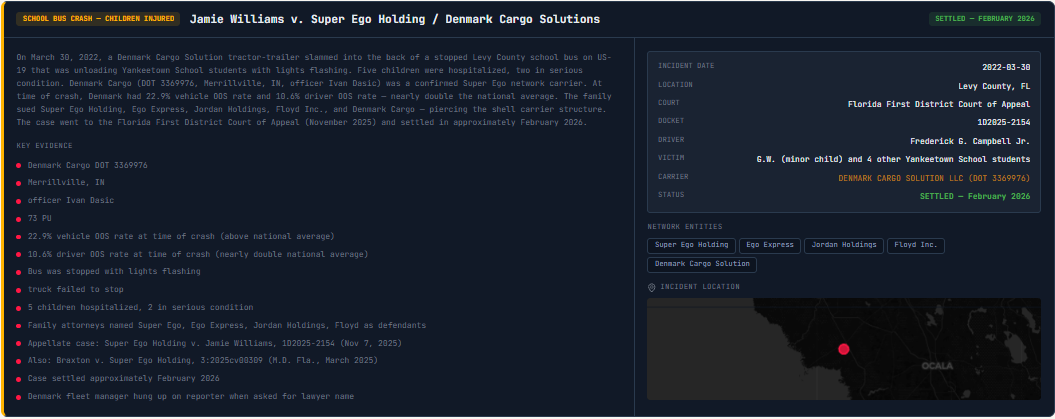
The definition problem Super Ego keeps litigating everywhere else resolves itself. In the 2020 AIFE complaint, an insurer swore that one man operated Windy City, Rex, Super Ego Holding, Kordun, Floyd, and Time Logistics as a single enterprise. In the wage litigation running in California, Austin v. Floyd, the plaintiffs allege Floyd, Super Ego Holding, Super Ego Inc., Super Ego Logistics, Rocket Expediting, Haidar Dawood, Rex Trucking, and Kordun Express collectively operate one nationwide trucking operation; a settlement of the consolidated cases, 23CV031309 and 24CV062510, went before Judge Peter Borkon in Alameda County for preliminary approval on July 30. Mimic himself, testifying as Floyd’s corporate designee under Rule 30(b)(6) in April 2025, told a plaintiff’s lawyer he was reading a driver-recruiting job post wrong because “I am the CEO in both companies.” The defense in every one of these matters has been that the entities are separate and unaffiliated. The financing paper says otherwise, and the financing paper is where operators tell the truth, because lenders check. UCC-1 filings recorded December 23, 2025, in Ohio, filing FS OH00295293993, and Washington, filing 2025-357-2848-4, name as co-debtors on the same secured facility: TIMEIT Logistics LLC, its officer Branimir Tadic personally, Aleksandar Mimic personally, and Super Ego Holding LLC. A parallel Ohio filing puts Mimic and Super Ego Holding on the paper with Rocket Expediting. Co-debtor status on a factoring facility is a cross-guarantee, and a cross-guarantee is what common financial control looks like when it has to be written down for a creditor. You do not co-sign the receivables of a company you’re not affiliated with. Roger Penske has a leasing company and you don’t see him co-signing debt for the customers.
The network’s map doesn’t stop at trucking entities. It includes its own insurance infrastructure. My entity mapping of the network, built from public corporate and federal filing records, the same mapping I’ve provided to federal contacts, includes an insurance agency, Millennium Insurance Group LLC, sitting alongside the carriers. Federal insurance filings, the public FMCSA records showing which insurer files coverage for which DOT number, show network carriers cycling onto risk retention group paper, and the documented node is Universal Casualty Risk Retention Group, an Oklahoma-domiciled RRG operating out of Jericho, New York through a New York MGA, which has filed as the insurer for Rocket Expediting among others. Universal Casualty has its own regulatory litigation history: the Oklahoma insurance commissioner’s office has been in federal court with it in the Western District of Oklahoma. The agency relationship is measured from the filings. What it means is my read, and my read is that a freight network alleged twice by admitted insurers to have gamed the claims process, holding an agency in its own structure and running its equipment on member-owned RRG paper, has moved from being an insurance customer to being an insurance participant, and the difference decides who absorbs the losses when the next set of allegations lands.
Understanding why that matters requires understanding what a risk retention group actually is, because the structure does work most of the industry never sees. An RRG is a liability insurer authorized by the federal Liability Risk Retention Act of 1986, licensed in a single domicile state, exempt from the insurance regulation of the other 49 states it operates in, and backed by no state guaranty fund anywhere. The statute requires that the policyholders be the owners. Sit with that. Every trucking RRG is, by federal law, owned by the trucking companies it insures. Carrier-affiliated isn’t a red flag on an RRG; it’s the charter. The question that decides everything is which carriers own it, who manages it, and which direction the selection runs. A well-run group captive selects inward for quality: membership is earned, the group audits your operation before it takes your risk, on-site loss control is the price of admission, and the members’ capital disciplines the members’ behavior, which is why the elite fleets are in captives. The distressed end of the RRG market selects the other way. It forms because its members can’t get coverage anywhere else, which means the ownership pool is built from the risks the admitted market already refused, the pricing is set by the people paying it, and the management is typically an MGA or a management company whose fee runs on premium volume, not loss outcomes. A captive exists to control risk. This kind of RRG exists to keep uninsurable trucks dispatched. Same statute governs both. Opposite machines.
The failure record shows what the second machine does when it runs to the end. I’ve reported the Spirit Commercial Auto lineage, a family of connected trucking RRGs that has already produced two liquidations, with a third affiliated group, County Hall, still writing while receivers counted what was missing from the last collapse. In February, I published the aggregate numbers on Omnia Risk Retention Group: fourteen insured carriers averaging a TEA carrier score of 47, with over 6,000 crashes, 200 fatalities, and 3,580 injuries among them. Fourteen carriers. Two hundred deaths. When an admitted insurer fails, the state guaranty fund stands behind the claims. When an RRG fails, there is no fund, so the judgment a crash victim wins against a carrier insured on that paper is a promise from an empty pocket, and the receivership pays pennies years later if it pays at all. The people who form these groups know that going in. The people hit by the trucks find out after.
Which is why “who is behind the RRG” is the question this industry keeps refusing to ask, and the one I’d put money on mattering most over the next three years. The formation trend is real: trucking RRGs keep appearing, domiciled in a handful of accommodating states, run by management companies, capitalized thinly, and populated by carriers whose loss history explains exactly why they’re there. Pull the domicile-state filings on any of them and read the officers and directors against the FMCSA carrier records and the state corporate registries, and the pattern I keep finding is the same names on both sides of the transaction: carrier principals, or people one entity removed from carrier principals, owning the insurer that papers their own trucks. The insurance history of a carrier already tells you more about it than its safety rating does; I showed in February how White Hawk’s descent through RRG and non-standard paper predicted the crash that Great West’s non-renewal couldn’t outrun. The ownership history of the RRG itself is the next layer down, and almost nobody reads it, because RRG governance records live in one domicile state’s filings while the group writes trucks in fifty.
Someone pays for all of it, because “insurance fraud is a victimless paper crime” is the most expensive lie in this industry. Alleged physical damage schemes of the kind AIFE and North River describe land in pooled loss ratios as paid claims long before any rescission suit claws a dollar back, and the small-fleet market prices off those pools. Insurers that conclude they’ve been burned have three moves: eat it, litigate it, or leave, and the third move is the one everyone else feels, because when admitted capacity exits trucking physical damage, the business flows downhill to exactly the member-owned paper described above. When that paper fails, the crash victims hold the empty judgment, the honest carriers absorb the market’s repricing of everyone’s risk, and the operators who built the structure re-form under the next entity name with the next management company. The AIFE dismissal shows the front end of the cycle: a rescission suit dismissed with prejudice generates no regulatory flag, no fraud-registry entry, no record the next underwriter would surface, and there is no evidence in either docket that any referral went to the Illinois Department of Insurance, the Indiana Department of Insurance, DOT OIG, or a prosecutor after 2020. North River, to its credit, is still litigating rather than walking. The question its case will answer is whether the second insurer to put sworn fraud allegations against this network on file gets further than the first one did.
Underwriters in this segment should pull UCC co-debtor records the way they pull loss runs, because the co-debtor web is the affiliation disclosure the application never makes. They should read the FMCSA insurance filing history of an applicant’s whole network, not one DOT number, because insurer churn across affiliated carriers is the descent pattern in motion. State fraud statutes like 720 ILCS 5/17-10.5 carry referral mechanisms insurers can invoke instead of settling into silence, and an industry that built CLUE for personal auto has no excuse for lacking a shared record of commercial rescission actions. Regulators in the RRG domicile states should be matching their licensees’ officers against the federal carrier census, because they are the only regulators these insurers have. Everything in this article comes from public court records in the Northern District of Illinois, the Western District of Oklahoma, DuPage County, Alameda County, federal insurance filings, and state UCC and corporate registries. Allegations are allegations; no court has adjudicated fraud against any party named here, and the North River case is active. The dockets are open. Read them, then check who owns the insurer on the next carrier you vet, because that answer is public too, and almost nobody looks.