

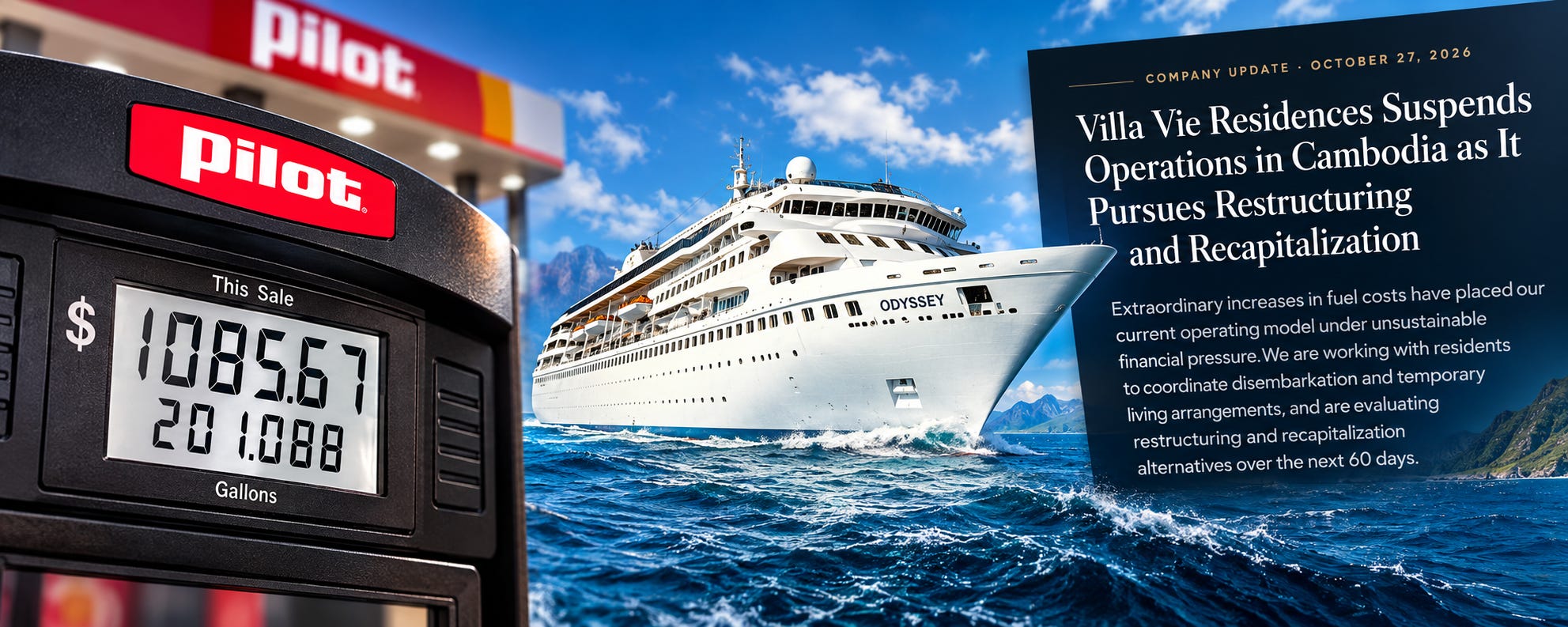
Carol Larson, 69, paid $120,000 for her cabin and spent 18 months aboard the Odyssey with her sister. Paul and Lynn Montoya, retirees from Wyoming, spent 17 months aboard. Lynn Montoya told Fox News they were tired of being asked for fuel money every two to four weeks. Some sold their homes to buy in.
The headline everywhere is fuel. Fuel is the wrong answer. The same mistake that put those retirees on a dock in Cambodia is sitting inside many trucking companies right now, and most of them can’t see it on their own P&L. Petterson told CBS that Villa Vie was paying about $700 a ton for marine fuel before the war with Iran broke out in late February. Since then, it has paid $2,000 to $3,000 a ton. The ship burns 700 to 800 tons a month. He said the monthly fuel bill went from about $400,000 to about $2 million, and asked where the company was supposed to find the other $1.6 million. Villa Vie’s own statement put fuel at about $1,800 per cabin per month before the war and $6,000 to $8,000 in parts of Asia after it.
The company slowed the itinerary and sat five or six days in each port to burn less fuel, hoping the Middle East would settle down. It didn’t. Nobody I know modeled a quadrupled fuel price into a business plan, and I’m not going to pretend I would have. That leaves out the fact that a business that dies when one input cost goes up fourfold was already living on borrowed time.
The question isn’t why it died in October 2026. The question is how long it ever had.
The model was bad from day 1
When I ran large fleet programs for private equity, the finance people I worked for drilled one idea into me until it stuck: pay more up front for certainty, because month-to-month costs are what kill you. Know which costs are fixed, which are variable, which you control, and which the world controls. Then make sure your revenue moves the same way your costs do.
Villa Vie built the opposite. Here’s how it worked, from the company’s own published pricing and reporting since 2023.
The ship itself is a 1993 hull. It sailed as the Crown Dynasty and later as Fred. Olsen’s Braemar, and Villa Vie bought it for about $13 million and put roughly $12 million into a refit at Harland & Wolff in Belfast. The company told buyers the ship had an expected life of 15 years, through 2039. So on day one you have a 31-year-old asset sold on a promise that it would run until it was 46.
Cabins started at $99,999 and ran into the hundreds of thousands. That bought a cabin guaranteed for at least 15 years. On top of that, owners paid a monthly fee of $1,750, $2,500, or $4,000 per person, depending on the cabin, which covered food, Wi-Fi, housekeeping, and ship operations. Petterson pitched it to retirees as a fixed budget. Live at sea for less than living on land.
A $99,999 cabin spread over 15 years is about $6,667 a year, or $556 a month. That’s the capex the resident paid. The company spent that cash early: on the ship, on the refit, and on a four-month delay in Belfast in 2024, when the ship was supposed to sail in May and didn’t leave until Sept. 30, and the company paid to put residents up while they waited. By the time the Odyssey was underway, much of the one-time money was gone, and what was left to run a 33-year-old ship around the planet was the monthly fee.
Before the war, Villa Vie’s fuel bill was about $1,800 a month per cabin. The cheapest monthly fee was $1,750 per person. On the entry-level cabin, the fee for one person didn’t cover that cabin’s share of fuel at prewar prices, let alone the crew, the food, port charges, insurance, and the maintenance on a ship built when Bill Clinton was in his first year in office.
After the war, it gets worse. If every one of the 203 residents aboard had paid the top fee of $4,000, that would be $812,000 a month. The fuel alone was running about $2 million. At the low fee, the same 203 people bring in $355,250. And the ship was built to carry hundreds more.
That’s the problem in one sentence: fixed-price revenue against a floating cost, with no reserve and no pass-through. The company said putting the fuel increase on residents was not a realistic solution. By then it was already asking them for fuel money every few weeks, borrowing and stretching payroll, according to Petterson. He told CBS the crisis had been going on for nine months.
So no, I don’t think fuel killed the Villa Vie Odyssey. I think it was a failed concept from the day the first cabin sold, and the fuel spike just moved the funeral up. With prewar fuel prices, it might have limped along another year. It was never going to make 2039.
If I’d written a $120,000 check for that cabin, I’d be talking to a lawyer this week. I’d also be realistic about what that gets me. In Chapter 11, secured lenders get paid first, and people holding a contract for a cabin on a ship with no money are likely to be far back in that line.
Trucking is the same business with tires
If you think this is a cruise story, look at your own numbers. The American Transportation Research Institute put the average cost to run a truck in 2025 at $2.336 a mile, the highest in the report’s history. Strip out fuel, and it was still a record $1.854. ATRI found average operating margins for truckload and refrigerated carriers stayed below 1% last year.
Below 1%. Villa Vie had more cushion than that on paper, and it’s sitting in a Cambodian port.
Then fuel moved. The Energy Information Administration put the national average for on-highway diesel at $6.352 a gallon for the week of Oct. 26, up $2.634 from a year ago. It set a record of $6.529 the week of Sept. 21. At today’s price, a truck averaging 6.5 mpg burns about 98 cents of fuel per mile.
Trucking is about as capital-expensive as a business gets. You buy the truck, the trailer, the insurance down payment, and the authority before you haul a single load, and then every mile you run costs fuel, tires, maintenance, and a driver. That’s capex and opex, and the gap between them is your operating ratio. If your operating expenses are 95 cents of every revenue dollar, you’re running a 95 OR and keeping a nickel before interest and taxes. At 100, you’re hauling for free. Above it, you’re paying to haul somebody else’s freight.
The fleets that survive this kind of year aren’t the ones with the lowest costs. They’re the ones that know which costs they can lock down, which ones they have to pass through, and which ones they can buy their way out of up front.
Where paying more up front pays you back
Start with the truck itself, because fuel economy is a capex decision you live with for years. At $6.352 a gallon, a truck that gets 5 mpg spends about $1.27 on fuel every mile. One that gets 6 mpg spends about $1.06. That’s 21 cents a mile. Over 100,000 miles, it’s about 3,333 gallons and $21,173 a year, per truck. Aero packages, low-rolling-resistance tires, the right engine and gearing for the lane, and a governed speed all cost money when you spec the truck or set the policy. They pay it back every month, and faster when fuel spikes. That’s the hedge the Odyssey never bought: it ran a 1993 hull through the most expensive fuel market in years.
Idle is the same math. The Department of Energy says a heavy truck burns about 0.8 gallons an hour at idle and a long-haul truck idles about 1,800 hours a year on rest periods alone, roughly 1,500 gallons. At today’s price, that’s about $9,528 a truck, every year, for heat and air conditioning. An APU, a bunk heater, or a battery HVAC system is a one-time cost against a recurring one. Do that math by truck before you tell me it’s too expensive.
Maintenance is where small fleets bleed the most. ATRI put repair and maintenance at 21.5 cents a mile in 2025, up 8.6%, and found costs were even higher for carriers with five or fewer trucks, largely because they buy older used equipment with little or no warranty. A cheap truck is cheap once. Preventive maintenance on a schedule costs more this month than skipping it. Then the breakdown happens on the shoulder, you pay roadside rates, the load is late, the customer is gone, and the out-of-service order lands on your Vehicle Maintenance BASIC. I’ve sat in depositions where the deferred maintenance record was the most expensive document in the room.
Insurance is the bill that decides whether you have a company next month. ATRI put insurance at 10.6 cents a mile in 2025, up 23.9% from 2021. Most authority revocations trace back to insurance lapsing, usually for nonpayment of premium. Paying in full or putting down more at renewal costs you cash now. Financing the premium costs you interest and starts a cancellation clock every month you’re short. When the cash gets tight, that’s the one payment that can’t slip.
Drivers are a capital decision too, even though they show up as opex. Paying more for an experienced, clean driver, and spending real money on onboarding and training, looks expensive next to the cheapest seat you can fill. Then a claim hits. At Heartland Express, insurance and claims went from 5.4% to 7.3% of revenue in the first quarter of 2026 compared with a year earlier. One bad claim year can move your OR more than a fuel spike, and a negligent hiring claim makes it nuclear.
Cash itself is the cheapest insurance you can buy. Villa Vie didn’t have weeks of operating expense in the bank. It had a ship, a fee schedule, and an investor search. Measure your reserve in weeks of operating expense, not dollars, and build it in good months, because nobody lends to a carrier in a bad one.
The Villa Vie trap in a trucking contract
The cruise company’s dumbest move was selling a fixed price against a floating cost. Carriers do it every bid season.
The Villa Vie fee schedule is a one-year contract rate with no fuel surcharge, or a surcharge capped at a number that made sense last spring. The shipper got a fixed budget. You got the fuel risk. Most surcharge programs key off the weekly DOE/EIA diesel index for a reason: it lets your revenue float with your highest variable cost. Read the table in every contract, check the base price and the step, and know exactly how many cents a mile you lose when diesel jumps a dollar before you sign.
Owner-operators leased on, this one’s for you. Under 49 CFR 376.12, your lease has to spell out your compensation. If you’re on percentage pay and the carrier collects a fuel surcharge from the shipper, read the lease and the settlement to see whether that surcharge reaches you. If it doesn’t, you’re a Villa Vie resident paying for the fuel twice.
Then there’s buying fuel forward. Big fleets hedge with diesel futures, and many carriers holding their margins this year bought fuel months ahead. One NYMEX ultra-low sulfur diesel contract covers 42,000 gallons, which is half a year’s fuel for a five-truck fleet. Smaller carriers get offered the same bet in a different wrapper: a fixed-price program, prepaid gallons, a tank in the yard. Those can work. They can also lock you in at the top. The EIA’s October outlook expected retail diesel to stay above $6 in October and come down gradually, averaging about $4.49 in 2027. If you lock in at today’s price and the forecast is right, you’ve paid up front for the wrong kind of certainty. Know what you burn, what your surcharge already covers, and what the seller is charging over the futures price before you sign anything.
How it lands by fleet size
The one-truck owner-operator with their own authority has the Villa Vie problem in its purest form: the owner pays themselves out of whatever is left, so the business looks profitable when it isn’t. Book your own pay as an expense at a market driver wage before you calculate anything. The two-to-10-truck fleet feels it when the owner stops driving; overhead shows up and every truck has to carry its share. Run OR by truck, because one bad unit can eat the fleet’s margin. The 11-to-50-truck carrier needs a bookkeeper who reads the surcharge tables, not just the invoices. Mid-size carriers need OR by customer, so they can see who they’re subsidizing. The big carriers already hedge. Their risk is buying fleets at the wrong point in the cycle and carrying an underperforming acquisition for years.
Same math at every size. Only the pressure point moves.
Which of your costs are fixed, and which float? Which ones do you control, and which ones does the world control? For every cost that floats and you don’t control, does a line in your revenue float with it? Where can you spend once to stop paying every month? How many weeks could you run if your highest variable cost doubled tomorrow?
If you can’t answer those, you’re not running a trucking company. You’re running a cruise. Somewhere in Sihanoukville this week, a couple from Wyoming is figuring out where to sleep. They did their math on the price of a cabin. Nobody did it on fuel.
The ticket was the cheap part. It always is.