

I am Robert (Rob) Carpenter. My Dad was also Robert (Robbie) Carpenter. It can cause confusion. My Dad's death in 2005, when he wrecked his Harley in Seaford, VA, had people surprised when I showed up for work. The Daily Press listed Robert Carpenter and Shirley Rd, Seaford, as the address. We both were Robert Carpenter; we both lived in different houses in the 300 block of Seaford Rd at the time. No one knew which of us was killed.
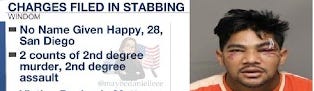
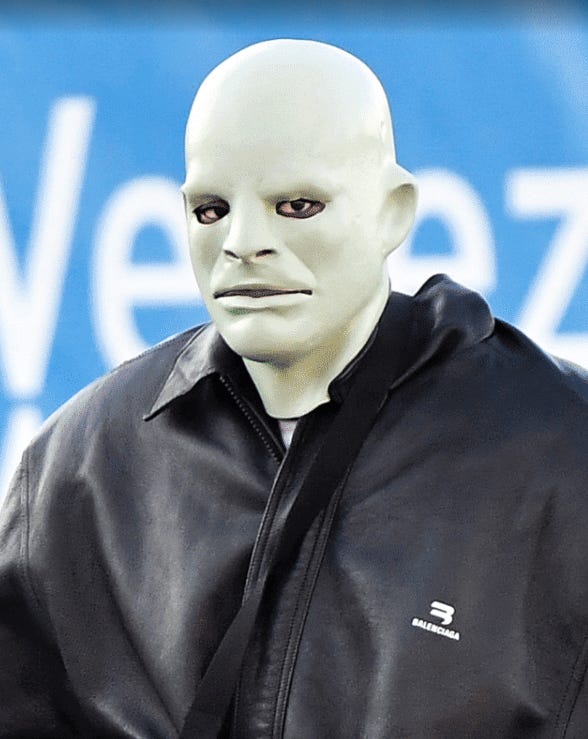
(This image was posted by a media outlet, but we’re not giving them credit because this actually originated from Danielle Chaffin, who put in the work to get these and originally didn't watermark her work, so the trash started posting her work as their own. Several images in the post attribute to Danielle's no-name-given mess (https://x.com/maybedanielleee). The other has a watermark.)
The purpose of naming goes back through all time, and it's about identity and affiliation. The earliest personal name in recorded human history may belong to a man called Kushim, who shows up on Sumerian clay tablets from around five thousand years ago, and Kushim wasn’t a king, a priest, or a god. He was an accountant signing off on barley. The first time our species ever wrote a name down, it did so to attach a transaction to a person, so that if the grain count was wrong, somebody specific answered for it. That’s what a name is for. It has never primarily been decoration or self-expression. It’s the oldest accountability technology we have.
Every naming system humans ever built does two jobs at once: it identifies and it affiliates. The given name points at you, one body in a crowd. Everything wrapped around it places you, and cultures have wrapped names in fathers, places, trades, and faiths for as long as there have been names to wrap. Johnson, Ivanovich, and ibn Rashid all mean son of somebody. Da Vinci means from a town. Smith, Miller, and Wagner mean a trade, and so does my own last name, which is a job description my family carried out of Europe. A name is a claim about who answers for you and who you answer to, which is why every society that ever wanted order started with the register of names.
Fixed, permanent, inherited surnames were mostly a government invention. Rulers who wanted to tax, conscript, and deed property needed subjects they could find twice, so states forced names into permanence: England grinding family names into place after the Conquest, Napoleon decreeing in 1808 that Jewish families adopt fixed surnames, Thailand mandating surnames by royal decree in 1913, Turkey doing the same in 1934. A person the state can name is a person the state can bill, draft, and arrest. The whole architecture of civilization, from credit to criminal records to a safety rating on a trucking company, sits on the assumption that acts attach to names and names attach to people.
For five thousand years the direction never changed: more names, more fixed, more permanent, more attached. That trend ran unbroken until now.
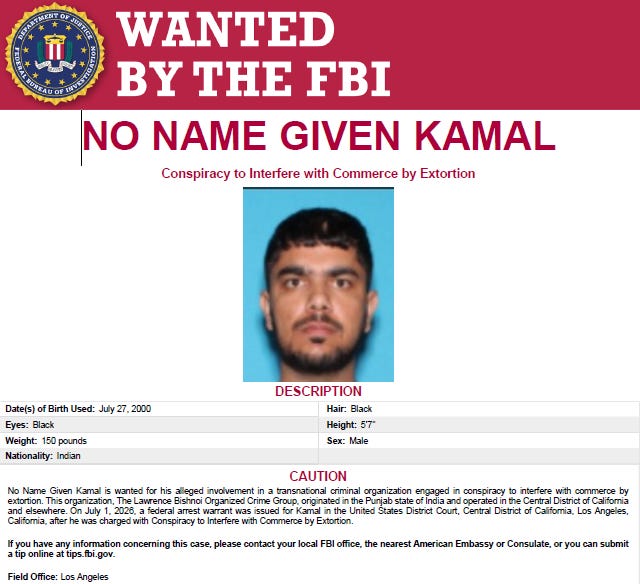
On August 18, the FBI’s Los Angeles field office published a wanted poster for a fugitive whose first name, printed in the bureau’s own red banner type, is No Name Given. The subject, identified only as Kamal, is charged with conspiracy to interfere with commerce by extortion as an alleged member of the Lawrence Bishnoi Organized Crime Group, a transnational syndicate that federal prosecutors say originated in Punjab, India, and operated in the Central District of California. Federal authorities issued an arrest warrant on July 1, 2026, in Los Angeles. The poster lists a date of birth used, a height of 5’7”, a weight of 150 pounds, black hair, black eyes, and a face. That’s the entire identity the United States government has for a man it wants badly enough to put on a poster.
A gangster on a wanted poster isn’t news. The FBI has been papering the internet with alleged Bishnoi, Bhagwanpuria, and Dhanda operatives all summer under Operation Hard Ball, the coordinated sweep that produced three federal indictments against 37 defendants, 50 search warrants, 24 arrests, and a $50,000 reward for Bishnoi’s alleged North American lieutenant, Goldy Brar. The federal government is asking the public to help find a man, but the government’s own records say he has no name. The industry has spent the last two years arguing about what it means. The wanted poster and the CDL are the same problem wearing two different uniforms, and the problem is identity.
Nobody passed a law creating “No Name Given.” No governor signed it, and no legislature debated it, which is the first thing to understand and the thing almost nobody arguing about it online has bothered to check. The phrase is a database artifact. Hundreds of millions of people worldwide carry a single legal name, a mononym, and that’s been true for centuries in parts of Afghanistan, Indonesia, Myanmar, and India. American government systems were never built for them. USCIS, CBP, the State Department, SEVIS, and the Social Security Administration all run on a two-field naming model, a given name and a surname, and every background check, biometric record, and watchlist query keys off those two fields. When a person with one name enters that architecture, the system forces the single name into one field and fills the other with a placeholder. USCIS inserts “No Name Given.” Consular officers stamping visas historically used “FNU,” first name unknown, or “LNU,” last name unknown. The State Department will issue a U.S. passport to a mononymous citizen the same way. The blank got a name because the software required one, and the software’s answer became a legal identity.
The approval, and there was one, sits in the USCIS Policy Manual, Volume 1, Part E, Chapter 5. The manual states that when a benefit requestor has a single name, USCIS considers the single name the family name, and “USCIS may insert No Name Given as the given name in this circumstance.” That’s published federal policy, carried over from the agency’s old Adjudicator’s Field Manual, which means the convention is decades older than the manual now hosting it and nobody can point to the day it was born. The State Department’s version lives in the Foreign Affairs Manual, where 9 FAM 303.2 governs proper names and name citation for visas (the section FNU comes from), and 8 FAM 403.1 governs name usage on passports. The IRS wrote its own FNU handling into the Internal Revenue Manual for taxpayer identification applications. Congress touched the chain too, in the REAL ID Act of 2005, which requires a state licensing agency to record an applicant’s full legal name as it appears on the source documents. The question of who approved this has an answer: policy staff at three agencies each signed off on a placeholder as a data-entry convention inside their own system, and Congress signed off on the transcription rule that carries the placeholder onto a license. Not one of them approved a driver’s license reading No Name Given. All of them together did.
The strangest part of the arrangement is who lost the power to fix it. Congress never gave USCIS authority to change anyone’s name, so a mononymous immigrant who wants a first name has to get one from a state court, or from a judge at a judicial naturalization ceremony where the oath and the name change happen in the same proceeding. A century ago, that judge was the default path, not the workaround. My grandparents’ generation walked out of naturalization hearings with Americanized names because the court that made them citizens could rename them in the same signature, and the historical record says plenty of those renamings were pressured, careless, or both.
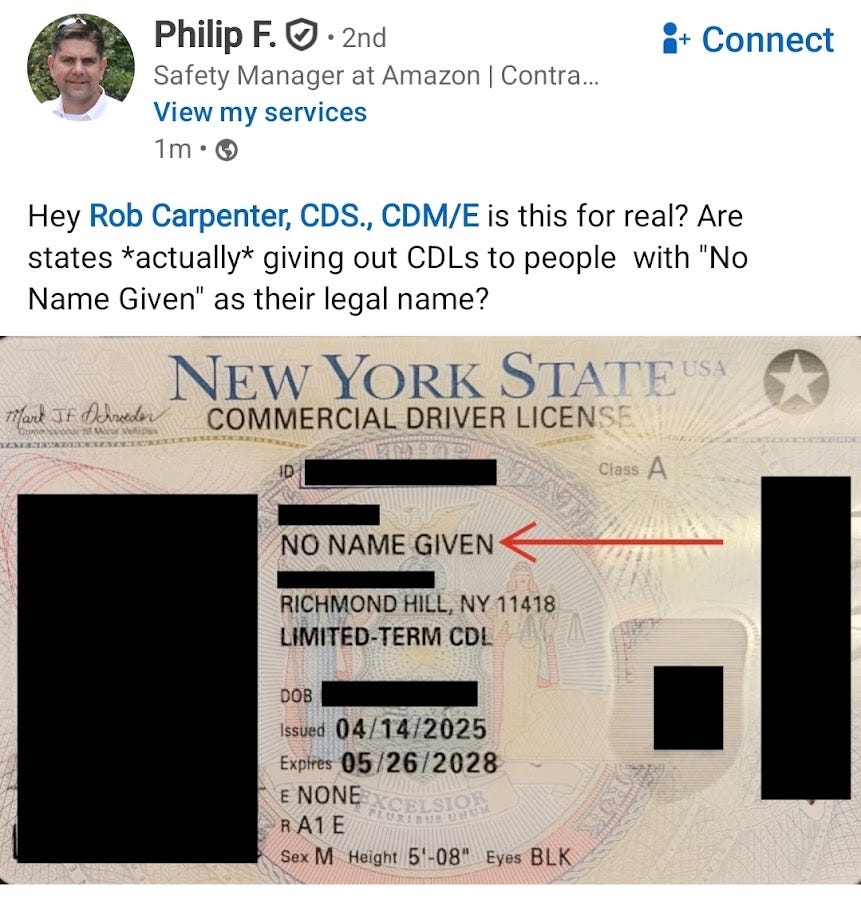
From there the string propagates downstream. The immigration document feeds the Social Security record, the Social Security record feeds the state driver licensing agency, and the licensing agency prints what the source documents say. So how did a CDL end up listing the first name as “No Name Given”? CA says the answer was procedural to the point of shrugging: California law requires an applicant to present an identity document bearing their true full name, and if the identity document says “No Name Given” in the first-name field, the DMV enters “No Name Given.” The policy applies to every license type the state issues. Under the REAL ID Act of 2005, that chain-of-documents rule is the whole design. The license is only as good as the breeder document behind it, and the breeder document is only as good as the federal database that produced it. The fact-checkers who waded into this fight after it went viral in the fall of 2025 landed in the same place. Lead Stories examined the claim that California and New York were handing out CDLs to unverified people and found the licenses belonged to mononymous drivers whose identities had been run through federal verification, including the SAVE database that confirms immigration status in seconds. A No Name Given license is not an unverified license. It’s a verified person with one name, filed in a system built for two.
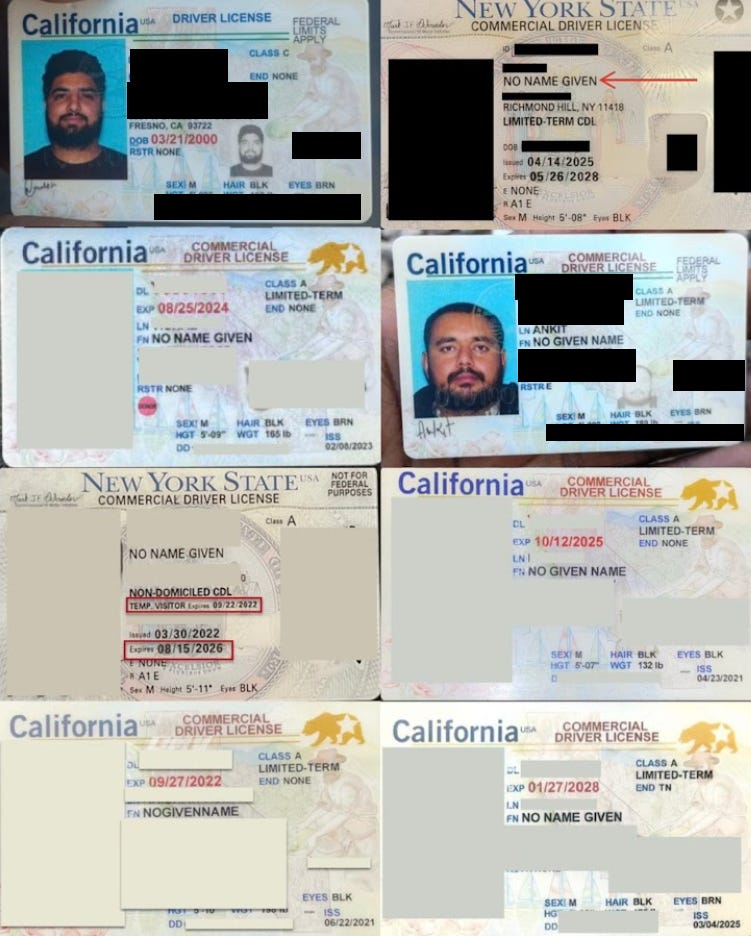
That distinction is real because tens of thousands of legal drivers carry these credentials and did nothing wrong. It’s also not the end of the story, because the same two years produced a record that keeps the question open. In June 2025, authorities recovered more than $1.6 million in stolen electronics near Flagstaff, Arizona, from a tractor-trailer that had blown past its Childress, Texas, destination after picking up at DFW. The tractor’s owner held that California CDL issued to No Name Given Diamond, and two of the three people in the cab were in the country illegally, according to Overhaul, the supply chain security firm that tracked the load. In September 2025, an Oklahoma Highway Patrol commercial enforcement sweep encountered a driver carrying a No Name Given license, and the governor’s office made sure everyone heard about it. New York issued a CDL to a driver recorded as Anmol No Name Given, and the state’s answer, like California’s, was that the license met every federal regulation in force at the time. Both answers are true. A credential can be procedurally perfect and still be operationally useless to the person standing at a truck stop guard shack trying to figure out who’s picking up two million dollars of freight.
My grandparents on my mother’s side came to this country from the collapsing edges of Europe, from Poland, Ukraine, Serbia, Hungary, Croatia, Romania, Germany, and Russia. I have their documents. The names on the European papers don’t match the names on the American ones, because somewhere between the ship manifest and the naturalization certificate, the old country name got traded for one that fit here. Nobody asked whether they liked it, and the historical record on that era is clear that the pressure to Americanize came from clerks, employers, school teachers, and the immigrants’ own hunger to belong, all of it rough and none of it optional in practice. They were never offered anything. The system of their day forced a name onto everyone, and the system of ours preserves the absence of one with bureaucratic fidelity. The system prints “No Name Given” on federal manhunt posters. What I can tell you is that no one made the modern version a decision. It was a series of small technical accommodations, each defensible on its own, that compounded into a country where a man can drive an 80,000-pound truck, own the tractor, get indicted, and flee, all under a name that’s the official absence of a name. I think my grandfather turning into a “Roman” upon entering the US was better because we at least had a differentiator.
The mononym is only half of trucking’s identity problem. The larger half is the opposite failure: names so common they stop identifying anyone. Sikh naming tradition, which runs back to the founding of the Khalsa in 1699, gives men the name Singh and women the name Kaur, and Punjabi given names draw from a deep but finite pool. The result in American freight, where Punjabi drivers and owners have become one of the industry’s largest and most productive communities, is a registration system where name collision is routine. Search FMCSA’s carrier census for common Punjabi given-name-and-Singh combinations, and you’ll find the same first and last name spread across hundreds of distinct operating authorities, each a separate legal entity, most of them legitimate, and no field on the registration that tells you which human being stands behind which one. The FBI’s own wanted gallery makes the point without meaning to. The same database that holds No Name Given Kamal, added August 18, 2026, also holds a fugitive added July 30, 2026, in the same crackdown, under the name Gurpreet Singh. One fugitive has no name, and the other has a name shared with a small city’s worth of people. From an investigator’s chair, those are the same case.
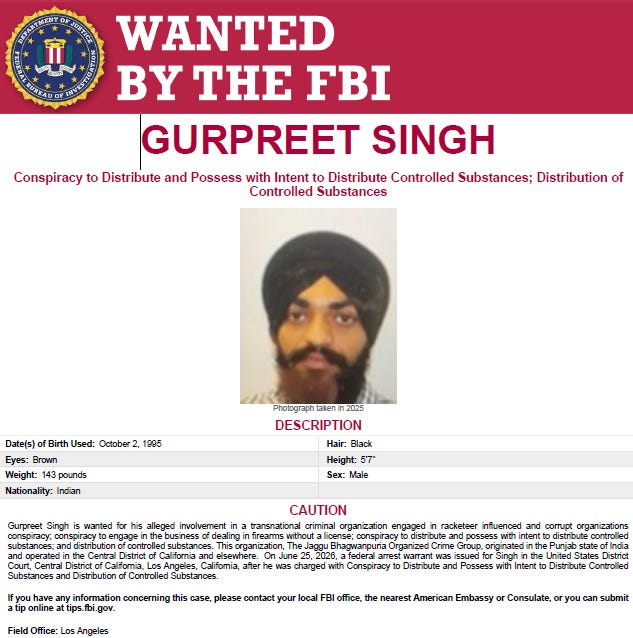
Everything in trucking runs on identity, because identity is what carries a safety record, and the safety record is the only thing standing between the public and a carrier that shouldn’t exist. A company’s crashes, out-of-service violations, and enforcement history attach to its DOT number, its officers, and its name, and that history is what sets its insurance pricing, its broker access, and its federal scrutiny. Sever the identity, and you sever the history, and the industry term for an operator who does it on purpose is a chameleon carrier. I’ve spent years building the detection side of that problem, and the methods that work ignore names entirely: VIN crossover between a dead authority and a live one, shared officers, shared addresses and phone numbers, common insurance producers, filings submitted in the same session. Names are the least reliable field in the entire federal dataset, and my own platform’s numbers say how unreliable. In FMCSA’s current federal census data, 250 carrier officer entries read No Name Given, and the placeholder family doesn’t stop there: 172 read FNU, the consular shorthand for first name unknown, 26 read NFN, and 34 read LNU, which puts the active census at more than 480 company officers whose recorded identity is a stand-in for a name. Our historical snapshots hold dozens more that have already cycled out of the active registry. Beside them sit 446 registrations whose officer field reads Owner, President, None, N/A, or Unknown; 149 of them are Owner entries that never passed through anyone’s identity verification. A No Name Given officer is a verified person the database couldn’t hold. An Owner officer is a database entry with no person behind it, and FMCSA accepted both. The collision side is worse. The officer name Gurpreet Singh, the same name on that July wanted poster, ties together roughly 1,090 carrier records in our connection graph. Harpreet Singh links 774, and Amritpal Singh, another name in the FBI’s summer batch, links 368. The pattern holds well outside Punjabi names, with Jose Hernandez linking 358 records and Michael Smith linking 324, which is what happens when any finite name pool meets a registration system that has no person-level identifier behind the name field. Our detection engine treats those officer names the way it treats a blank, as non-identifying, because a field that matches a thousand records identifies nobody. The No Name Given phenomenon didn’t create that weakness. It just printed the weakness on a license where everyone could finally see it.
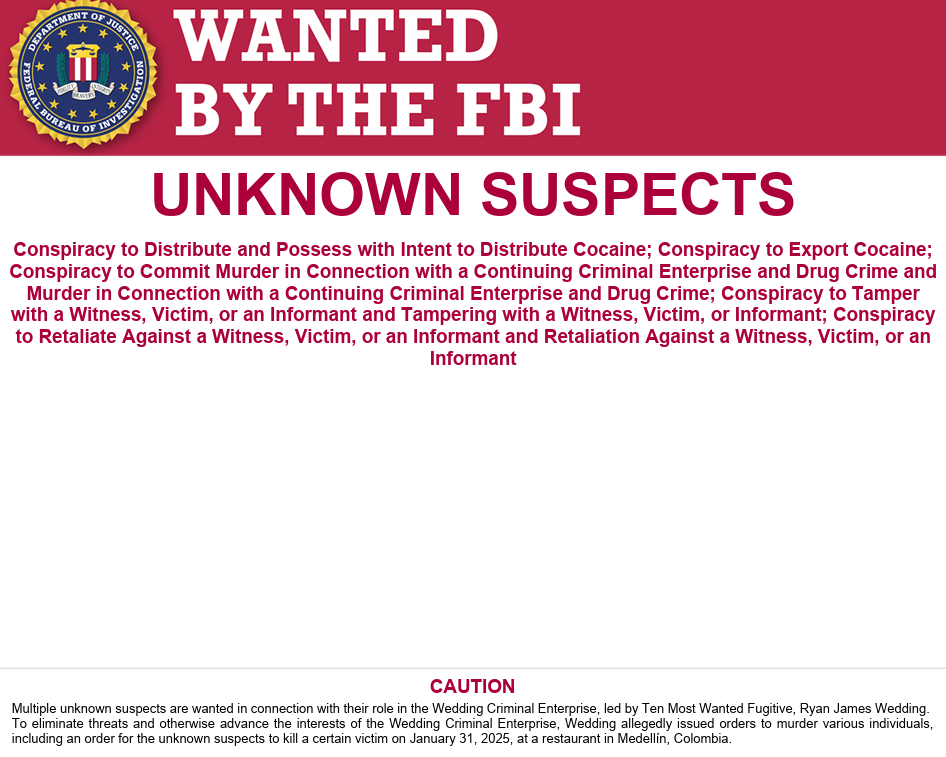
The federal wanted system has always had nameless entries, and what makes the Kamal poster new is the difference between them. A John Doe poster, and the FBI’s database holds hundreds of them alongside entries titled Unknown Suspect and Unknown Bank Robber, is an admission that the government doesn’t know who the person is and is asking the public to supply the identity. The bureau even carries an entry titled simply Unknown Suspects, added in November 2025, in the same Criminal Enterprise Investigations category that holds Kamal. His poster is the opposite animal. The government knows exactly who he is, with his face, a date of birth he’s used, his height, his weight, and a federal indictment describing his alleged conduct. No Name Given on that poster is a transcription of his own federal paperwork, not an admission of ignorance. A John Doe is a person without an identity. Kamal is an identity without a name, and only policy built the second kind.
The placeholder problem has no ethnicity. Semion Mogilevich, the Ukrainian-born boss the FBI ranked among the most powerful figures in Russian organized crime, spent six years on the Ten Most Wanted list under a poster carrying eight aliases, and several of them were never aliases at all. Simeon Mogilevitch, Semjon Mogilevcs, Shimon Makhelwitsch: the same Cyrillic name pushed through different transliteration systems, which means part of the bureau’s poster is a list of spellings; when Russian police arrested him in Moscow in 2008, he was living under a different name entirely, Sergei Shnaider. The State Department still offers $5 million for him. Mogilevich is the mirror image of the mononym. One system produces a man with no name, another produces a man with eight, and both defeat a database that matches text.
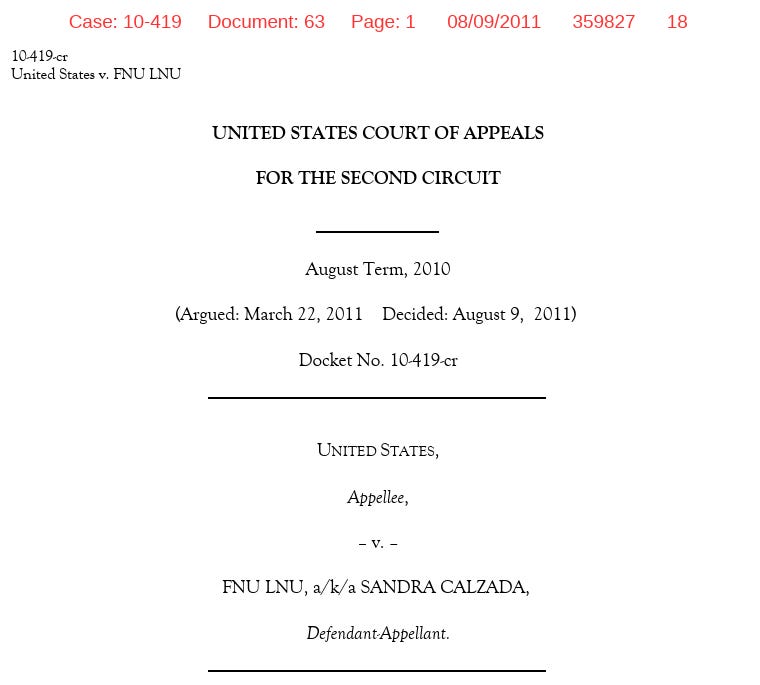
The courtroom version is stranger still. In 2011, the Second Circuit decided an appeal captioned United States v. FNU LNU, brought by a woman who flew into JFK on another person’s passport; she was convicted of passport fraud and aggravated identity theft and moved through trial, conviction, and appeal without the government ever learning her name. First Name Unknown, Last Name Unknown served as her legal identity throughout the proceedings. A different FNU LNU was sentenced in the Southern District of New York in 2010 to 110 months in federal prison, served the time, was released to supervision, violated it with state charges for criminal impersonation and identity theft, a nameless man convicted of pretending to be someone, and went back in 2018 for the statutory maximum, all under a caption the appeals court footnoted to explain that FNU LNU signifies first name unknown, last name unknown. The United States imprisoned that man for the better part of a decade, supervised him, and imprisoned him again without ever establishing who he was. A third FNU LNU sits on a live federal docket in Georgia right now, indicted in 2025 alongside co-defendants who all have names. The system doesn’t need your name to convict you. It needs your name to warn everyone else about you, and that’s the function that’s failing.
The enforcement math is bad: if Kamal has never been arrested in the United States, there are no fingerprints under that identity in IAFIS, no booking photo, no criminal history to match against, and the wanted poster’s date of birth is listed as a date of birth used, which is the bureau’s way of saying it may not even be his. A man in that position who gets stopped at a roadside can present himself as anyone, and the officer running the name has nothing to disprove it with, because the name on file is a placeholder and the placeholder matches thousands of documents. Facial recognition and biometrics are the only anchors left, which is exactly why the poster leads with the photograph and the physical description rather than the name, and why the bureau is asking the public to look at a face instead of remember a name. The same logic already reshaped trucking policy. FMCSA’s emergency interim final rule of September 26, 2025, issued after the fatal Florida crash involving Harjinder Singh and a federal audit that found more than a quarter of California’s reviewed non-domiciled CDLs improperly issued, forced every state to verify status through SAVE and restricted non-domiciled eligibility to specific employment visa classes. California admitted to 17,000 noncompliant licenses in November, fought the cancellations into the spring, and the permanent rule took effect March 16, 2026. Every piece of that fight was, underneath the politics, an argument about whether a credential proves who somebody is.
Kamal is charged, not convicted, and the charges against him and every Operation Hard Ball defendant are allegations until a court says otherwise. The people carrying No Name Given licenses to legitimate jobs every morning deserve that same precision, and they deserve better than being treated as suspects because a federal database couldn’t handle their grandmother’s naming tradition. The system, though, is owed nothing, and the system is the story. A country that verifies people by matching text strings will always be beaten by the two edge cases this article is about: the name that doesn’t exist and the name that exists ten thousand times, and both edge cases are now permanent features of American freight and American crime. The fix isn’t a better placeholder. Verification has to move down to the level that can’t be duplicated or left blank: the biometric, the VIN, the network of records a real operation can’t help leaving behind, because that’s the level where my platform catches chameleon carriers and it’s the level where the FBI will eventually catch Kamal, if it catches him. Until then, there’s a poster on a federal website asking the public to find a man, and the first thing it tells you about him is that nobody knows what to call him.
FBI wanted poster, No Name Given Kamal: https://www.fbi.gov/wanted/cei/no-name-given-kamal
FOX 11 Los Angeles, Operation Hard Ball indictments and timeline: https://www.foxla.com/news/37-charged-indian-crime-syndicates-canada-assassination
ANI, FBI Most Wanted additions (Kamal, Major Singh, Nitish Kaushal, Amritpal Singh): https://aninews.in/news/world/us/fbi-places-indian-national-kamal-on-most-wanted-list-over-alleged-lawrence-bishnoi-gang-links20260821020446/
USCIS Policy Manual, Vol. 1, Part E, Ch. 5, Verification of Identifying Information (single-name / No Name Given policy): https://www.uscis.gov/policy-manual/volume-1-part-e-chapter-5
State Department Foreign Affairs Manual, 9 FAM 303.2 (visa name citing) and 8 FAM 403.1 (passport name usage): https://fam.state.gov/fam/09FAM/09FAM030302.html and https://fam.state.gov/fam/08fam/08fam040301.html
Lead Stories fact check on mononym CDLs and the Oklahoma sweep: https://www.yahoo.com/news/articles/fact-check-california-york-not-074043459.html
DHS SEVIS Name Fields Job Aid (prohibiting FNU/LNU entries): https://studyinthestates.dhs.gov/sites/default/files/SEVIS%20Name%20Fields%20Job%20Aid.pdf
FreightWaves, non-domiciled CDL final rule (published Feb. 13, 2026, effective March 16): https://www.freightwaves.com/news/the-non-domiciled-cdl-crackdown-has-arrived-13000-drivers-out-a-national-rule-a-few-days-away
U.S. Department of State, Semion Mogilevich reward page and poster aliases: https://www.state.gov/semion-mogilevich
Thank you so much for taking the time to explore this subject. I have learned something today that I knew nothing of yesterday
A real fine mess, ain't it?