

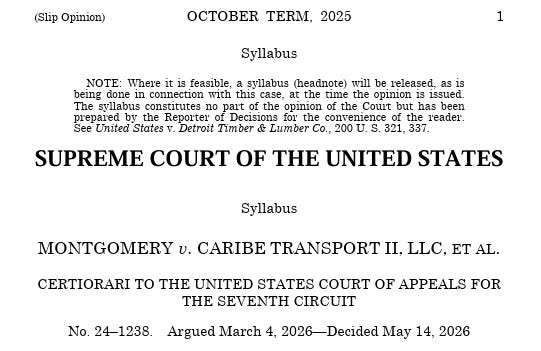
On May 14, 2026, the Supreme Court of the United States handed down its decision in Montgomery v. Caribe Transport II, LLC. It was unanimous. Nine to zero. Justice Amy Coney Barrett wrote the opinion. Justice Brett Kavanaugh filed a concurrence with Justice Samuel Alito, saying the case was closer than the majority might suggest, and then joined anyway.
The holding fits on a napkin. A negligent-hiring claim against a freight broker is not preempted by the Federal Aviation Administration Authorization Act. The FAAAA’s safety exception, 49 U.S.C. Section 14501(c)(2)(A), saves it. States retain authority to regulate safety “with respect to motor vehicles.” Requiring a broker to exercise ordinary care in selecting a carrier concerns motor vehicles. End of analysis. Eight pages. No dissent.
Shawn Montgomery, the driver who lost his leg when a Mack Truck hauling plastic pots through Illinois veered off course and hit his tractor-trailer, can now pursue his negligent-hiring claim against C.H. Robinson. The freight brokerage industry’s federal preemption defense, the legal shield that brokers had relied on since the Seventh Circuit decided Ye v. GlobalTranz in 2023, is gone.
I have been writing about this case for months. I covered the oral arguments on March 4. I wrote about the circuit split between the Sixth, Seventh, Ninth, and Eleventh Circuits. I laid out the shipper and broker liability exposure before the opinion dropped. None of what Barrett wrote surprised me. The only thing that surprised me was how fast the court moved and how little disagreement there was.
What I want to talk about now is not what the opinion says. I covered that for FreightWaves the day it came down. What I want to talk about is what happens next, who pays for it, and why the people celebrating this decision and the people panicking about it are both missing the point.
Barrett’s opinion is clean and narrow. The FAAAA preempts state laws “related to a price, route, or service” of a broker. But the safety exception preserves “the safety regulatory authority of a State with respect to motor vehicles.” Barrett asked one question: Does a negligent-hiring claim against a broker concern motor vehicles? She used dictionary definitions and the court’s prior construction in Dan’s City Used Cars v. Pelkey. “With respect to” means “concerns.” A motor vehicle is a vehicle used on a highway for transportation. Requiring a broker to exercise care in selecting a carrier concerns the trucks that will transport the goods.
C.H. Robinson raised three counterarguments. Barrett rejected all three. The safety exception does not swallow the preemption clause because plenty of state laws related to prices, routes, and services have nothing to do with safety. The surplusage argument fails because the overlap comes from the word “safety,” not from the breadth of “with respect to.” And the subsection (b) anomaly, the fact that Congress included a safety exception in subsection (c) but not in subsection (b), produced what may be the most quotable line Barrett has ever written: “Better to live with the mystery than to rewrite the statute.”
Kavanaugh’s concurrence is the one the industry should actually read. He was honest about the competing considerations. He acknowledged two points in the brokers’ favor. First, the FAAAA mandates minimum insurance for carriers but not for brokers, which suggests Congress did not anticipate tort suits against brokers. Second, the subsection (b) problem creates an anomaly where state tort suits are permitted for interstate but preempted for intrastate, which is “exactly backward” from federalism principles.
Then Kavanaugh explained why those points do not carry the day. The FAA Authorization Act was an economic deregulation statute, not a safety deregulation statute. Congress left tort suits against carriers fully intact. There is no meaningful federal safety regulation of brokers’ carrier selection practices. FMCSA requires brokers to select a federally registered carrier but does not impose safety standards on how they make that selection. If Congress preempted state tort law and simultaneously failed to impose federal safety requirements on broker selection, brokers would operate in “a black hole with no meaningful safety-related regulation.”
Kavanaugh was not willing to read that result into an economic deregulation statute.
Then he wrote the paragraph that matters most. Truck safety is a matter of life and death. In 2022, approximately 500,000 reported truck accidents resulted in about 5,000 deaths and 114,000 injuries. Not all can be prevented. But some can. Some carriers are known to be less safe. Some truck drivers are known to be unfit. If brokers can be held liable for disregarding poor safety records, they have “a strong incentive to do business only with safe and reliable motor carriers.”
That is the entire theory of the case. The liability exposure is the point.
The only federal financial responsibility requirement for a freight broker in the United States is a $75,000 surety bond filed under 49 CFR 387.307. That bond does not cover tort liability. It does not respond to a personal injury judgment. It does not pay out when a jury decides that a broker was negligent in selecting a carrier whose truck killed someone. It exists for one purpose: to ensure that motor carriers and shippers get paid when a broker defaults on freight payment obligations. Contracts. Agreements. Arrangements. Payment obligations. That is it.
There is no federal requirement for a freight broker to carry bodily injury liability insurance. Not a dollar. Not a penny. Nothing.
FMCSA tightened enforcement of the bond requirement with a final rule that took full effect January 16, 2026. The reforms closed loopholes in BMC-85 trust funds, eliminated junk assets, required surety providers to notify the FMCSA within 2 business days of a drawdown below $75,000, and authorized immediate suspension of authority if the bond is not replenished within 7 days. Those were good and necessary reforms. They protect carriers from getting burned by brokers who default on payments. They do absolutely nothing to protect the public from the consequences of a broker’s negligent selection of a carrier.
Some brokers voluntarily carry contingent auto liability and contingent cargo insurance. I did when I brokered freight. It was a business decision, not a regulatory requirement. Contingent auto is the policy that responds when a carrier’s own insurance is exhausted or disputed and the broker faces a claim arising from the carrier’s operations. It is exactly the policy a broker needs post-Montgomery. It has never been mandatory. The sophisticated brokers carry it. A lot of brokers do not.
Post-Montgomery, both categories are equally exposed to state tort law. The difference is that one has insurance that responds and the other is defending a $36 million claim with a $75,000 bond that was not designed for tort liability. The numbers are staggering and they are getting worse.
ATRI’s updated trucking litigation analysis, published in late 2025, found that truck-tractor tort case filings grew at an average annual rate of 3.7 percent between 2014 and 2023. The median nuclear verdict, jury awards exceeding $10 million, reached $36 million in 2022. That is 50 percent higher than the median in 2013. The share of verdicts exceeding $50 million jumped 6.4 percentage points. The average trucking verdict between 2020 and 2023 was $27.5 million.
Thermonuclear verdicts, awards exceeding $100 million, are no longer rare. In 2024, a St. Louis jury awarded $462 million against Wabash National in a fatal underride crash, including $450 million in punitive damages. In 2021, a Florida jury returned a $1 billion verdict in a fatal crash. In 2018, a Texas jury hit Werner Enterprises with $90 million in a case where the truck driver was not even cited by responding officers.
In more than 80 percent of verdicts exceeding $1 million, non-medical damages, such as pain and suffering, were up to 10 times higher than the actual medical bills. The plaintiff’s bar has turned trucking litigation into a specialized arena. The reptile theory puts the carrier’s entire safety record on trial to inflame jurors. Third-party litigation funding removes the financial pressure on plaintiffs to settle early, because investors bankrolling lawsuits want to maximize payouts. Swiss Re’s 2025 study found that 76 percent of American consumers now believe jury damage awards are too low. Among adults under 40, it is 83 percent. The jury pools are getting more hostile, not less.
California, Georgia, Florida, Texas, and Louisiana are consistently identified as nuclear verdict hotspots. ATRI found that state courts produce significantly higher awards than federal courts. For cases above $1 million, the median award was $3.6 million in state court versus $2.5 million in federal court. The industry lost an estimated $102.8 million in 2022 alone in excess awards because eligible cases were not removed from state courts.
The federal minimum insurance requirement for interstate motor carriers hauling general freight is $750,000. Congress set that number in the Motor Carrier Act of 1980. The regulation was finalized in 1985. It has not been adjusted in 45 years.
If $750,000 had tracked core inflation since 1985, it would be approximately $2.2 million today. Adjusted for medical cost inflation, roughly $3.7 million. FMCSA’s 2026 quadrennial filing shows that $750,000 now covers under 1.5 percent of the median nuclear verdict.
On April 9, 2026, Representatives García and Tran reintroduced the Fair Compensation for Truck Crash Victims Act, which would raise the carrier minimum to $5 million and index it to inflation going forward. This is the fourth time García has introduced this legislation. FMCSA has separately signaled it expects to publish a Notice of Proposed Rulemaking that would raise the minimum to $2 million or more.
The carrier minimum debate has been going on for over a decade. The Trucking Alliance favors an increase. ATA has generally opposed it. The Trucking Alliance’s data shows that if all crash settlements were covered by a $750,000 limit, 42 percent of the monetary exposure would represent uninsured liability. That is the carrier side.
The broker side is worse. The carrier at least has $750,000 in mandatory liability coverage. The broker has zero.
Montgomery is a win for highway safety. It is a win for crash victims. It is a win for accountability. I do not argue with any of that. The principle that a broker who selects a carrier with a known dangerous safety record should face consequences for that decision is correct. Kavanaugh was right. The liability exposure is the incentive.
The downstream effects of this decision will not fall evenly across the trucking industry. They are going to land hardest on the people who can least afford it.
Large carriers will benefit from Montgomery. Werner, J.B. Hunt, Schneider, the asset-heavy fleets with documented safety records, internal compliance departments, dashcam programs, and telematics suites are exactly what a liability-conscious broker is now going to demand. A broker facing tort exposure for negligent carrier selection will gravitate toward carriers who can demonstrate, with verifiable data, that they are safe. That means large carriers with established safety profiles, visibility platforms, and insurance portfolios that can absorb a claim. Every post-Montgomery carrier vetting checklist will favor size, track record, and technological sophistication.
That is a competitive advantage for large carriers and it is a structural disadvantage for everyone else.
Small carriers and owner-operators, particularly those without their own customers and who rely on brokers and load boards for freight, are facing a market that just got harder. A broker who is now personally liable for their carrier selection is going to look at a one-truck operation with authority less than two years old, minimal inspection history, and no telematics platform and see risk. Not because that carrier is unsafe. Because the broker cannot prove that carrier is safe. The absence of data is the problem. A large carrier with 500 trucks and a decade of inspection history has a statistical safety profile. A new owner-operator with eight months of authority and four inspections does not have enough data to generate one.
The broker is not going to take the chance. Not when the alternative is booking a carrier whose safety record can be documented, verified, and presented to a jury three years from now.
This is the same dynamic that played out when CSA scores first became public in 2010. Carriers with elevated BASIC percentiles, even when the scores were statistically unreliable for small fleets, lost freight because brokers and shippers could see the numbers and did not want the exposure. The same thing will happen here, except now the exposure is not a compliance flag on a spreadsheet. It is a tort claim in state court.
Owner-operators who find their own freight, who have direct shipper relationships, who market themselves on safety and service and do not depend on brokers for load volume, will feel this less. They are not in the broker selection pool in the same way. Those who get squeezed are the operators who depend on the brokerage ecosystem for their livelihoods. That is a lot of trucks.
I know what it feels like to be a one-truck operator trying to build something. The guy who just got his authority, bought a truck, and is trying to build enough history to prove he is a professional is going to have a harder time getting loads from brokers who are now calculating their own tort exposure on every load tender.
The brokers are not wrong to do it. That is the problem. They are being rational. They are responding to a legal incentive that the Supreme Court just created. But the cost of that rational response falls on the small operators who did nothing wrong and who were not parties to the Montgomery case.
The insurance market will move quickly on this.
Contingent auto liability, which has been a voluntary niche product for sophisticated brokers, is about to become the most important coverage in the freight brokerage ecosystem. Underwriters will develop and scale products for the broker market. Brokers who can demonstrate documented, data-driven carrier vetting processes will get better rates. Brokers who cannot will pay more or get denied.
Carrier insurance premiums, which have already been climbing at 10 percent annually according to the U.S. Chamber Institute for Legal Reform, will face additional upward pressure because brokers will now require higher carrier coverage as a condition of load tender. A broker facing tort exposure for carrier selection will demand that the carrier’s own insurance be adequate. Carriers with minimum coverage only may find themselves squeezed out of broker freight, just as carriers with elevated BASIC scores were.
The number of insurers serving the trucking industry is already shrinking. Werner’s chief legal officer said at ATA’s Management Conference in October that insurers are reducing the number of policies they are willing to write. Progressive’s commercial lines general manager said the commercial automotive industry has made money in only one of the past 10 years. Adding 28,000 freight brokers to the tort defendant pool is going to concentrate underwriting attention on an industry that is already struggling with capacity.
Congress should mandate minimum liability insurance for freight brokers. The surety bond serves its purpose for carrier payment protection. It was never designed for tort liability and it does not respond to it. A broker’s minimum matching whatever the carrier minimum becomes, whether that is $750,000, $2 million, or $5 million, would create parity between the party that operates the truck and the party that selected the operator. The brokers who already carry contingent auto would be in compliance. The brokers who do not would need to buy coverage or exit the market.
That sounds harsh. It is also what happens in every other industry where the intermediary who selects the contractor bears legal responsibility for the consequences of that selection. Construction general contractors carry liability insurance. Property management companies carry liability insurance. Staffing agencies carry liability insurance. Freight brokers have been the exception. Montgomery just eliminated the legal basis for that exception. The insurance requirement should follow.
Montgomery settled the preemption question. It did not settle the question of financial responsibility. The court said brokers can be sued. It did not say brokers are required to carry insurance that would pay the judgment.
The median nuclear verdict is $36 million. The carrier minimum is $750,000 and it has not moved since 1980. The broker insurance requirement is zero. The surety bond is $75,000 and it does not respond to tort claims. Somewhere in the gap between those numbers is the next crisis.
For the large carriers, this is a tailwind. Documented safety becomes a competitive moat. For the small carriers and owner-operators who rely on brokers for freight, this is a headwind they did not create and cannot control. For the brokers, the era of selecting carriers with no financial consequence for that decision is over.
I have said this before and I will keep saying it. If you pick the carrier, you own the choice. Document it. Defend it. Or answer for it. The Supreme Court made the decision; now the rest is up to Congress, the insurance market, and 28,000 brokers who need to decide what kind of operation they are running.
Great article Rob @thewhitesmoke
This decision is going to ripple through the trucking industry fast with significant consequences for many. As you rightly said for the brokers, the era of selecting carriers with no financial consequence for that decision is over! The insurance landscape is going to change quite a bit/