

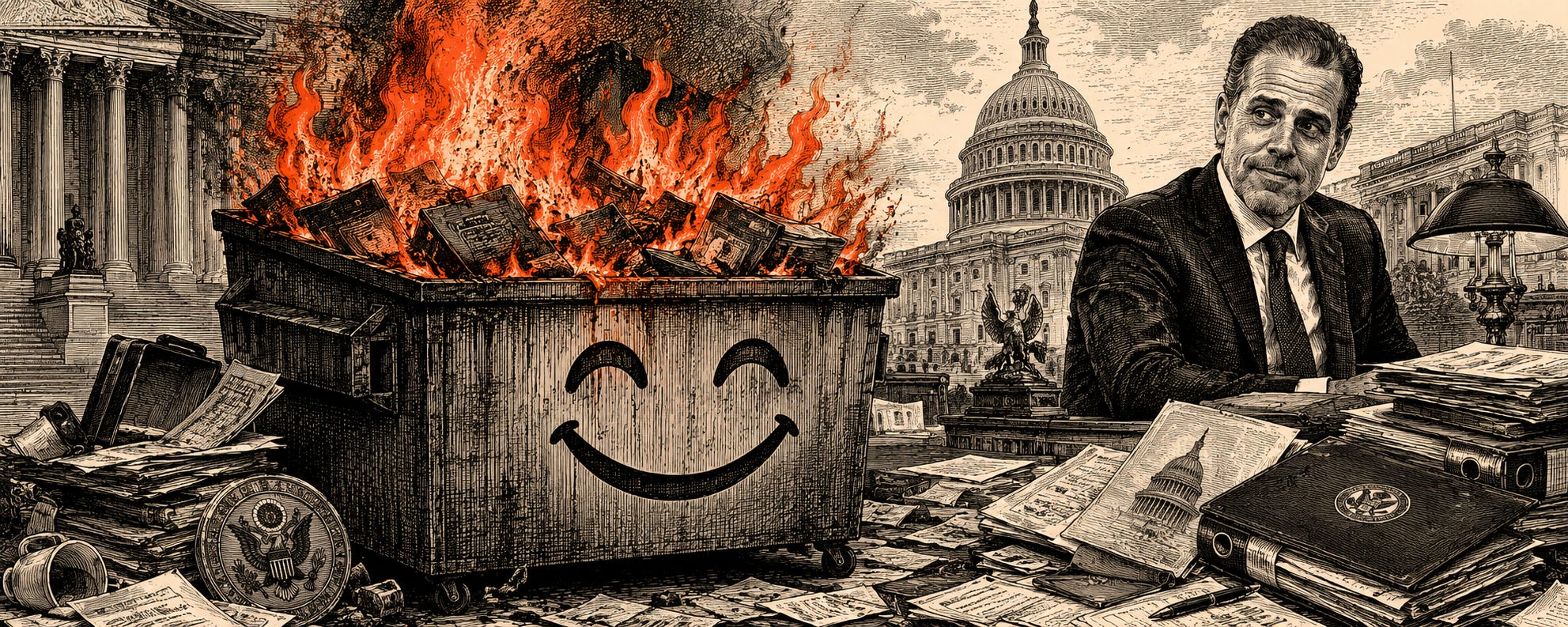
A year ago, Hunter Biden was the single most toxic name in American politics. The laptop. The crack. The federal gun conviction. The foreign business deals. The former stripper and the daughter he spent years denying was his. The sister-in-law turned bed partner. Hard to find someone who makes worse personal decisions. The right, including me, ran him like a battering ram against his own father for the better part of a decade, and it worked because someone created this guy, right? The whole family is like used car salesmen, but guess what… used car salesmen often sell you used, shitty cars with no warranty. Be a more cautious, discerning buyer.
Now look at him. New account on X that opened with “I’m Hunter Biden. You’ve never actually heard from me.” Three-hour sit-down interviews. A turn on Candace Owens’ show. Picking fights with the Democratic pundits who bailed on his dad. A prediction market floated him for the 2028 nomination hard enough that the post went viral, and Trump himself stood in the Oval Office and said the guy could actually win. Even old Joe is healthy as a horse again, just a little stroke, he’s still fine. (More used car sales.)

First, Hunter has not announced anything. He’s said for years he has no interest in running. The markets have him a distant third, somewhere around 14 percent just to enter, behind Newsom and AOC. He is not the front-runner, but I will say we’re two years out and a lot changes in two years, just ask Hillary Clinton or Kamala Harris.
That is the whole point. The fact that we are saying his name in the same breath as the word “president” at all is the most remarkable rebrand I’ve watched in years. Twelve months ago, he was a punchline and a federal defendant. Today, he’s “Dark Brandon Jr,” and people are buying shares on him.
How does a guy go from that closet full of skeletons to leadership material? He stopped hiding.
The mess is the message
Here’s what people respond to, whether they’d admit it or not. Hunter Biden doesn’t run from any of it anymore. The addiction, the gun charge, the bankruptcy of his old image, the hookers, the pipe, all of it, being a deadbeat Dad. He walks out and basically says: Yeah, that was me.
The second he did that, the story flipped. The mess is what makes him relatable. Sober and polished, he’s just Joe’s kid who failed up on a board seat. Owning the wreckage, he becomes something else entirely. He’s not the prince anymore. He’s the guy who blew up his life, got addicted, got arrested, got humiliated in public, and got back up. That story doesn’t say “elite.” It says, “I’m one of you.” I’m a guy with a record and a baby-mama fight and a financial disaster and demons, same as half the country. The mess is what makes him human, and human is electable.
It doesn’t even matter whether he came to the confessional on his own or the GOP dragged every bit of it into the daylight for him. The skeletons got out. What he did with them after that is the entire lesson. He took the worst PR position in the country and turned it into a brand.
He’s basically Bill Clinton 2.0. The difference is that Clinton spent his whole career parsing the meaning of “is,” still fighting his own story to this day. Hunter just adopts it. One of them is at war with who he is. The other one made it a product. If Clinton walked out tomorrow and owned every bit of his past instead of lawyering it, he’d be a rock star again in a week. Hillary could learn a lesson here, so could many others. That’s the world we live in now. Nobody cares about your closet anymore. If somebody tries to use it against you, no matter how full that closet is, you can still make lemonade out of it.
This isn’t new, and it isn’t only politics. There’s a reason Jordan Belfort sells out arenas. The man defrauded investors out of $200 million, did 22 months in federal prison, and now charges six figures to teach people how to spot the exact scam he ran. He doesn’t bury the fraud. He leads with it. The transparency is the product.
That’s the line between redemption and deception. Between a mess that becomes a message and a mess that becomes a lawsuit.
Your mess can be your message, but only if you disclose it.
The brain grades familiarity, not character
The human brain was never built to judge character. It was built to judge threat and belonging fast and on almost no information. Character takes months to verify. Familiarity takes seconds. So we swap one for the other and tell ourselves it’s judgment.
The mere-exposure effect. The more you see a face, a name, a logo, the more you trust it, no new information required. Repetition alone does the work. Lay a parasocial relationship on top of that, the one-sided bond you build watching a guy talk for three hours on a podcast. Your gut doesn’t file Hunter Biden under “stranger I need to vet.” It files him under “guy I know.” Nobody runs a background check on somebody they already feel like they know. That’s the rapport. It wasn’t earned and manufactured by volume.
Then there’s the pratfall effect. Elliot Aronson found that when a person you already see as competent stumbles, owns a flaw, knocks over the coffee, you like them more, not less. The screwup makes them human. It only works if you’ve already granted them competence. Drop the same flaw on somebody you’ve written off and it just proves you right. So the confession is leveraging credit already in the bank. Hunter owning the wreckage works because the room already spots him a floor, Joe’s kid, Yale Law, the boardrooms. The disclosure turns the standing he already had into relatability. A guy with no standing who confesses the exact same sins isn’t relatable. He’s just a defendant.
The bar was worn down, piece by piece. Repetition rewires truth itself. The illusory truth effect is the theory that a claim repeated enough times starts to feel true, regardless of the evidence. Run that on a character, and you get scandal fatigue. When the transgression is constant and everywhere, each new one hits softer than the last. The tenth scandal doesn’t move you the way the first one did. You get used to it. Once everybody in the arena has a closet, having one no longer disqualifies you. It becomes the cover charge. “They all do it” isn’t cynicism anymore. It’s just the room reading the room.
We also quit voting on character and started voting on tribe. Dan Kahan’s work on identity-protective cognition shows people don’t weigh facts about a leader on the merits; they weigh whether swallowing those facts threatens their own side. A flaw in our guy gets a reason. The identical flaw in their guy is proof he’s rotten. Character got captured. The question stopped being “is this person good?” and became “is this person ours?” Once that flips, the closet doesn’t matter because nobody was really looking in it.
We also love a comeback more than we love a clean record. Dan McAdams calls it the redemptive self. The story hits hardest with the fall and the climb back, the sinner who returns. We’re wired to reward the arc, not the absence of sin. A spotless résumé reads as boring, maybe even fake. Wreckage-to-redemption reads as real. So “real” quietly took the place of “good.” We never actually lowered the standard for character. We changed what we were measuring. We started measuring authenticity, and authenticity only means you’re not hiding. It tells you nothing about whether the thing you’re not hiding is any good.
That’s the trap. Owning the mess makes you relatable. Relatable isn’t trustworthy, and likable isn’t safe. Your brain treats them like the same word. They aren’t. The operator in the branded polo is betting you’ll run the familiarity shortcut instead of pulling the data, betting the handshake and the circuit and the mutual friends do the vetting your eyes never will. Same wiring that floats a disgraced name toward a debate stage is what puts a dangerous carrier behind your podium. We don’t get conned because we’re stupid. We get conned because the shortcut feels like being smart.
The moment you conceal it, you’re a liability
The second you hide it, the whole thing inverts. Now you’re not relatable, you’re a risk. Not just to yourself. To everyone who stands next to you. The people who partner with you, sponsor you, platform you, put you behind a microphone, and smile for the camera while they do it.
This is where my world and Hunter Biden’s world meet.
I get questions all the time about me, my history, you name it. Especially in court or in depositions. Last week in a deposition, I was played a recording of me, of which there are plenty. The Attorney asked, “Is that you?” Yes, sir, that’s me. “Did you say or do XYZ?” Absolutely I did. “With that being the case and your history and your words, do you think you’re the best person to be giving advice on this?” Absolutely, I do. I wrote an article on this two years ago titled, “Damn right I did it.” This is the very reason why. Own it all. If you own it when it’s discussed or brought up, you take away the ammunition and the gun, and you become instantly relatable. It’s the only reason I get 250 million views across platforms. I’m real, and if you know me, you know it. That’s what separates me from every other content creator or writer. People know I’ve lived it, I’m real. I stay true to principles, and I am one of them.
Companies in this industry screen the wrong things. They screen employees. They run background checks on drivers, verify CDLs, and pull MVRs (well…sometimes). That’s compliance. That’s the floor. Who’s screening the associations? Who’s vetting the speakers at the conference, the sponsors on the banner, the vendors in the booths, the faces in the branded polos sitting across from the podcast mic?
When one of those people turns out to be running a chameleon carrier network with a stack of crashes and dead bodies behind it, your brand doesn’t get a pass because you didn’t know. Your brand gets a question. Why didn’t you?
A case study that’s played out recently
There’s a conference circuit in this industry. I won’t name it. The kind of event the business actually needs. In November 2025, at an Orlando event, a man sat down at a podcast microphone wearing a Sam Express polo. His name is associated with KG Line Group, a carrier that claims to operate 310 trucks from a $610,000 house in Streamwood, Illinois. He wasn’t repping his own company. He was repping Sam Express. On camera. Into a mic. At a public industry event. With fraud people, no, pros even, in the room.
Sam Express reps at that event told attendees they run 500 trucks under a holding group. FMCSA data put Sam Express Inc. at roughly 100. The rest are scattered across a web of interconnected DOT numbers sharing 139 VINs, residential addresses, sequential registrations, and the same stylized mountain logo, no matter whose name is on the door.
Three months later, a truck from that network crossed a centerline in Jay County, Indiana, and killed four Amish men. The driver had held a CDL for seven months. He was from Philadelphia. He had an ICE detainer. The carrier, 1st Choice Logistics, is part of the same ecosystem.
A Chicago consulting firm with deep ties to this network handed Sam Express “Best Trucking Company of the Year” at a black-tie gala in 2023. That same firm developed an ELD allegedly linked to backdoor access that enabled the falsification of hours-of-service records, according to a federal civil complaint. The firm’s CEO has maintained public relations and social media friendships across this industry, including with people who work in fraud prevention.
Several trucking influencers are right now pushing Sky Blue Leasing to drivers to pad the Sky Blue base and get drivers on the road. Sky Blue came to be the week my 60 Minutes piece on Super Ego went live, with millions of global views. Sky Blue is the reincarnation of Super Ego. Whether these “influencers” know it or not doesn’t really matter; they’re Eastern European/US trucking influencers, so they certainly should, if they don’t. Point being, we know Super Egos’ track record is driver exploitation. Why would pro-trucking and pro-driver “influencers” want to push the reincarnated Super Ego? This will hurt their image. Now and especially in the future.
The names I can find this morning
I checked today. Right now, I can identify at least six well-known anti-fraud professionals in this industry who are still Facebook friends with that CEO. People who attend fraud conferences. People who speak on panels about vetting carriers. People whose literal job is exposing the kind of operation this network represents.
Before the pitchforks come out, let me be fair: investigations are quiet by design. You don’t broadcast who you’re looking at. Insurance investigators, litigation support teams, and compliance pros are often contractually gagged. There are people who’ve worked chameleon carriers for years, doing excellent work, who can’t say a word because it’s wrapped in NDAs and litigation holds. Knowing something doesn’t mean you can talk about it, and staying connected on social media doesn’t make you complicit, but if your ear is to the ground, if you live in the day-to-day data, if you take the speaking fees and shake the hands, you know what’s up. Or you should.
FMCSA and Congress launched the ARCHI program 13 years ago precisely because chameleon carriers were a known, documented, quantified problem. The GAO wrote about it. The OIG wrote about it. Then the attention faded, because that’s what attention does. It burns hot when somebody dies and goes cold the second the news cycle moves on. We’re all suddenly experts again for two weeks, and then we’re not.
This is risk screening, not compliance screening
Compliance tells you whether somebody checked the boxes. Risk tells you whether those boxes mean anything.
There’s a reason we don’t put property-crime or violent offenders on routes delivering to people’s front doors, but they might be a perfect fit driving for a landfill. That’s not prejudice. That’s placement. You match the person’s risk profile to the role’s risk tolerance. There’s a reason you get a full background check just to be issued a laptop and a badge at the world’s largest retailer. There’s a reason a cop can’t have a record, because every ticket he writes gets his credibility put on trial.
This is corporate PR and risk management 101. Every Fortune 500 company on the planet runs this playbook, yet trucking, for all its talk about professionalism, still treats reputation risk like an afterthought.
A while back, an anti-human-trafficking group gave a presentation at a sheriff’s office near me. One of the speakers got brought in at the last minute, unvetted, and gave an impromptu talk. Turned out she had an active OnlyFans account and a history that ran directly counter to the organization’s mission. Somebody outed her. Last speech she ever gave for them. Not because she’s a bad person. Because nobody screened her. Nobody asked the question. When you put a person on a stage, behind a mic, under your banner, you own whatever walks up there with them.
The difference between a past and a secret
This is where the mess-is-your-message philosophy runs straight into the risk-management reality, and it’s the whole ballgame.
Some of the best fraud investigators alive are former inmates. Former scammers can spot a Ponzi from the parking lot. People with records, addiction histories, bankruptcies, and ugly chapters are doing extraordinary work right now because they stopped hiding and started helping. Hunter Biden owning his wreckage is the same move. The Wolf of Wall Street walking on stage and saying, “Here’s exactly how I did it,” is the same move.
A chameleon carrier does the opposite. Same owner. Same trucks. Same dangerous practices. New name, new DOT number, new insurance policy, new branded polo at the next summit. The concealment is the point. The absence of disclosure is the product.
When you share a stage, a sponsor banner, a podcast mic, or a friend request with someone operating in concealment, you’re not guilty by association, but you are exposed by association. The litigation risk is real. The reputational risk is real, and “I didn’t know” gets thinner every single time someone dies, and the data was sitting right there in FMCSA’s database the whole time.
So screen your associations the way you screen your employees. Vet your speakers the way you vet your drivers. Audit your sponsors the way you audit your carriers.
Your mess can absolutely be your message. Hunter Biden is the loudest proof of that I’ve seen in a decade, and the man may end up on a debate stage because of it, but other people’s mess becomes your problem the second you let it stand next to your name without asking the obvious question. The difference is disclosure. Always has been.
Great article Rob 👌