

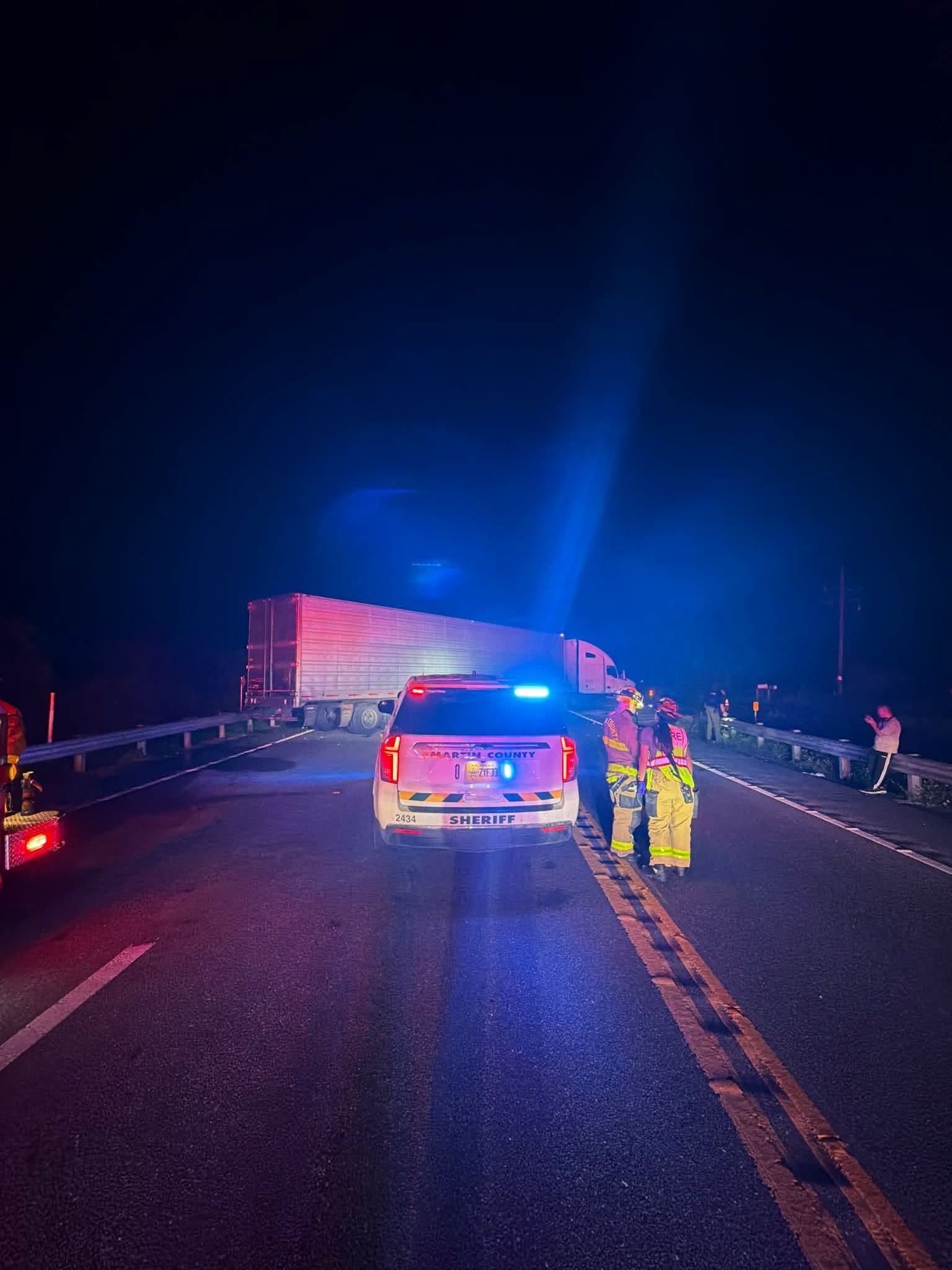
The driver of the truck was just chilling on his phone with another dead American under his truck. Just another day. This isn’t the first, and I have a dozen of these cases across the country that no one ever touches because they sit in litigation. One I highlight at the end of this article, which is insane to me and goes back to our European hotshot investigations. An immigrant CDL holder with a Russian CDL based out of a high-rise Florida Airbnb. Flashlights as taillights.
But...old news, right? For this new crash....
A 26-year-old 2000 Utility enclosed trailer was backing south across all lanes of State Road 710 near Indiantown around 9 p.m. According to the Florida Highway Patrol, a 2026 Subaru Outback heading east in the inside lane struck the trailer's left rear. A white 2021 Kenworth T680 was pulling it through the 20000 block of Southwest Warfield Boulevard in Martin County, Florida. The Subaru’s driver, a 31-year-old West Palm Beach man, was pronounced dead at the scene.
Dashcam video CBS12 obtained from a second car shows a family on that dark road braking hard and stopping short of the trailer. The same video shows the Subaru wedged under the trailer with its hazards still flashing. The man’s wife got a crash notification on her phone, which was linked to his iPhone, and drove up from Palm Beach County. A sheriff’s chaplain met her at the scene and told her he had died.
Martin County Sheriff John Budensiek told CBS12 the truck driver passed the newer section of Fox Brown Road and turned onto an old section that doesn’t go through. Instead of calling for help or getting a flagger, the sheriff said the driver backed out and blocked the lanes of a narrow road. The driver is a 56-year-old man from New York. Budensiek said he is not from the United States, that his native language is Mandarin, that he spoke English with deputies, and that the license he showed was issued in Queens less than a month ago. The sheriff said the commercial license also appeared to be that new. The driver stayed at the scene, was interviewed and was not taken into custody. FHP’s traffic homicide unit is leading the investigation, and the agency said it will release more after it reviews the case with the State Attorney’s Office.
Warfield Boulevard was closed for about six hours. CBS12 reported it was the fifth traffic death on that road this year, and the sheriff said the Florida Department of Transportation’s widening project isn’t expected to break ground until 2028.
Some coverage called this a U-turn. It was a backing turnaround out of a dead end, the same bad decision as a U-turn across a highway, with the same fix. I’ve worked these crashes from the cab, the safety office, the claims desk and the witness chair, for plaintiffs and for defendants. Nearly every failure point in this one can be trained out of a driver and managed out of a carrier.
Start with the dead end, because trip planning should have already done its job. Before the wheels turn, a driver should know the route, the roads he will use to get on and off it, and the receiver’s truck entrance. He should know what that route can’t handle: low clearances, weight limits, dead ends, low-ground-clearance crossings and streets where a 53-foot trailer has no business. A car GPS doesn’t know you’re pulling a trailer, and even a truck-specific unit is a tool. Satellite view, the shipper’s written directions, a phone call to the receiver and the state’s truck route map are the plan.
When the road in front of you isn’t the one you planned, stop safely and solve the problem before you move.
Once that truck was sitting on the old section of Fox Brown Road, the driver had better options than putting a trailer across a state highway in the dark. Stay put with the four-ways on and call dispatch, the receiver or the sheriff’s office. Get out and walk the road to see whether there was room to turn around off the highway. Ask for a deputy or a flagger to hold traffic before the trailer ever touched SR 710. Florida law already draws this line. Section 316.1985 says a driver shall not back a vehicle unless the movement can be made safely and without interfering with other traffic. Section 316.1515 sets the same bar for turning around. A combination backing across all lanes of a state road at 9 p.m. clears neither one.
Waiting for help means sitting there as a stopped commercial motor vehicle, and 49 CFR 392.22 spells out what that takes. The hazard flashers go on as soon as you stop, and the warning devices must be out within 10 minutes. On a two-way road, that is one device about 10 feet off the traffic side of the truck and one about 100 feet back in each direction. The regulation allows fuses and liquid-burning flares in place of triangles. At night, I carry flares and I recommend them. A reflective triangle only works when somebody’s headlights find it. A flare throws its own light and tells approaching drivers something is wrong long before their low beams reach your trailer. Keep flame off any load or cargo tank where federal rules prohibit it, and keep triangles for those loads.
Any trailer at least 80 inches wide and with a gross vehicle weight rating over 10,000 pounds, built on or after Dec. 1, 1993, must carry red-and-white retroreflective sheeting or reflex reflectors on its sides and rear under 49 CFR 393.11 and Federal Motor Vehicle Safety Standard 108, and carriers must maintain it. This trailer was built in 2000. A trailer crossing a road at a right angle shows oncoming traffic its side, and the tape on that side is built to throw an oncoming driver’s headlights straight back at him. Tape that’s peeled, faded or caked with road film might as well not be there. Whether that sheeting was intact and clean, and whether the marker and clearance lamps were working, is one of the first things a reconstructionist should document.
The last piece on the roadside is communication. Other drivers can’t read your mind. Four-ways, a spotter, a flagger, a deputy with lights, a horn tap before a move: each tells the motoring public what you’re doing or about to do. If you can’t communicate your intent and control the space, you don’t make the move. Finding the right place to stop is part of this too. Pick the spot where the opportunity is best: a lot, a wide shoulder, a lighted intersection. A turnaround across a highway is never that place. Driving on and making a reasonable turn somewhere else costs minutes. Sometimes a mechanical failure leaves you no choice about where you stop. A wrong turn always leaves you to choose what to do next.
Now the carrier. A driver weeks into a license, alone in a tractor-trailer at night on unfamiliar rural roads, is a hiring criteria problem before it is a driving problem. One caution before anyone runs with that. A new license card doesn’t prove a new driver. New York issues new cards for renewals, transfers and upgrades, and the sheriff’s account is the only one on the record right now. The driver qualification file will settle it. If he had years of verifiable experience, the questions shift to training, supervision and dispatch. If he didn’t, the hiring decision is the case.
Most commercial auto underwriters want about two years of verifiable CDL experience before they’ll schedule a driver, and some want a lot more. In 25 years I don’t know of an insurer that accepts a one-month driver outside of high-rate, subprime coverage. So my first question is whether the policy even listed this driver. If he wasn’t, the insurer will have the “not on the policy” answer ready, and, if the carrier runs interstate for hire, the MCS-90 endorsement becomes the floor. It pays the public up to the federal minimum, $750,000 for general freight, after a judgment, and then the insurer goes after its own insured to get it back. I’ve watched that play out in other crashes where the motor carrier turned out to be a single-truck company with nothing to collect.
Training is the next file. Since Feb. 7, 2022, anyone getting a Class A CDL for the first time has to complete entry-level driver training from a provider on FMCSA’s Training Provider Registry. The range portion covers straight-line, offset and alley-dock backing. The rule sets no minimum hours for any of it. A trainee shows proficiency on a range, passes the skills test and is legally qualified. Nothing in that process teaches a man what to do at night when a GPS has put a 53-foot trailer in a dead end in a county he’s never seen. That’s the carrier’s job, through a real road test, a finishing program and supervised miles before anybody runs solo at night. Under 49 CFR 391.33, a carrier can accept a CDL in place of a road test under 391.31, and plenty do.
I’ll spend hours on these files in a case like this. Every carrier should audit its own before a crash forces someone else to. Start with the driver qualification file under 49 CFR 391.51: the application, the motor vehicle record pulled at hire, the safety performance history from prior employers, or the written note that no investigation was possible, the medical certificate, and either a road test certificate signed by someone competent to give it or the CDL the carrier accepted in its place.
The Drug and Alcohol Clearinghouse pre-employment full query under 49 CFR 382.701(a) with a result in hand before he drove. The pre-employment drug test before his first dispatch, and whether he was added to the random pool when he was hired. A fatal crash always triggers post-accident testing under 49 CFR 382.303: alcohol within eight hours, drugs within 32. If either didn’t happen, the carrier must have a written record explaining why.
Then the operation. Hours-of-service records, ELD data, and supporting documents. Telematics and camera footage, forward- and inward-facing, and the driver’s event history from hire to the crash: were his events reviewed, coached and documented, or just collected? Engine control module data on speed, braking and the backing movement. Dispatch records: who planned the route, what directions he was given, in what language, and what navigation he was using. Company policy on backing onto public roads, getting lost, and calling for help, and whether anyone ever trained him on it. Whether the company follows its own policies, and whether its culture tolerates bending them.
The equipment. That trailer is 26 years old. I’ll want the maintenance file under 49 CFR 396.3, the driver vehicle inspection reports under 396.11 with the work orders that close out every defect, the last annual inspection under 396.17 and the preventive maintenance policy, if one exists, including any lifecycle or replacement standard for trailers. Lamps and conspicuity tape get their own line. A 26-year-old trailer can be safe. A 26-year-old trailer with no PM program and no paperwork is a jury exhibit.
There’s one more record to pull early. The sheriff said the driver isn’t from the United States. Nobody has said what kind of CDL he holds, and I’m not assuming. If it’s a non-domiciled CDL, FMCSA’s final rule that took effect March 16 limits those licenses to drivers in H-2A, H-2B and E-2 status. In April, FMCSA moved to withhold more than $73 million from New York after an audit found 107 of 200 sampled non-domiciled records issued in violation of federal rules. What class of license this is, and what documents New York issued it on, is a question for the New York Department of Motor Vehicles, and it belongs in the file.
Side underride guards will come up in the civil case too. The Subaru’s front end went into the trailer’s left rear and stayed there. No federal law requires side guards on trailers, and Congress reintroduced the Stop Underrides Act in February. I’m not a fan of fixing the world’s problems with bandages, but guards work, and plaintiff’s counsel will put them in front of a jury. They still aren’t the real solution here. The real solution isn’t putting a driver who doesn’t know better in a position to back a trailer across a highway at night.
FHP’s release says the Subaru’s driver “failed to observe” the trailer. Florida changed its comparative fault law in March 2023, and now a plaintiff found more than 50% at fault for his own harm recovers nothing. In the wrongful death case that is almost certain to follow, the defense will work to push the Subaru driver’s share past that line: speed, phone use, attention, what his headlights should have shown him. The plaintiff side will answer that nobody expects a trailer across every lane of a state road at night, and will put the conspicuity, the lighting and that family’s dashcam in front of the jury. The family stopped in time, and the defense will say so. The plaintiff side will say the family was lucky. Expect both sides to subpoena phone records, the Subaru’s event data recorder and the iPhone’s crash detection timeline. Florida’s deadline for a wrongful death suit is two years.
The suit will name the driver and the motor carrier, and the claims follow: vicarious liability; negligent hiring, training, supervision, retention, and entrustment; and negligence per se under the statutes and regulations above. If a broker arranged the load, expect a negligent selection claim. If someone other than the carrier owns the trailer, the maintenance file determines who is responsible. Meanwhile, FHP investigates the traffic homicide, the State Attorney decides on charges, and the crash report becomes public 60 days after it’s filed.
For every driver reading this, the lesson from the Subaru side is about how you drive. Look as far down the road as you can see, 12 to 15 seconds out. On a dark two-lane, drive at a speed that lets you stop within what your headlights show. Keep the windshield clean inside and out and change wipers before they streak. Put the phone away. And learn to drive for everybody else, because other people won’t always do it for you. Some will do things that make no sense. Your job is to see it coming.
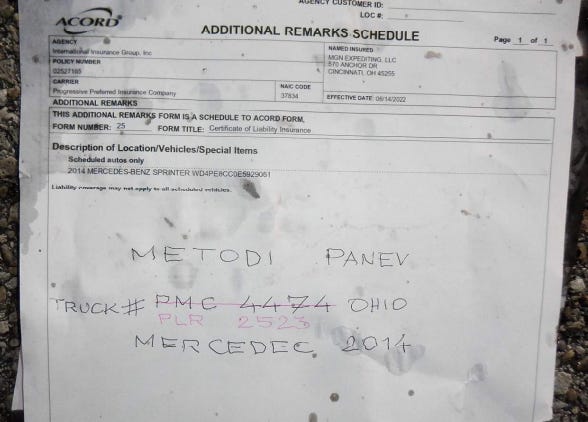
This isn’t the first time the Treasure Coast has seen a truck across the road. In August 2025, troopers said Harjinder Singh used an “Official Use Only” turnaround on Florida’s Turnpike near Fort Pierce and stretched his tractor-trailer across the northbound lanes. Three people in a minivan died. Singh has pleaded not guilty to three counts of vehicular homicide and three counts of manslaughter. I’m also a retained expert in a rear-end case involving a hotshot driver with a Russian commercial license and no U.S. CDL, working for an operation that listed an Airbnb unit in a Miami high-rise as its address, who ran at night with flashlights instead of working taillights. A father of three died.

Has the carrier name been made public?