


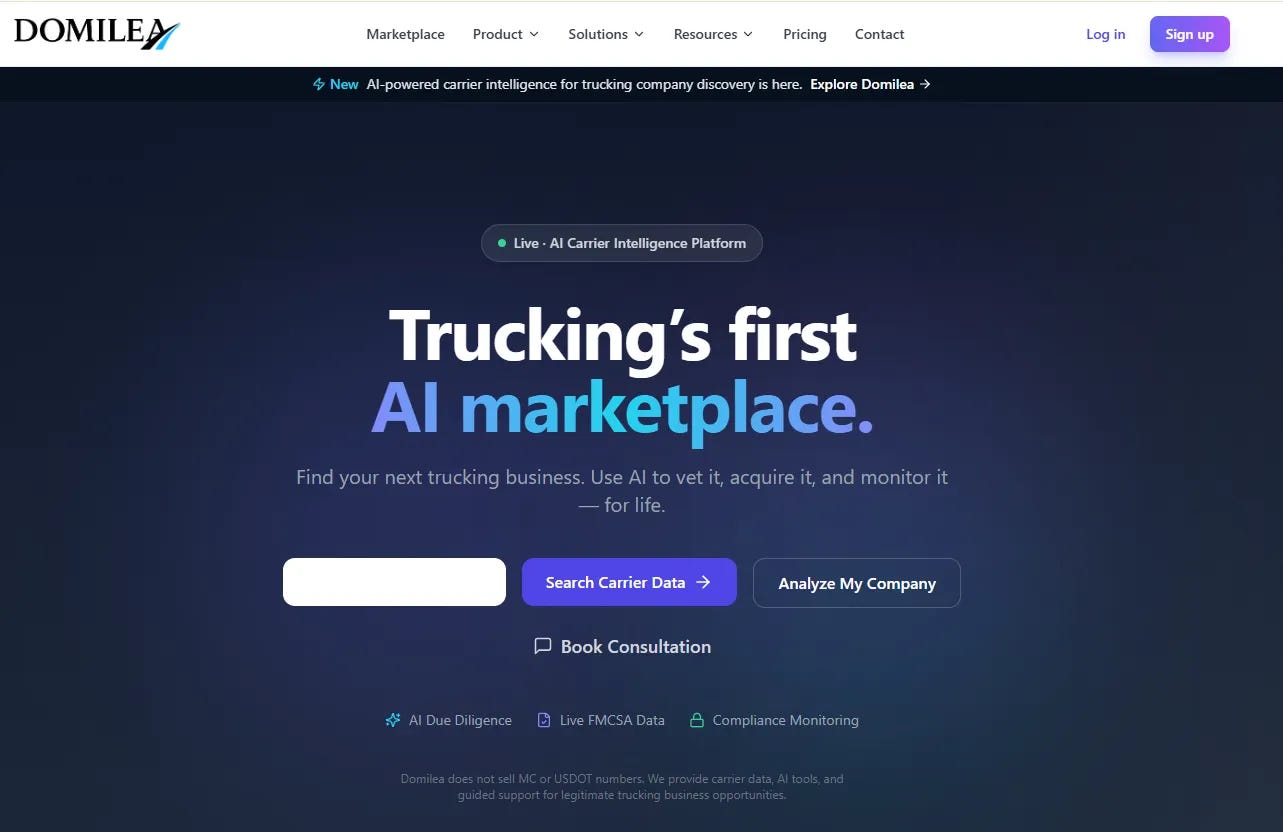
Seldom is what you see what you get in the Chicago trucking world. I’ve been covering the Domilea.com Viava Grama authority sales for some time, but I fell in love with the story when she sold Alexander Mimic’s/Super Ego’s co-debtor entity, “Timeit,” for $35k in April via Telegram chat. Some were even Sam Express affiliated. (For the list of those she listed and supposedly sold on Domilea, you can find those here.) The entity data changed, but Alexander and Super Ego remained the co-debtors; the UCC lien went nowhere. Maybe it’s my unhealthy focus on Alexander Mimic’s Super Ego, and that crazy that also led to my CBS 60 Minutes deal. Maybe it’s the 33 entities she sold in April alone or the $1.5M she made selling more trucking authorities that often turn out to be repurposed on the market as shells for aspiring chameleon carriers and bad lease deals.
To my surprise, Viava Grama, the name behind the Telegram chat channel and Domilea.com, decided that Instagram was her next-best hustle. Blondes and boobs=influence. truckercollege.com is her newest venture spinoff from that influence. Tell the world how she built a trucking company and how they can do it too. Well, there's a story there, and it’s very different than the one she tells on Instagram. It is a very common story where drivers, vendors, lenders, and ultimately the rest of the industry and the public absorb losses from failed companies.
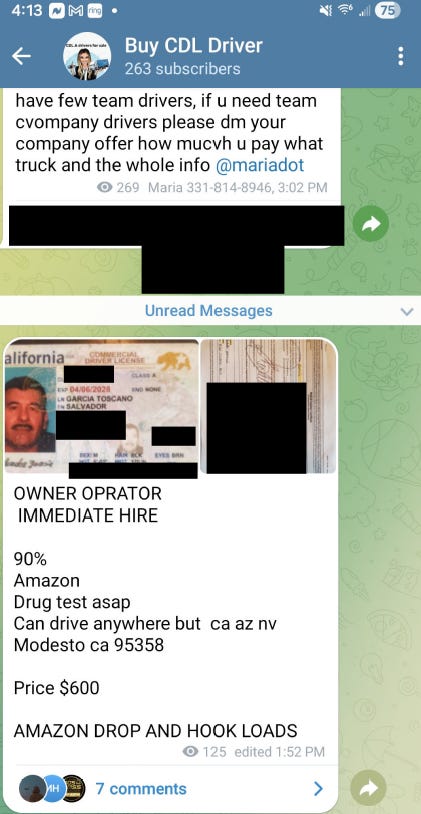
She even had a “Buy CDL Driver” Telegram channel where she posted drivers’ licenses, Social Security numbers, and other PII and sold them. Many non-domiciled CDLs. Basically a Truck driver Tinder feed with all their personal data in a Telegram feed. This went on for months until someone tipped off Telegram to the terms of service violation, but we scrolled and recorded the entire feed weekly. It’s all a big game that costs all of us as an industry and as a society. You could buy Salvador Garcia here for right at $600. Entire driver file basically in the Telegram channel. Need team or ghost drivers for your ELD…we got you.
So where did Grama come from? What got her here? Who is she? Is she Maria, Viava, Sandra, or what? Well, here's the shortest long version of how we got here.
On March 14, 2025, a lender named Auxilior Capital Partners filed a verified complaint in the Northern District of Illinois, alleging it couldn’t locate its own trucks. The filing states that the equipment sits at 13717 South Route 30, Suite 111, in Plainfield, that the borrowers are “wrongfully and unlawfully detaining” it, and that Auxilior “has been unable to secure the Equipment by peaceful means.” A vice president of portfolio management, Dominick Cevet, signed the verification two days earlier under penalty of perjury. The company asked a federal judge for a writ of replevin and for authority to break locks.
Eleven days later, a 2022 Utility reefer trailer with VIN 3UTVS2536N8719109, one of the twenty-nine units on that loan, underwent a roadside inspection. Over the following ten weeks, six more of those units were inspected in Utah, Mississippi, and Illinois, as well as along an Arkansas-to-Wyoming corridor. All seven ran under the USDOT number of a carrier that appears nowhere in the loan agreement, nowhere in the guaranty, nowhere on the UCC-1, and nowhere in the lawsuit.
The trucks weren’t hiding in a lot in Plainfield. They were working.
What actually got built
So how do Domilea, Trucker College, and Viava Grama of Instagram “How I built a multimillion dollar trucking entity and got rich” Instagram fame fit into this typical EuroChicago leasing craziness? They don’t directly, but they didn’t just materialize. His “trucking success story started somewhere, and this is it. We’re going to tell you how she really built a trucking company. We won’t charge you for a class. It’s all free unless you want to pay to subscribe. RTL Leasing, LLC is the borrower on that loan. Illinois file number 09786732, organized January 27, 2021, principal address 13717 U.S. Route 30 in Plainfield. It has two managers on the state filing, Vaiva Grama and Jake Kuenzl, and Kuenzl took over as registered agent on August 20, 2024. It has never held a USDOT number. It has never held operating authority. It has never been party to a roadside inspection because a leasing entity doesn’t haul anything yet controls everything, and that’s the story on leases and largely part of the reason they fail.
On July 11, 2025, the Illinois Secretary of State dissolved it. The status field reads INVOLUNTARY DISSOLUTION. Nobody wound down the company, closed the books, or filed articles of dissolution. Somebody stopped paying the annual report fee, and the state took the entity off the board for it. A company that borrowed $2,113,122.29 was terminated over a filing that cost $75.
The operating carrier is a separate company in a separate state. Reserve Truck Lines Ltd. Co., an Iowa corporation at 222 3rd Ave SE, Suite 504, Number 18, in Cedar Rapids, USDOT 3175112, carrying federal operating authority roughly eight years old. Kuenzl signed the corporate guaranty on its behalf as sole member. Reserve still has a DOT number but no authority; twenty power units on file. Its last recorded roadside inspection was January 13, 2025.
The titled owner is a third company, and it was dead the entire time. Every one of the twenty-nine certificates of title in the exhibits reads “MERGING EXPRESS LLC, 1110 Manhattan Road, Joliet,” with Auxilior recorded as the first lienholder. Auxilior’s own complaint concedes, at paragraph 16, that RTL never obtained new titles, so the titles still identify Merging Express as the owner. Merging Express had ceased operations and liquidated before the loan closed.
That is the structure, and it repeats across dozens of these cases. The debt lives in one entity, the operating authority lives in a second, the title lives in a third, and the equipment moves freely among all of them, often under common control, while declaring it was a rich leasing company. A broker vetting the load sees the carrier. An insurer underwriting the risk sees the carrier. A lender underwriting the collateral sees the leasing entity and the title. Nobody sees the whole thing, and that isn’t a flaw in the arrangement. That’s what the arrangement is for.
The paper
Auxilior didn’t lend into this cold. Auxilior financed the equipment for Merging Express; Merging Express told Auxilior it had subleased that equipment to RTL Leasing; Merging Express then ceased operations and liquidated, Auxilior foreclosed, and RTL was sitting on the iron when the music stopped. Rather than send trucks and a recovery agent to pull twenty-nine units out of a yard, Auxilior wrote a new loan to the party already holding the keys.
Auxilior wrote $2,113,122.29 at 4.90 percent on July 26, 2024. The Wall Street Journal prime rate that day was 8.50 percent. A finance company with no deposits, funding itself through warehouse lines and the equipment asset-backed securities market, wrote paper more than three and a half points below prime to a borrower with no operating history, no authority, and no trucks of its own. Nobody does that for a customer they like. They do it when the alternative is booking the loss on the last borrower this quarter.
Five months later, it got worse on paper and better on the books. On December 30, 2024, the last business day of the year, Auxilior and RTL executed an amendment restating the payment schedule from the beginning. The new schedule opens with four monthly payments of $0.00 running September 15 through December 15, 2024, months that had already come and gone. One payment of $12,883.44. Five interest-only payments of $8,772.77. Six at $15,000. Twelve at $30,000. Thirty-six at $45,000. One final balloon of $400,632.70. A loan four payments delinquent became current with one signature, retroactively.
The amortization schedule attached to the complaint, December 31, shows what those zero-dollar months actually did. Interest accrued of $35,310.99. Principal applied of negative $35,310.99. The balance climbed from $2,113,122.29 to $2,148,433.28, then remained flat through six interest-only payments. The first dollar of principal reduction on the schedule falls on payment eleven, July 15, 2025, and it’s $6,227.23. For the first year of a loan on 2017-through-2022 iron, Auxilior’s exposure was scheduled to sit above where it started while the collateral depreciated underneath it. The complaint puts the fair market value of all twenty-nine units at $1,100,000.
RTL missed the January 15, 2025 payment and every payment after it. Total cash Auxilior collected on $2.1 million: none. That’s not a borrower who defaulted six months in. Under the schedule Auxilior itself drafted, nothing was owed until January, and January is when it stopped. Basically, they got handed a fleet they wouldn’t have to pay for over months. They ran the trucks. Collected a bunch of cash flow. Then made no payments ever on the equipment. Moved on. That’s how you build a successful Chicago lease-all, debt-zero, cost-trucking company while pocketing all the proceeds under an entity you simply close and reopen. Wash. Rinse. Repat. Go on Instagram and tell the world how to build such a successful operation. Should be everyone’s life mission.
Charleston
The reason Merging Express liquidated runs through a federal court in West Virginia, and the publicly available part is a settlement notice.
On March 10, 2025, a mediator named Charles S. Piccirillo convened the parties in Amy Young, as Administratrix of the Estate of Hans Robinson v. Star Insurance Company, Civil Action No. 2:24-CV-00240 in the Southern District of West Virginia. His letter to Judge Joseph R. Goodwin the next day reports a full and final confidential settlement, contingent on the court’s approval of the wrongful death distribution. Six related cases were swept in with it, including four personal injury actions against a driver named Walky Occeus and a carrier called Tesla Cargo Solutions, Inc., as well as Star’s own declaratory action against Transport Enterprise Leasing, LLC.
Merging Express, LLC is named in that declaratory action, No. 2:24-cv-00363, alongside Transport Enterprise Leasing, Tesla Cargo, Occeus, and the individual claimants. A seventh case, Star Insurance Company v. Merging Express, et al., No. 2:24-cv-00706, was held open while Star pursued default judgment against defendants who had already defaulted. It was dismissed by judgment order on April 2, 2025.
What the record says is narrow. Merging Express was a respondent in an insurance coverage proceeding arising out of litigation over a man’s death, and it didn’t appear to defend itself. Whether its truck was in that crash, whether it was a claimant, whether it was a co-insured with an interest in the same policy limits.
The sequence, though, is fixed. Star filed against Merging Express on December 9, 2024. Auxilior restructured the RTL loan twenty-one days later. RTL defaulted sixteen days after that. Auxilior filed for replevin on March 14, and Star’s case against Merging Express was dismissed on April 2. Two federal courts in two states spent the first quarter of 2025 chasing the same collapsed company from opposite ends.
Where the iron went
Twenty-nine units, twelve tractors and seventeen trailers, all titled to a dead company in Joliet. The inspection record picks up eleven of them.
Seven ran under Trans Alps Carrier LLC, an Illinois company organized February 3, 2023, at 310 North Hammes Avenue in Joliet, whose sole manager and organizer of record is Rolando Alvarez. That carrier operates a fifty-nine-unit fleet. The seven collateral units carry Illinois plates ZP89808 on a 2020 Freightliner, P118486 on a second 2020 Freightliner, P1182506 on a 2020 Volvo, 877883ST and 846405ST on trailers, plus an Indiana plate P1120376 on a 2019 Volvo and a Maine plate 877885ST on a 2022 reefer whose sequential sibling is registered in Illinois.
Two of the twenty-nine ran under Reserve, the guarantor. One of those, a 2020 Freightliner carrying VIN 3AKJHHDR8LSLR1516, appears under Reserve on January 13, 2025, two days before the missed payment, and under Trans Alps from December 3, 2024 forward. Reserve and Trans Alps share six more VINs beyond the Auxilior collateral. Six shared power units and trailers between two companies, with no corporate relationship on any filing, aren’t equipment churn. That’s a shared fleet.
There’s a trailer in the Trans Alps fleet that isn’t on the loan and should be. VIN 1GR1A0625LB169309, a 2020 Great Dane on Illinois plate 947320, inspected in Utah on November 1, 2024. Auxilior’s Schedule A covers Great Dane serial numbers 169306, 169307, 169308, and 169310. Serial 169309 sits in the middle of that block. Same year, same make, same batch, and it’s the one unit of five that didn’t end up on the lien.
From mid-2025 forward, the fleet scattered. A 2020 Freightliner shows up under a carrier in Ontario, California, in March 2026, and another in Dayton, Ohio, in May. A Great Dane reefer surfaces in Hialeah, Florida. A 2017 Wabash runs four inspections under a carrier in McAllen, Texas. Two Volvos land with a carrier in Adamsville, Tennessee. A reefer moves to a carrier in Bolingbrook, Illinois, eleven miles from where the whole thing started.
What it cost, and who paid
Run the ledger on this one deal, and every party on it absorbed something, except for the equipment.
A family in West Virginia lost Hans Robinson, and his estate settled its claims eighteen months later under terms nobody outside the case will ever see. Star Insurance paid into a wrongful death settlement and went hunting for a default judgment against a company that had already ceased to exist. Merging Express liquidated. Auxilior wrote $2.1 million, collected zero, forgave four months of it after the fact, and sued for $2,173,343 plus eighteen percent contract interest against collateral it valued at $1.1 million in its own pleading. In an asset-backed securities structure, that gap doesn’t stop at the originator. It runs to the noteholders. RTL Leasing was terminated by the State of Illinois over an unfiled annual report.
The drivers who turned the wheels on those twenty-nine units appear in none of these records. Not in the loan file, not in the guaranty, not in the titles, not in the pleadings. The only trace any of them left is a roadside inspection with a VIN on it, and the only reason we can follow this equipment at all is that a state trooper wrote down that number.
Every corner of the arrangement took a loss. The iron didn’t. Those trucks and trailers have been earning revenue continuously since 2022, through a liquidation, a wrongful death settlement, a foreclosure, a refinance, a restructure, a default, a replevin action, and an involuntary dissolution, under at least eight different USDOT numbers in eight states. Nothing shut down. The paper died, and the equipment kept working.
The gap
Lease agreements aren’t public. FMCSA doesn’t collect equipment ownership. State titles lag the real world by months or years, and in this case they pointed at a company that had already liquidated for the entire life of the loan. The only public instrument that ties a specific truck to the company actually running it is a roadside inspection record, and inspections happen when they happen.
That’s why nobody caught this for two years, and it’s why the next one won’t get caught either. A broker running a carrier through a vetting platform sees the authority. It doesn’t see the note, the guarantor, the title, or the four other companies that have been in those trucks.
Somebody had to pull the VINs by hand because while the folks who built and ran these companies might just show up on your Instagram feed selling you trash authorities, they’re also telling you how to start a trucking company, just like they did. A trucking company just like many others in the Eurochicago market, one that costs everyone else everything and costs them nothing.
At the end of the day, this costs the industry. It costs real drivers with real families. It costs insurers. It costs lives. These operations cost legitimate operators, and consumers absorbed costs, increased regulatory focus, and legitimacy. That's why focus on these operational histories matters.