

Trooper Michael Pahira spent 20 years pulling dangerous trucks off I-81. The truck that killed him was nine days from losing its insurance, wearing a Florida plate tied to a web of micro-carriers, hauling for a company whose paperwork runs from an Alabama mailbox to a Houston filing suite. In Beaumont, Texas, we saw another Haitian immigrant driver on another temporary credential, dispatched through a chain just as rotten. The names change. The architecture never does.
Interstate 81 keeps a ledger. On October 8, 2019, a Gold Coast Logistics driver named Chheanrem “Rocky” Chhean died on I-81 in Shenandoah County, Virginia, when his truck struck a guardrail, an embankment, and a bridge pillar. Five and a half years later, someone filed an Illinois corporate form naming Rocky Chhean, dead since 2019, as president and registered agent of the company he died driving for. Every subpoena served on that company now routes to a dead man.
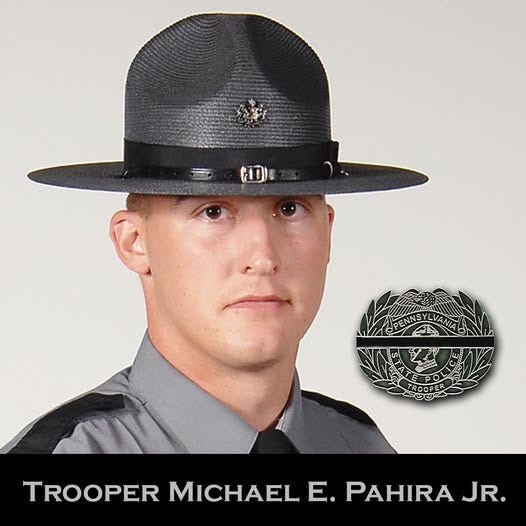
On July 1, 2026, on I-81 in Schuylkill County, Pennsylvania, the ledger took another entry. This one was wearing a badge, Trooper Michael Pahira Jr.
Michael Pahira Jr. was a Motor Carrier Safety Assistance Program inspector with Troop L in Frackville. Twenty years on the job, and by all accounts, one of the best commercial vehicle inspectors Pennsylvania had. The man whose entire job was standing on highway shoulders finding the bad brakes, the falsified logs, the trucks that should not be moving, before they killed someone.
At 7:01 a.m. on July 1, on a straight, dry, defect-free stretch of I-81 southbound near mile marker 119, he was doing exactly that. A red Freightliner out of New Jersey pulled fully onto the shoulder. Pahira’s marked Ford F-350 was behind it, emergency lights running. The driver, Walter Alfredo Reinoso of Queens, was sitting in the cab, working the brake pedal at Pahira’s direction while the trooper checked the braking system. A textbook inspection. Everything off the travel lanes. Everything by the book.
Then a white 2019 Freightliner, Florida plate DF64HU, left the roadway. No curve. No weather. No defect. The affidavit of probable cause by Cpl. John Sleboda and Sgt. Matthew J. Klein of Troop L says Bon’s truck had to exit its lane of travel to hit anything at all. It clipped the driver’s-side mirror of Pahira’s patrol truck, slammed into the rear of the parked rig, and pinned the trooper under its front bumper, dragging him down the shoulder before both trucks went up in flames.
Construction workers from a nearby job site saw the black smoke and ran toward it. The affidavit says the man who had been driving that Freightliner, 33-year-old Michael Bon of Brockton, Massachusetts, told them to “leave him” and “stay away from the truck.” They didn’t. They pulled Michael Pahira out from under a burning tractor-trailer while tires exploded from the heat and carried him 30 yards to a patch of grass. He never regained consciousness. He was pronounced dead at 11:45 a.m.
I obtained the archived Schuylkill County fire and EMS radio traffic from that morning, and it tells you what the affidavit can’t. At 7:05, four minutes after impact, the county toned out Englewood, Altamont, and the rescue: “Interstate 81 South, Delta 119, an accident with entrapment and fire.” At 7:08, the first size-up from the scene: at least one tractor-trailer burning, two involved, “someone trapped underneath a tractor-trailer at this time.” And then five words that tell you everything about the violence of this crash: “Sounds like a trauma arrest right now.” Seven minutes after impact, the trooper pinned under that truck was already in cardiac arrest from his injuries.
At 7:13, with PSP on scene, command called for a medevac to land directly on the interstate. Life Flight 5 was on the ground in the southbound lanes by 7:32. There are no hydrants on Interstate 81; the fire required a tanker task force, five fire districts hauling water by truck, a nurse-tanker operation, and a fill site improvised off a hydrant on Keystone Boulevard. Twice on the tape, crews at the nozzle radio that they’re out of water. Volunteer firefighters ran a rural water shuttle on a federal interstate, in July heat, to knock down a fire that had already consumed two tractor-trailers, while the flight crew and troopers worked on one of their own in the median.
He is the 106th member of the Pennsylvania State Police to die in the line of duty. He had recently moved back home to help care for his mother through cancer treatment. Days before the crash, he helped her shave her head.
One more detail from the affidavit. A fourth witness, a truck driver who stopped and called 911, told Cpl. Sleboda said that the striking driver, who had a head injury, tried to help free the trooper before backing away from the fire, and that he “had a difficult time understanding him” at the scene. 49 CFR 391.11(b)(2) has required English proficiency sufficient to converse with the public and respond to official inquiries for as long as I’ve held a CDL. In a five-day nationwide enforcement sweep this February, 300-plus investigators and 1,426 on-site operations, exactly one driver was placed out of service for an English proficiency violation. One.
The dashcam on Reinoso’s truck captured Pahira walking in front of the vehicle moments before impact, and the crash itself. That footage, I assume, we can expect after court next week. Bon is charged with homicide by vehicle, aggravated assault by vehicle, involuntary manslaughter, and a stack of related offenses. He’s held on $700,000 bail with an ICE detainer lodged. Preliminary hearing July 16; the docket is searchable on Pennsylvania’s UJS portal. He is presumed innocent of the criminal charges, and the cause of his departure from the roadway hasn’t been publicly established.
The driver’s paper trail
Bon entered the United States through Fort Lauderdale-Hollywood International Airport on July 2, 2024, under the CHNV humanitarian parole program. In October 2024, he applied for Temporary Protected Status; it was denied. In March 2025, Massachusetts issued him a non-domiciled Class A CDL. On June 13, 2025, DHS terminated his parole and ordered him to leave the country. He didn’t. In February 2026, eight months into his unlawful presence, Massachusetts renewed the license. One month later, FMCSA’s final rule restricting non-domiciled CDLs took effect, and by the RMV’s admission, he would have been rejected under it.
The RMV’s response to the trooper’s death was to point at Washington: the program is federal, Bon showed eligible in the federal SAVE database, and the state followed the rules as they existed. A licensing regime in which a state can hand an 80,000-pound vehicle credential to a man under a federal removal order, renew it, and then correctly claim it followed procedure is not a licensing regime; it’s complacent ritualism.
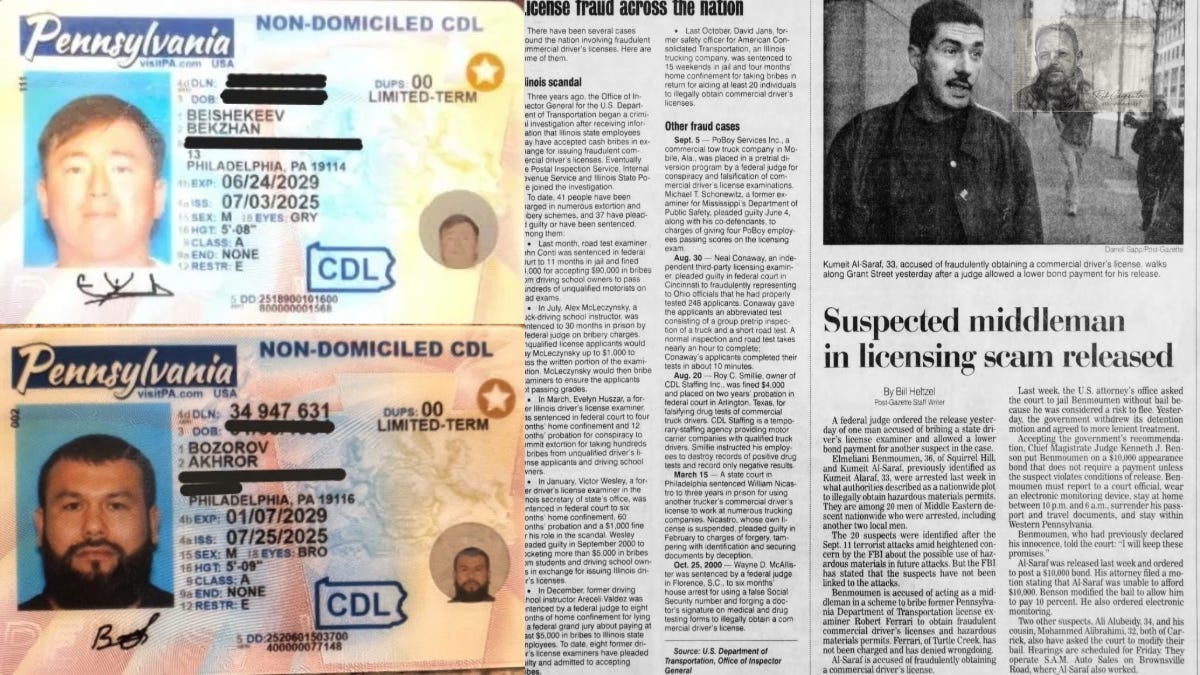
This is the same state where a state trooper certified CDL applicants he privately described as “brain dead” in exchange for a driveway, a snowblower, and a bag of Twizzlers. The self-certification model that made that possible in Massachusetts is the same model running in all fifty s
tates today. I wrote the 25-year history of that model in February, from the PennDOT examiner taking bribes under his desk calendar in 2001, to the Ohio examiner running 10-minute skills tests, to the 7,000-plus ELDT training providers removed, flagged, or placed under investigation in the past few months, roughly 44% of every registered provider in the country. The system that qualified Michael Bon to drive a tractor-trailer has not failed once. It is a system performing exactly as it was built: volume over verification.
The truck paper trail
This is not just a driver’s story.
The affidavit identifies the vehicle as a white 2019 Freightliner with Florida registration DF64HU. On June 19, twelve days before the crash, DOT records show the USDOT number of Augustin Freight Services LLC, USDOT 4162522, MC-1599787, of Albertville, Alabama.
So let’s meet the suspected carrier.
Augustin Freight Services is a four-truck, four-driver operation with Francelaine Augustin as its FMCSA officer of record. Its interstate authority dates to late November 2023, about two and a half years old, still within the window when carrier failure and crash risk are highest. It has no safety rating.
Its roadside record is the profile of exactly the kind of truck Michael Pahira existed to intercept. Seventeen inspections produced 19 violations across three BASIC categories. A 40% vehicle out-of-service rate, double the national average. In April 2025, inspectors wrote it up for defective brakes equal to or greater than 20% of service brakes (out-of-service), a leaking wheel seal (out-of-service), contaminated brake friction surfaces, and brakes out of adjustment. In October 2025: a cracked or broken frame, a defective ABS lamp, inoperative lighting, and a severity-7 hours-of-service violation for a driver making a false report regarding duty status and a falsified log. In January 2026: a tire below 50% of the maximum inflation pressure (out of service), an inoperative front turn signal, and a failure to obey a traffic control device. In February 2026, one of its trucks was in a tow-away crash in Metuchen, New Jersey.
Run that through FMCSA’s own Inspection Selection System methodology, and this carrier scores an estimated 98 out of 100. INSPECT. Top priority. Three BASICs above intervention thresholds. Trooper Michael Pahira would’ve been pulling this truck over. Michael Pahira was doing precisely what the data demanded, inspecting trucks on I-81, when a truck fitting that exact profile left the roadway and killed him.
The insurance
Now the part that determines whether anyone, the trooper’s family, Reinoso, anyone, ever sees a dollar from the carrier. Augustin Freight Services carries $750,000 in bodily injury and property damage coverage. The federal minimum for general freight, unchanged since 1985. It carries it through Universal Casualty Risk Retention Group, Inc.
The FMCSA insurance history on this carrier reads like a cardiac monitor. Progressive Specialty wrote it effective December 2024 and canceled by the end of February 2025. Geico Marine picked it up in February 2025 and canceled in August. Everspan Indemnity filed coverage on August 28, 2025, and canceled it the same day. The federal record then shows no primary BIPD filing until Universal Casualty’s policy took effect on December 30, 2025, a four-month gap that aligns with involuntary revocation actions churning through the carrier’s authority docket. Universal Casualty’s first filing was itself canceled on February 12, 2026, and refiled the same day.
Five filings. Four insurers. Nineteen months. Nobody who looked at this carrier’s loss profile wanted to keep it.
As of this week, FMCSA’s Licensing & Insurance system shows the operative BMC-91X filing carrying a cancellation date of July 14, 2026. Under the federal filing rules, that means the risk retention group served notice of cancellation in mid-June, before the crash. When Michael Bon’s truck left the roadway on July 1, the carrier’s insurance was already dying. It had thirteen days left.
Coverage was in force on the day of the crash. Think about what $750,000 has to cover: a trooper’s line-of-duty death, a destroyed patrol vehicle, a destroyed tractor-trailer, Reinoso’s injuries, the fire, the highway closure. It won’t come close. Because Universal Casualty is a risk retention group, there is no state guaranty fund behind it. RRGs are exempt from guaranty-fund participation under the federal Liability Risk Retention Act. If the RRG can’t pay, nobody pays.
So who is Universal Casualty? My platform’s insurer intelligence shows a book of roughly 1,000 currently active policies and 2,405 lifetime carrier relationships. Across those insureds: 3,644 total crashes, 1,654 injuries, and 111 fatal crashes. Half of its currently scored book sits in the high-risk tier. Average insured authority age: 5.8 years. Youngest: about a month old.
I keep finding this same character in every fatal crash I investigate, and it’s never the same company, but it’s often the same kind of insurance, instant issue, or an RRG company. In Beaumont, the insurer on the truck that killed Brandon Rogers was Ace American, a book of 3,542 carriers generating 354,755 crashes and 10,954 fatalities. In the Indiana Amish crash, the carrier’s paper came from Ace Property and Casualty, a sibling in the same corporate family. Here on I-81, it’s a minimum-limits RRG with 111 fatal crashes in its portfolio and a cancellation notice already in the mail. No federal or state law requires an insurance company to evaluate a motor carrier’s safety fitness before binding the policy. I put a number on that gap in March. The filing is the product. The loss is somebody else’s problem. These aren’t insurers in any sense a family standing at a graveside would recognize. They are authority-keeping devices: machines that convert a premium check into the federal filing that keeps a truck like unit 509 legally on the road.
The trucks that outlive their carriers
Zoom out one more level. FMCSA registration and inspection data link Augustin Freight Services to four other carriers via shared VINs and license plates. Lafleur Transport LLC of Huntsville, Alabama, twenty minutes up the road from Albertville, shares both a Freightliner VIN and Florida plate XE778I with AFS. Venky Perfect Passage LLC of Palm Springs, Florida, shares another Freightliner VIN and Florida plate XE277H. Transforce International Inc. of Miami shares a third VIN, a truck that federal crash records show also transferred to Milo Michel Trans LLC at the end of 2024. And a fourth VIN, with an Ohio plate, connects this four-truck Alabama outfit to Roadpulse Logistics LLC of Lyons, Illinois, a fleet of more than 600 power units.
Look at the pattern, not just the names. Florida-plated Freightliners circulate among two-, three-, and four-truck carriers spread across Alabama and Florida. The truck that killed Trooper Pahira was itself a Florida-plated Freightliner operated by an Alabama carrier started by a woman in Texas in a rundown shack tied to her own trucking company. The equipment moves; the authorities come and go around it. Shared VINs and plates are recorded facts in the federal system, and they are not, by themselves, proof of common ownership or of anything unlawful. Trucks get sold, leased, and re-leased legitimately every day. But this is the same structural signature and identifier I documented in the Gold Coast network, where trucks traceable by VIN through pre-revocation crashes rolled on under new branding after the authority died, and in the Sam Express constellation behind the Indiana crash. Trucks that outlive the paper entities operating them. It raises the questions that matter in every negligent entrustment case I’ve ever worked: who actually owns unit 509, who maintained it, who leased it to whom, and who put Michael Bon in its driver’s seat. The title history behind plate DF64HU is now the most important document in this case.
The paperwork trail runs through Houston
The corporate records add one more layer.
Augustin Freight Services LLC was formed in Alabama on December 3, 2021, nearly two years before it obtained federal operating authority. Its registered agent is Francelaine Augustin of Guntersville, Alabama. Its organizer, per the Alabama Secretary of State, is a different person entirely: Lovette Dobson, listed at a suite address on State Highway 249 in Houston, Texas.
Dobson’s facts are exactly as the records show; accuracy matters here. An organizer is the person who files an LLC’s formation paperwork; it is not the same thing as an owner, and formation services organize other people’s companies legitimately every day. What the records show is this: Dobson is the FMCSA-listed officer of her own carrier, Uncle D&D’s Trucking, USDOT 3982582, of Houston. Uncle D&D’s authority grant sits within a cluster of seventeen Houston-area carriers whose FMCSA authorities were all granted the same day, with nearly sequential USDOT numbers, 3981783 through 3983578, the batch-processing signature of applications filed together in the same session, likely by the same hands. Seventeen carriers, one day, one city.
That pattern is consistent with a filing operation that stands up carriers in volume. It could be an entirely legitimate registration service. It could also be the front end of the authority-mill pipeline I documented in the Sam Express and Aydana investigations, the machinery that manufactures the carriers that hire the drivers the licensing counters wave through. Motor carrier authority costs $300 to file and requires no proof of operational competence; authorities grew 45% between mid-2019 and mid-2023 while freight demand grew about 11%. Somebody is doing all that filing. Which kind of operation this one is, the Texas Secretary of State’s records and a full pull of every entity Dobson has organized will tell us. That’s the follow-up, and it’s already underway.
We’ve seen this before
Between my writing at Freightwaves, Substack, X, CBS 60 Minutes, CBS, Fox, etc, etc etc., one thing you need to understand between dozens of articles is Michael Bon is not the first Haitian immigrant on a transitional commercial credential to be the last link in a fatal chain that was rotten at every link above him. I’ve already written that story once. It happened on I-10 in Beaumont, Texas. I interviewed with Will Cain on this crash in the Dallas studio.
April 15, 2023. A load of Ghost Energy drinks, Anheuser-Busch freight, Arizona to Florida. The assigned carrier fell off the load. The broker that scrambled to cover it was ArcherHub, incorporated in Colorado and marketed as a Denver digital freight brokerage, but actually operating with a workforce of more than 200 people out of an office in Chisinau, Moldova, reachable via a Gmail address. The truck ArcherHub put on the load belonged to Gold Coast Logistics, Dragos Sprinceana’s DMG Consulting, a carrier that at that moment carried a public federal record of nearly $900,000 in settled yet unpaid enforcement fines, carrier-level CDL violations, a documented finding that it used a driver known to have tested positive for controlled substances, and a crash count building toward 150 events and 10 fatalities. Its authority was technically active. Everything disqualifying about it was sitting in SAFER, public, free, one search away.
The driver was Leandre Sime, a Haitian immigrant holding a Florida temporary Class A CDL issued on January 3, 2023, a transitional credential for a driver who hadn’t yet satisfied the requirements for a permanent one. Fourteen weeks after Florida issued that temporary license, Sime was behind the wheel of an 80,000-pound Gold Coast truck on I-10. Seventeen people were hurt or killed. Brandon Rogers died. His widow, Jennifer, is raising three children alone. Sime is under criminal indictment. The civil case, with seventeen plaintiffs and Anheuser-Busch’s name typed onto the bill of lading as the motor carrier, which they call a clerical error, is headed for trial in Jefferson County.
Beaumont, 2023: a Haitian immigrant on a Florida temporary CDL, driving for a carrier with ten fatalities on its record, dispatched by a Moldovan-operated broker, insured by a company with ten thousand fatal crashes in its book, hauling for a Fortune 500 shipper. Schuylkill County, 2026: a Haitian national on a Massachusetts non-domiciled CDL, renewed eight months into a removal order, driving for a carrier with a 40% vehicle OOS rate and insurance nine days from cancellation, through an RRG with 111 fatal crashes in its book and no guaranty fund behind it.
Two drivers, three years apart. Different states, different credentials, different carriers, different insurers. Identical architecture. And that’s the point people keep missing when they make these stories about the driver’s passport. The driver is the last link. He is also the cheapest link, the most replaceable link, and the only link that ever sees the inside of a courtroom in handcuffs. Every link above him, the licensing counter, the training mill, the carrier, the equipment owner, the dispatcher, the broker, the insurer, the shipper, got paid, and walks.
Where the road ends is Dragos
If you want to know what this business model produces when it’s allowed to run to maturity, I spent three FreightWaves installments documenting it, and I’ll give you the shape of it here, because the Pahira case is the same organism at a younger age.
Dragos Sprinceana’s Gold Coast network peaked at 350 trucks. It accumulated 150 crashes, 10 fatalities, 86 injuries, and $889,630 in settled federal fines. When the August 2023 revocation finally came, 134 days after Brandon Rogers died, the trucks did not stop. They migrated: same VINs, same plates, new DOT numbers, new names, including a company run by Sprinceana’s chief operating officer of seven years, whose firm had been sharing the network’s factoring-trust financial infrastructure since 2018, five years before the revocation. The network stood up an ELD operation with log editors overseas. Sprinceana filed a UCC lien against himself, debtor and secured party, same man, two addresses, placing a first-priority claim on his own assets ahead of any judgment creditor, the same month the civil suits were closing in. Process servers documented 24 failed attempts to serve him and his company. He was meanwhile photographed at Mar-a-Lago, dining with senior federal officials, having donated $134,992 to political committees while owing nearly a million dollars in federal safety fines.
The paperwork detail is the wildest part to me: to keep the corporate shell breathing, the network filed forms rotating Rocky Chhean, the driver who died in a Gold Coast truck on I-81 in 2019, through the roles of president and registered agent, his signature appearing on documents filed under penalty of perjury more than five years after his death. There is no record that a workers’ comp death claim was ever filed for him. His family raised $4,922 of a $10,000 funeral goal from strangers on the internet.
A dead I-81 driver, conscripted as a corporate shield. A living I-81 inspector was killed by the front end of the same pipeline. Bon and Augustin Freight Services are where this pipeline starts: young authority, cycled insurance, pooled equipment, a driver the licensing system waved through. Sprinceana is where it ends: hundreds of trucks, a death wake, a yacht, a Rolls-Royce in the wife’s name, and a ghost signing the paperwork. Michael Pahira, Brandon Rogers, Rocky Chhean, Henry, Menno, Paul Eicher, and Simon Girod are what it costs at every mile marker in between.
Pennsylvania, Massachusetts, and the counter that never learns
The bitter irony of where this happened should not be lost on anyone, and I laid out the full 25-year record in February, so I’ll be brief here.
Pennsylvania is one of the states FMCSA’s nationwide audit found to be issuing non-domiciled CDLs illegally, licenses outlasting lawful presence, licenses issued without documented verification, and a licensing system with no field to record which immigration documents a clerk reviewed. USDOT put $75 million on the line and ordered the state to audit its 12,000-plus active non-domiciled credentials. Pennsylvania issued a CDL to Akhror Bozorov, a terrorism suspect wanted in Uzbekistan, who cleared the federal SAVE check, and, the governor admitted, still cleared it after he was in custody. Pennsylvania issued the CDL that Bekzhan Beishekeev carried into the Indiana crash that killed four Amish men, certified through a training school with no legal existence. The same agency’s verification infrastructure feeds the state’s automatic voter registration. Same counter, same checks, same answer every time: our verification works, it has always worked, nothing to see.
Pennsylvania handed out those credentials. On July 1, the ledger came home; this time the license came from Massachusetts, but the man it killed was one of Pennsylvania’s own, the MCSAP inspector whose job was catching what the licensing counters let through. The front end of the system killed the back end. The system ate its own immune response.
From Robert Ferrari selling hazmat CDLs from under a desk calendar in 2001, to ten-minute skills tests in Ohio, to a Massachusetts trooper certifying drivers for a snowblower and a bag of Twizzlers, to a Hatboro ghost school certifying the Indiana driver, to a SAVE database that green-lights terrorism suspects and removal-order parolees alike, it has been the same self-certification architecture for twenty-five years, surviving every scandal, every administration, and every audit, because the industry’s shortage narrative demanded volume and the counters delivered it. The ATA’s own chief economist admitted last fall that America has a driver quality problem, not a quantity problem. Nobody at that podium acknowledged who spent twenty years lobbying the quality out of the system.
Who ships with these carriers?
There’s one more party in every one of these stories, and they never make the headlines…the freight.
Augustin Freight Services’ inspection records show it hauling for nine different freight principals over the past year: seed companies, packing houses, an ice company, one inspection each, the scattered profile of a carrier living on load-board spot postings. On July 1, its trailer was full of clothing. Somebody tendered that load. Somebody, or somebody’s broker, looked at a carrier with a 40% vehicle out-of-service rate, no safety rating, and insurance on its fourth insurer in nineteen months with a cancellation notice pending, or, more likely, never looked at all, and put freight in its trailer at whatever rate cleared the board.
Before anyone tells me this is a bottom-feeder problem confined to no-name freight: in Beaumont, the shipper on the bill of lading was Anheuser-Busch. In my files right now sits another carrier, 17 trucks, 14 crashes, 200 violations, repeat falsified-log citations, an estimated ISS of 89, and a 27-carrier web of shared VINs, plates, and officers behind it, whose inspection records over two years show it hauling for household dairy and yogurt brands, national poultry processors, the biggest cold-storage chains in the country, major grocery banners, a global coffee chain, an e-commerce giant, and the United States Postal Service. Blue-chip freight, riding on falsified logs. That network gets its own article.
Truck rates are at historic highs, which means the arbitrage on a cheap truck has never been fatter. The Montgomery-era nuclear verdicts were intended to prompt shippers and brokers to vet their carriers. Instead, a class of thinly capitalized brokers, required to carry no meaningful insurance of their own, some dispatching from offices an ocean away from any American courtroom, takes the low bid, books the cheapest authority on the board, and when the crash comes, files bankruptcy and re-forms under a new MC number. They’re running the same reincarnation playbook as the chameleon carriers they hire, one level up the chain. The demand side of this market is exactly as culpable as the supply side. It just has better logos.
What actually has to change
The March 2026 non-domiciled CDL rule closes the door Bon walked through, and the state-by-state revocation audits matter more than the rule itself. Licensing is only the first link, and this case proves the rest of the chain kills just as efficiently.
English proficiency enforcement has to mean roadside out-of-service, consistently applied; one out-of-service action across 1,426 enforcement operations is not enforcement; it’s theater. New entrant audits have to reach the driver qualification file in the first weeks of authority, not month eighteen: the DQ file on a driver like Bon either documents the disqualifying facts or it doesn’t exist, and both answers should end an authority. The BMC filing system needs to treat insurance cycling, five filings, four insurers, same-day cancellations, and coverage gaps as the real-time revocation trigger it obviously is. Risk retention groups and minimum-limits mills writing trucking paper need the same audit treatment the state licensing agencies are getting: pull the loss runs, count the bodies in the book, and ask whether a filing backed by nothing is a filing at all. Brokers need a bond and insurance regime scaled to exposure, so the judgment-proof double-broker model stops being free, and a broker dispatching American freight from Chisinau needs to be reachable by an American subpoena. The ELDT self-certification model that has survived since Ferrari’s desk calendar needs to die: minimum hours, on-site verification, and examiner accountability with teeth.
None of this is radical. Most of it existed, in concept, in FMCSA’s own thinking a decade ago. The data to see these networks, the shared VINs, the same-day filings, the insurance churn, the plates rotating between authorities, the dead men on the letterhead, is visible from orbit if anyone bothers to look. I know, because I look at it every day.
Michael Pahira looked too. Every working day for twenty years, one truck at a time, on the shoulder of a highway. The system he was defending couldn’t be bothered to look back.
He deserved better. So did Brandon Rogers. So did Rocky Chhean. So does the next inspector standing on the white line, and the next family in a van, trusting that the truck in the mirror is driven by someone the system actually checked.
I-81 keeps a ledger. It’s time somebody balanced it.
Rob Carpenter is the founder of THE TEA Highway Intelligence Platform, VP of Compliance at TruckSafe Consulting, and an expert witness in commercial motor vehicle litigation. He writes Talking Wreckless.
Related reading: “How PA’s CDL Failures Diminished Highway Safety, and Compromised Voter Rolls” (Talking Wreckless, Feb. 23, 2026); “The Gold Coast Death Wake That Led to Mar-a-Lago,” “Catch Me If You Can: Romania’s Back Channel to Mar-a-Lago,” and “A Moldovan Broker, Romanian Carrier, Temporary CDL Driver and Another Fatal Truck Crash” (FreightWaves, Parts One–Three of the Gold Coast investigation); “Insurers Judged by the Trucking Company They Keep” and “New Data Puts a Number on the Insurance-Safety Gap in Trucking” (FreightWaves).
Sources: Affidavit of probable cause, Commonwealth v. Bon, sworn by Cpl. John Sleboda and Sgt. Matthew J. Klein, PSP Troop L, filed July 1, 2026, Magisterial District Court, Schuylkill County (docket via ujsportal.pacourts.us; affidavit released by the Administrative Office of Pennsylvania Courts); DHS statements of July 3–4, 2026; Massachusetts RMV statements; FMCSA MCMIS/SAFER/Licensing & Insurance records for USDOT 4162522, MC-1599787; FMCSA insurance history and BMC filings; GenLogs roadside imagery, June 19, 2026; archived Schuylkill County fire/EMS radio traffic, July 1, 2026, 6:53–8:22 a.m., reviewed and transcribed by the author; Alabama Secretary of State entity record 000-955-466; FMCSA Preliminary Determination of Noncompliance – Pennsylvania (Nov. 19, 2025); FMCSA Non-Domiciled CDL Final Rule (eff. Mar. 16, 2026); Jefferson County, Texas civil filings and FMCSA records in the Beaumont matter; Illinois, Arizona, and Florida UCC filings in the Gold Coast matter; Tea Technologies platform analysis of federal data; prior FreightWaves and Talking Wreckless reporting by the author.
Thanks for this timely, informative series. I was a fraud and computer crimes detective at a large suburban sheriff's department for a decade, with no cases that intersected with motor carrier cases. The rare vehicle frauds involved car dealerships and one unusual money laundering case defrauding lenders with recycled and altered construction equipment VINs. I found the UCC filings to be very useful.
Thank you Rob !
Do you think this is a problem that will get solved ?
I’m worried I watched a truck force two campers off the road, absolutely sure it was a third world driver .
Hell I’m hoping they won’t kill me !