

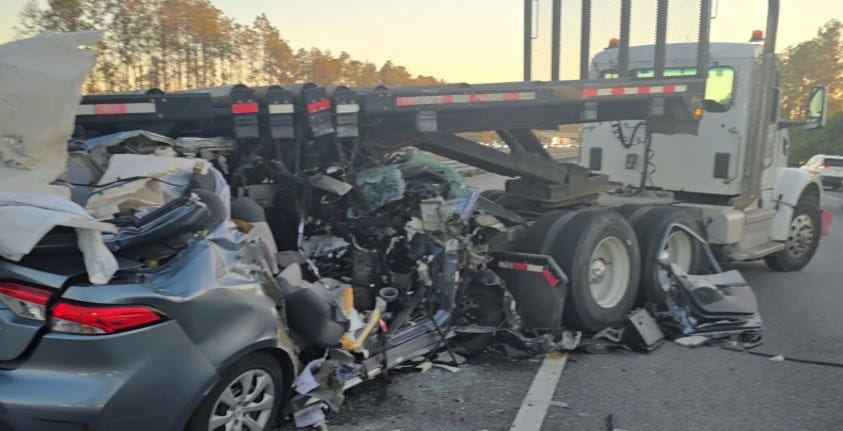
A commercial truck crash lawsuit is not really about the crash. It is about a set of decisions made years earlier, in a formation filing, an insurance application, a $19 process agent designation, and a driver qualification file that either exists or does not
There is a moment in almost every catastrophic truck crash case, usually three or four months in, when the plaintiff’s lawyer figures out what kind of case they have. It’s not the moment they get the police report. It’s not the reconstruction. It’s the moment the corporate records come back, and they learn whether the company that owned the truck is a trucking company or a literal chameleon. The longer I do this work, the more convinced I am of one thing: the litigation is written at formation. The crash is just the filing date.
I am going to walk through every stage of a trucking company’s life, from the state it incorporates into the agent that accepts its mail to the insurance paper it buys to the systems it runs or refuses to run, and I am going to show you how each of those choices resurfaces after a crash as an exhibit, a discovery request, a coverage denial, or a reason the family of a dead motorcyclist never collects a dime. Along the way, we will cover the ghost agent problem, the risk retention group collapse problem, the unscheduled vehicle problem, expert selection, deposition strategy, subrogation, and the exit ramp where the worst operators dissolve and reincarnate before the judgment lands.
First, I serve as a retained expert witness in commercial motor vehicle litigation, on both the plaintiff and defense sides. Worth noting, we generally ONLY take defense work because we choose to defend trucking. For the worst in our industry who have gutted it, deflated wages and rates, and bled it dry while wiping out families through their carelessness, we take very specific Plaintiff cases. I make money in the ecosystem this series describes. Every claim in this series traces to a record: federal registration data, state corporate filings, court dockets, insurance regulator liquidation orders, Pacer, and the Federal Register.
What the data says
The analysis behind this series runs on the same datasets I have used in my published investigations: more than 2.2 million active federal carrier registration records, a 9.5 million-row roadside inspection index, a federal crash file that required deduplication from roughly 6 million raw rows down to 1.24 million unique crash records, and the complete process agent designation dataset that every authorized carrier is required to file.
Registered agent and process agent infrastructure concentrations are the start. A single address in Sheridan, Wyoming, 30 North Gould Street, appears in the federal carrier data as the registered address for more than 10,900 motor carriers. Concentration at anonymous formation addresses is often a selection effect, and the thing being selected is unreachability.
The concession
Most trucking companies are not built to disappear. The overwhelming majority of the 2.2 million carriers in the federal data are what they appear to be: a person, a family, or a company that bought trucks, got authority, bought real insurance, and hauls freight. A Wyoming LLC is not a crime. Plenty of legitimate small businesses form in Wyoming, Montana, New Mexico, or Delaware for tax simplicity, privacy from harassment, or because an online formation service defaulted them there. A cheap process agent is not a crime either. Neither is a minimum-limits policy.
The problem is at the margins, and the margins are where the bodies are. When you sort the carrier population by the infrastructure choices this series describes- anonymous formation states, mill-grade registered agents, discount process agents, unrated or thinly capitalized insurance paper, and inaccurate federal filings- the crash and violation profile of the resulting cohort separates from the general population like oil from water. The choices cluster. They cluster because they are not independent choices. They are one choice, made at formation: build the company so that when something goes wrong, nothing can be recovered from it.
Track one: how the company gets built
Follow the build in order.
The entity. Before there is a truck, there is a filing. The state selection question sounds like boilerplate, but it is anything but. Wyoming offers anonymous ownership, $100 filings, no state income tax, and something most people outside asset protection law have never heard of: charging order protection extended even to single-member LLCs. That means a plaintiff who wins a judgment against the individual owner generally cannot seize the LLC or its assets. They get a lien on distributions that the owner simply never takes. In the worst cases, the state was chosen as a post-judgment strategy before the company hauled its first load.
The agent. Every corporation needs a registered agent in its formation state, and every federally authorized motor carrier must additionally file a Form BOC-3 designating a process agent in every state, the person who can legally accept a lawsuit on the carrier’s behalf. This requirement is nearly a century old. Congress put process agents into the Motor Carrier Act of 1935 precisely so that an interstate trucker could always be sued somewhere. The modern version lives at 49 CFR Part 366, and it has been inverted into its own opposite. A blanket BOC-3 filing can be purchased online for less than $20 from operations that are themselves mail drops. When the agent is a mailbox, service of process fails, and when service fails, litigation does not start slow. It does not start at all. Deadlines run, evidence retention windows close, and the defendant’s absence becomes its best defense. I have written before about the formation-mill ecosystem behind some of these agents, including operations run by principals with federal fraud adjudications in their past, and this article returns to that topic. In its own rulemaking discussion of process agent regulations, the agency acknowledged that enforcement personnel have at times been unable to complete service of process on regulated entities. The federal regulator that requires the designation cannot always serve through it. If the government cannot serve the carrier, what chance does a widow have?
The authority stack. Next comes the federal registration itself: the operating authority application, the DOT number, and the MCS-150 form on which the carrier self-reports its fleet size, mileage, drivers, and operation type. Self-reports are the operative word. The MCS-150 is the census document of the American trucking industry and, at the margins, a work of fiction. Fleet sizes are understated to depress insurance premiums, crash rates, and inspection exposure. I have documented carriers publicly claiming 3 to 700% of the trucks that their federal filings declare. Every falsified line item on that form is a future exhibit, and as we will see in track two, sometimes a coverage rescission is waiting to happen.
The insurance. Federal law requires a carrier to maintain minimum liability limits, generally $750,000 for general freight, a figure set in the early 1980s and never adjusted for inflation, and to file proof of it. The law does not say much about who the insurer must be, and this is where the build decision with the largest downstream consequences is made. There is a functioning market of admitted, rated insurers who underwrite carefully, charge accordingly, and stand behind their paper. Below it, there is a descending ladder: surplus lines paper, thinly capitalized risk retention groups, fronting arrangements backed by offshore reinsurance, and captives. A carrier’s position on that ladder is chosen up front, and the insurer allows it. Insurance selection is a leading indicator of where a carrier is in its lifecycle, because underwriters see the loss history the public never does. When a carrier migrates down the ladder, it is usually because the rated market has already priced it out. The paper gets cheaper as the risk gets worse, which means the victims of the worst carriers are systematically matched with the weakest coverage. Remember that. It is the thesis of the entire money chapter.
The systems, or the absence of them. Last comes everything the regulations call safety management: driver qualification files, drug and alcohol testing, hours-of-service compliance, electronic logging devices, maintenance programs, telematics, dispatch discipline, load acceptance standards. They are cheap to run and expensive to fake, and the carriers built to disappear do not bother with either. They simply do not create the records. During the paper log days, when a carrier received an audit notice, the carrier would just burn the logs if they had them. It was cheaper to get one violation for not requiring drivers to keep a ROD than to incur 100 hours of service violations. This, counterintuitively, is also a litigation strategy, because you can’t produce in discovery what you never generated. The absence of a safety program is the safety program.
Track two: how the company gets dissected
Now run the film backward, starting at the crash.
Hour zero. A catastrophic truck crash triggers two parallel investigations. Within hours, the carrier’s insurer can have a rapid-response team on scene: defense counsel, a reconstructionist, sometimes a recon guy, all working under attorney work-product protection while the victim’s family is still at the hospital. The evidence gathered and the evidence lost in the first 72 hours shape everything downstream. The single most time-sensitive document in the plaintiff’s file is not addressed to the carrier at all. It’s the preservation letter to the telematics and ELD vendors, because federal regulations require carriers to retain electronic logging records for only six months. A defendant who cannot be served for four months has run two-thirds of the clock on the most important dataset in the case. The ghost agent problem is not a paperwork problem. It is an evidence destruction machine that runs on a calendar.
The coverage fight. Before liability is ever litigated, coverage is. The insurer’s first questions are not about fault. They are about the policy: Was the truck on the schedule? Was the driver listed? Were there exclusions? Were there exemptions? What was the language of the policy? Was the application truthful? Was the premium paid? In case after case, the truck involved in the wreck turns out not to be a scheduled vehicle on the carrier’s policy, or turns out to be titled to a third party nobody has heard of, or a certificate of insurance appears at the scene from an agency with no corresponding policy behind it. The application fraud that made the carrier cheap to insure becomes the insurer’s rescission argument, and rescission does not just cut off the carrier. It cuts off the victim. The final backstop, the MCS-90 endorsement required on federally regulated policies, is narrower than almost everyone assumes it is a surety obligation to the public, not insurance for the carrier; it applies only when no other collectible coverage exists, and the insurer that pays under it has the right to chase the carrier for reimbursement, which against a shell is the right to chase smoke.
The identity investigation. Then comes, who is this carrier for real? The competent investigation does not start with the crash. It starts with the birth certificate. Pull the federal registration history and compare every MCS-150 filing against observable reality. Pull the state formation records and read the registered agent line. Pull the UCC lien filings. Pull the process agent designation and determine whether the BOC-3 agent is a law firm or a P.O. Box. Run the officers, addresses, and phone numbers through the federal carrier database and see how many other companies they touch. Run the VINs and plates through the inspection record and see which other authorities the same physical trucks have operated under. The inspection index is the industry’s fossil record. Companies dissolve. Assets don’t. When a vehicle’s inspection history shows it working under three different DOT numbers in 18 months, you are not looking at three companies. You are often looking at one operation wearing three names, and the litigation posture changes completely because the target is no longer an entity. It is an enterprise. Who had control? Often, common control is the key.
Parties and theories. The identity investigation dictates the caption. Against a real carrier, the case is negligence, negligent hiring, entrustment, retention, and supervision, with the federal safety regulations supplying the standard of care and, in many states, negligence per se. Against a shell, the case has to reach further: alter ego and enterprise theories against the network behind the name, fraudulent transfer claims chasing the trucks that migrated to a successor entity, and increasingly, selection liability against the broker or shipper that put the load on the truck. That last front was the most active doctrinal battlefield in transportation law before SCOTUS ruled in May. The federal circuits were split on whether the FAAAA preempts negligent selection claims against brokers, with the Ninth Circuit allowing such claims under the safety exception in Miller v. C.H. Robinson, and the Seventh Circuit rejecting such claims in Ye v. GlobalTranz. SCOTUS ruled and killed the pre-emption. The entire vetting record of everyone who touched the load becomes discoverable, and what you know about this carrier and when becomes the central question of the case. Meanwhile, the Graves Amendment shields equipment lessors from vicarious liability, which is precisely why leasing structures have become one of the preferred liability laundering mechanisms in the chameleon ecosystem, a subject that should get its own installment.
The experts. Catastrophic truck cases are won by translation, and the expert bench is the translation team. Reconstruction establishes what happened. Human factors establish what the driver perceived, when, and what a driver reasonably could have done. The medical and economic experts establish the loss. The expert who increasingly decides these cases is the regulatory and industry-standards expert, because the winning narrative before a modern jury is almost never a bad three seconds. It has been a bad three years. Juries forgive a mistake. They punish a system that was designed never to catch one. The regulatory expert’s job is to take Track One, the formation, the filings, the agent, the insurance, the missing files, and show the jury that none of it was an accident. The crash was the machine’s output, not a malfunction. This is what we do, and it’s also what we defend; as I said, it’s all case-by-case. Generally, we, like many experts, only take on defense work for trucking companies that did the right thing but may have made a mistake. Where I take Plaintiff work is with the worst carriers that had systemic failures and cost real people their lives or their families.
Discovery, depositions, trial. Discovery in these cases is Track One converted into numbered requests: every MCS-150 ever filed, the complete insurance application file, the driver qualification file, the drug and alcohol records, the ELD data and its audit trail, the maintenance records, the dispatch and load records, the formation documents, the bank records that show who actually controlled the money and where it might actually be. The corporate representative deposition is the moment the build itself gets put under oath, and the safety director, if one exists, is asked to defend systems that were never built. At trial, the verdicts the industry calls nuclear are not driven by the crash photos. They are driven by paper. By the empty file where the qualification records should be. By the insurance application that undercounted the fleet. By the process agent that turned out to be a mailbox in a state the owner has never visited.
The exit. In the cases this series exists to describe, the defendant leaves. Authorities revoke or voluntarily surrender, the entity dissolves, trucks are retitled and reappear in the inspection data under a new DOT number within weeks. The plaintiff holds a judgment against a name. The operation holds the trucks. Federal court records and national broadcast reporting have now documented this lifecycle in detail, and my own published network analyses have traced individual vehicles across a half dozen successive authorities. The judgment chases the shell. The fleet keeps rolling.
The money chapter
What happens when the victim wins and still gets nothing?
The risk retention group problem. RRGs exist because of a federal statute, the Liability Risk Retention Act, that lets an insurer licensed in a single state write liability coverage nationwide with minimal oversight from the other 49. The statute also does something that most policyholders, most claimants, and, frankly, most lawyers don’t learn until it is too late: it excludes RRGs from state guaranty funds. When a traditional admitted insurer fails, every state maintains a guaranty association that pays outstanding claims up to a statutory cap. It is the FDIC of insurance. When an RRG fails, there is nothing behind it. The claims die with the company. This happens in real life, no matter what the RRGs tell you. Spirit Commercial Auto Risk Retention Group, a Nevada RRG that insured thousands of trucking operations, was placed in receivership in 2019 and ordered liquidated, leaving claimants across the country holding paper against an empty estate. Global Hawk, a Vermont-domiciled trucking RRG, was liquidated the following year. In each collapse, people who had been hit by insured trucks, who had done everything right, who in some cases had already settled, discovered that the insurance was a promise from a company that no longer existed, with no fund standing behind it. They were victims twice: once on the highway, once in the liquidation.
Then stack the rest of the money layer on top: defense-within-limits policies where every dollar of lawyer time erodes the coverage available to pay the claim, premium finance cancellations that open coverage gaps mid-term, liens from Medicare and hospitals and health plans that consume settlements from the inside, and subrogation battles that redistribute whatever remains. Full accounting belongs in its own piece, but the discipline it points to can be stated now: the collectability audit. Before a dollar of litigation budget gets spent, map the entire recovery path. Policy validity. Insurer identity, domicile, rating, and capitalization. Guaranty fund status. MCS-90 availability. Excess layers. Broker and shipper targets. The principal’s assets and the transfers that moved them. Plaintiff lawyers evaluate liability at intake. Almost nobody evaluates collectability at intake with the same rigor, and in this corner of the industry, collectability, not liability, is usually the case.
The inversion
Every mechanism in this story was built to protect the public, and every one of them has been inverted into a shield against the public. The criminals realized the gaps in the stops and exploited them, reverse-engineering safety and legal controls to their benefit. Usually with help.
The process agent requirement was written in 1935 to guarantee that an interstate trucker could always be sued. It now guarantees, on the margins, that certain truckers can never be found. The LLC was designed to encourage enterprise by limiting liability. Anonymous formation states have refined it into a judgment-proofing product sold by the thousand. The Liability Risk Retention Act was passed in 1981 to solve a genuine commercial insurance crisis. It now lets the industry’s worst risks buy paper that evaporates on contact with a large claim, with no guaranty fund behind it. The federal minimum insurance limit was set to protect crash victims. Frozen for four decades, it now functions as a ceiling that tells the market exactly how little protection is legally enough. Even the safety regulations themselves, which exist to force carriers to generate records of competence, have been inverted by operators who learned that the records you never create can never convict you.
The prescriptions follow directly from the inversions. Verify process agents: a registered agent that cannot be served should not be allowed to accept service on behalf of anyone else, and a physical-presence audit would end the ghost-agent industry in a year. Cross-check the MCS-150 against observable data; the inspection record already reveals the real fleet, and the technology to compare the two exists today. Condition authority on insurer quality, not just insurer existence; a filing from a company one liquidation away from erasing every claim against its insureds is not financial responsibility, it is a costume. And treat formation infrastructure as safety data, because it is: the address on the filing predicts the crash record better than most of what the current federal scoring system measures.
A few years into this work, I stopped being surprised by the crashes and started being surprised by the aftermath. The crash is physics. The aftermath is design.
Somewhere tonight, a formation service will file another LLC at an address where ten thousand carriers already live. A process agent nobody can serve will accept another designation. An application will go to an insurer that will not exist in three years, understating a fleet by two-thirds. No law will be broken loudly enough for anyone to notice, and a truck will roll out under it all, legal in every direction. The company was just built. So was the lawsuit. Only one of them knows it.
Rob, this should be required reading by every legislator at the state and federal level. It’s follow on effect would validate the direction this country is going; bolstering the high trust society that generated this system or continued ‘enshittification’ of what was once a dynamic ecosystem that held great promise in 1982 with the unburdening of regulations. I am disgusted and dismayed at the continued lack of accountability in this industry and society as a whole. After 50 years in this industry, unless there is a positive change through the bludgeon of Montgomery vs Caribbe in the near future, I am looking at other pastures. Disheartening!
It's an excellent piece, with application broader than the trucking context. Well done.