

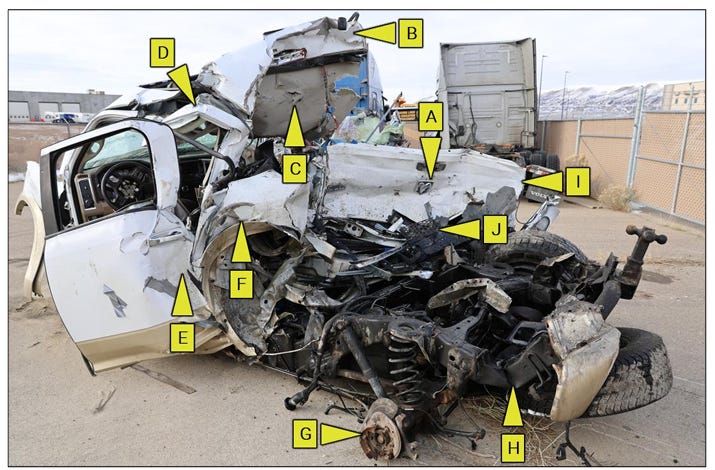
I got the call the day it happened. A fleet owner whose truck was caught in the chain reaction reached out to me while smoke was still pouring from the westbound bore. He sent me the initial dashcam footage. His driver did not run. That driver worked to pull people out of a burning tunnel. I want to mention this to emphasize the part of the story where a driver goes above and beyond. We still have amazing drivers who represent the best part of trucking. The simpler version of this story is that truckers are the problem. Not all of them. Most of the drivers in that tunnel did everything right. Some of them were heroes. The failure here was specific, and it had a paper trail going back years.
(FYI, several reports go into a final for NTSB, and in this case, there is a Motor Carrier Report that can be read here, and it starts how you might think it typically would, with an issue with the initial visit and the principal place of business, which was a building that wasn’t built yet, and an entity leased onto another entity. https://data.ntsb.gov/Docket/Document/docBLOB?ID=20081124&FileExtension=pdf&FileName=05_Green%20River%20WY%20-%20MC%20Factual%20Final_Redacted-Rel.pdf)
On Feb. 14, 2025, at about 11:34 a.m., traffic was moving westbound on Interstate 80 through the Green River Tunnel in Sweetwater County, Wyoming. The tunnel has been in service since 1966. Each bore runs roughly 1,200 feet with two lanes. Snow had fallen that morning; water dragged in on the tires had frozen on the deck, and the variable speed limit had already been reduced from 65 mph to 55 mph for the conditions. The tunnel itself was signed at 55.
According to the National Transportation Safety Board, a 2006 Toyota Tundra lost traction as it exited the tunnel, struck the guardrail and spun back across the lanes. That was the trigger. A beverage hauler braked and steered left to miss the disabled pickup, clipped the wall and narrowly missed the Tundra. A second combination unit came in behind, tried to stop, and jackknifed, leaving its trailer across the right lane and its tractor sideways in the left. The roadway was now blocked, on ice, in a tunnel, on a holiday Friday.
What turned a bad wreck into a mass-casualty event came next as the crash grew into a 26-vehicle pileup, 10 passenger cars and 16 commercial vehicles by the Wyoming Highway Patrol’s count. Fire broke out. Witnesses reported explosions, which were tires and fuel going up in a confined space. Six commercial vehicles and two passenger vehicles were destroyed by fire. Three people died. Christopher Johnson, 20, and Quentin Romero, 22, both of Rawlins, Wyoming, and Harmanjeet Singh, 30, of Nova Scotia, Canada, were killed, Singh after he was trapped in his cab in the fire. Twenty people were hurt. The tunnel was closed for months.
Who was involved
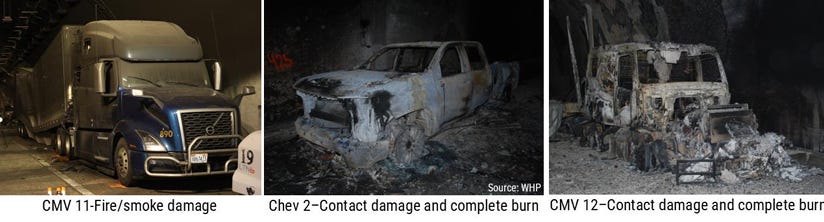
The unit that the state now ties to the fatal mechanism was a 2019 Freightliner Cascadia operating for IGM Logistics Inc. out of Salt Lake City, identified in the NTSB docket as CMV 3. The driver was 24-year-old Riaz Ahmad Noori.
There is a criminal case now and the man is presumed innocent until a court says otherwise, but he is actively wanted on charges related to this crash. According to court records, Noori is wanted on two counts of aggravated homicide and one count of aggravated assault and battery, all Wyoming felonies each punishable by up to 20 years in prison. The charging documents were filed in Sweetwater County Circuit Court on May 22, 2026, more than 15 months after the crash. As of late May, there was an active arrest warrant and no arrest. He also faces a wrongful death suit naming him and IGM.
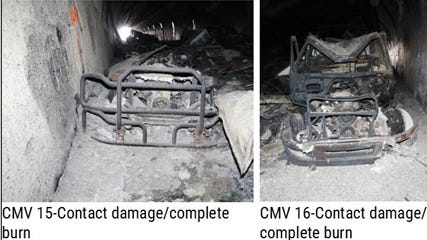
Per the affidavit from Wyoming Highway Patrol Trooper Tyler Chapman, a Dodge Ram had passed the IGM semi on the left before the tunnel. As the Ram approached the jackknifed trailer, it began to slide and rotate toward the wall. Noori moved into the left lane, struck the tunnel wall, overrode the Ram’s bed, and continued into the disabled tractor-trailer. The Ram carried four people. The driver and one passenger survived. The two who did not were Johnson and Romero.
The NTSB human performance report documents that Noori told investigators he decided to jackknife his own truck on purpose, believing it would cause a crash without killing anyone. He said he cranked the wheel all the way left and braked. The truck went straight anyway, because that is what a loaded combination unit does on ice. The NTSB asked both his CDL school and his prior employer whether jackknifing is taught as an evasive maneuver. Both said the same thing. You teach drivers to read the road and slow down. Nobody teaches you to throw a 40-ton vehicle sideways on purpose.
Why it happened
Contrast that with the drivers around him. The cautious operator in the jackknifed unit ahead, the one identified as CMV 2 and run by Two Bros and Jack Company out of Oregon, had refused to chain up that morning because he treated the need for chains as a sign the road was too dangerous to run. He waited for the chain law to lift. He lifted off the accelerator, entering the tunnel. He still got caught, because by the time he rounded the curve, the disabled pickup was already across the lanes. He did not cause this. He got trapped by it.
The beverage hauler ahead of him made what his interviewer called a split-second decision to put his own tractor into the wall rather than hit the Toyota driver who was standing in the road. He blew a tire doing it. He considered it a blessing that the blowout pushed him clear of the woman. Then he parked, got out, and stayed with an injured survivor, calling her family and keeping her conscious until help arrived. He did not leave until about 1 p.m.
Chapman’s affidavit notes that 13 vehicles came to a controlled stop in that tunnel without hitting anything. Five got struck. Same ice. Same blind curve. Same 55 mph sign. The difference was neither the regulation nor the weather. “Human error was the primary factor contributing to these crashes,” the trooper concluded. Most humans in that tunnel did not make the error.
The public score isn’t always “good enough.”
The NTSB pulled the carrier’s BASIC measures, the public Compliance, Safety, Accountability data that brokers and shippers and plaintiff lawyers all look at, and none of the categories were over threshold. Unsafe Driving sat at the 51st percentile. Hours of Service at 34. Vehicle Maintenance at 47. The carrier had passed its new entrant safety audit in December 2022. It had a non-rated compliance review in September 2023. If you had run a standard vetting check the week before this crash, the system would have told you that this carrier was acceptable.
Then the NTSB and FMCSA went on-site and reviewed the history rather than the score. They found that the carrier’s operating authority had been revoked on Sept. 5, 2024, for an insurance lapse and reinstated five days later. The 2019 Freightliner that crashed was not even listed on the carrier’s insurance policy. The maintenance file for that unit held three receipts, total. There was no systematic maintenance program, which is a violation of 49 CFR 396.3. The front-left steer tire, found out of service after the crash, worn to 4/32 of an inch with steel cords showing, had been a used tire slapped on by a roadside mechanic months earlier, with no work order and no documentation of its origin. The carrier ran its dispatch out of Macedonia and had no standalone safety plan. The post-crash compliance review produced 22 violations.
The driver’s file was its own story. He held a Colorado limited-term CDL tied to a work authorization that expired in July 2025, restricted to automatic transmissions. He had been one of two dozen applicants flagged for apparent cheating on a Utah written test, had his license pulled, failed the pre-trip inspection three times, then took a circuitous route through two third-party testers that were later put on probation for not verifying English proficiency, and came out the other side legally licensed. Before IGM recruited him, he had washed out of a major carrier after three speed-related stability-control events in his first weeks and a written warning telling him, in plain language, to slow down for curves and grades. Every one of those facts existed before Feb. 14, 2025. None of them were in the score.
Why FMCSA exists, and what the rules actually are
People in this industry love to complain about the FMCSA. I have done my share of it. Strip away the paperwork gripes and the agency exists for one reason. Commercial vehicles are heavy; they are everywhere, and when a carrier cuts corners, the people who pay are usually not the carrier. They are a 20-year-old and a 22-year-old from Rawlins who happened to be in the wrong tunnel on the wrong afternoon.
The regulations are the floor. They are the minimum you must clear to legally put a truck on the road. Clearing the floor is not the same as being safe, and a clean public score is not the same as a clean history. The rules are most useful not as a pass-fail gate but as a record of behavior. A revocation for an insurance lapse is behavior. A maintenance file with three receipts is a behavior. A used roadside tire with no paper is a behavior. A driver hired straight out of a documented washout is behavior. String those together and you are looking at a pattern, and patterns predict the future.
That is the entire premise of carrier risk scoring done right. You do not grade a carrier on whether the SMS percentile is red today. You grade it on the trajectory of its decisions, because the next catastrophe is almost always pre-written in the last 24 months of choices. IGM met the floor. The floor saves nobody.
What we do about it
A few things, vet on history, not just scores. If you are a broker or a shipper, the public BASIC percentile is the start of the conversation, not the end. Pull authority history, insurance continuity, lease and maintenance posture, and driver provenance. A carrier whose authority blinked off for an insurance lapse six months ago is telling you something.
Treat licensing provenance as a risk input. The fraud-adjacent CDL pipeline is real and documented in this very case. When third-party testers get probated for skipping English proficiency checks, the drivers they passed are already on the road. Carriers and their insurers should be looking at how a driver obtained their license, not just whether the license scans.
Maintain the steer tire like a life-safety item, because it is. There is no acceptable way to run a used, undocumented, cord-showing steer tire. A real preventive maintenance program is cheap insurance against the most expensive day of your life.
Build a speed-and-conditions culture and back it up. The carriers that came through this clean had drivers who slowed for the tunnel, refused to run when chains were required, and stopped when the road told them to. That’s training, policy and a dispatch operation that does not punish a driver for shutting down in bad weather.
Give the good drivers their due. The man who put his own truck into a wall to avoid a person standing in the road, and then stayed to keep an injured stranger alive, is the actual face of this industry. The system did not produce him. His own judgment did. The least we can do is build the kind of carriers that hire for that judgment and the kind of vetting that can tell the difference before the smoke starts.
Three people did not come home from that tunnel. The history that led there was readable throughout. Our job is to read it before the next one.
I take it this Noori imbecile is still on the lamb somewhere? Probably back home in Bumfuckistan?
This event is the inevitable result if the system. Migrants are brought here for these roles. Lax and underfunded regulators allow high profit criminal operators to thrive.
Expect more of these news stories as the US adopts a more low-trust society. Passivity has consequences.