

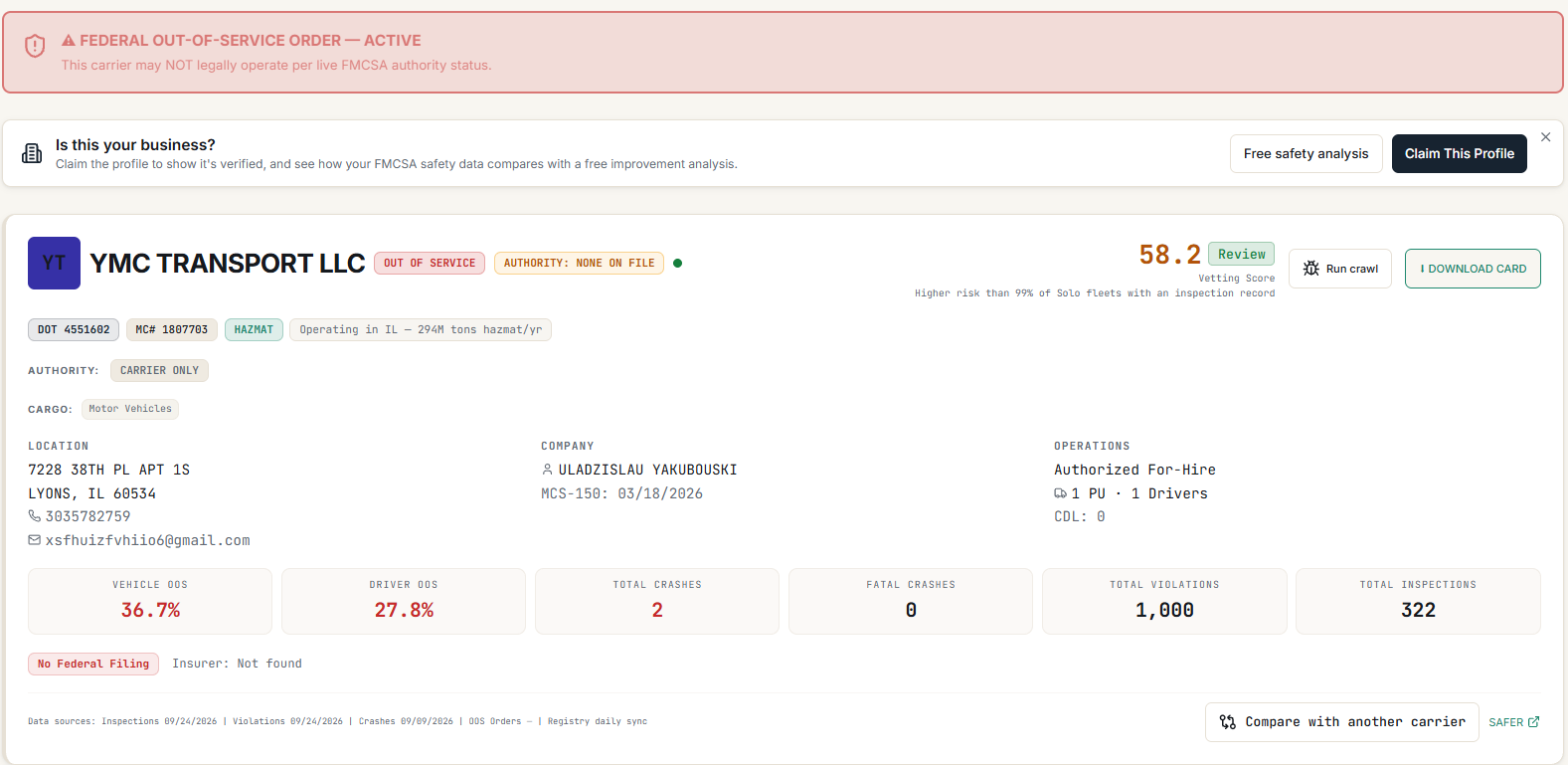
On Nov. 10, FMCSA ordered YMC Transport LLC out of service. That's the good news. The trucks it ran started moving to a new USDOT number on Aug. 7 and are running today under MLTZX Group. And the next company in line went live on Nov. 1, right on the schedule we said it would.
Yesterday afternoon, the alert hit my inbox. FMCSA had issued an out-of-service order to YMC Transport LLC, USDOT 4551602, and the carrier is no longer allowed to operate. Credit where it’s due. The agency is shutting these companies down faster than it did a year ago, and YMC is one more name off the board.
Well, there’s a problem. The bad actors are playing chess with a government that plays checkers with missing pieces. YMC’s last roadside inspection was Sept. 24. Its USDOT number went inactive on Oct. 11. By the time the order was signed, YMC was an empty mailbox. The trucks it ran were gone, and they hadn’t gone home.
YMC registered with FMCSA on March 18, 2026, from an apartment in Lyons, Illinois. Its MCS-150 declared one power unit and one driver. Between June 18 and Sept. 24, inspectors in dozens of states wrote up 217 different vehicle identification numbers under YMC’s number. Most were one-ton Ford and Ram pickups, the hotshot rigs this network runs, and more than 40 were trailers, roughly half Kaufman car haulers. One truck on paper. 217 VINs on the road.
www.teatechnologies.com via www.theteaintel.com
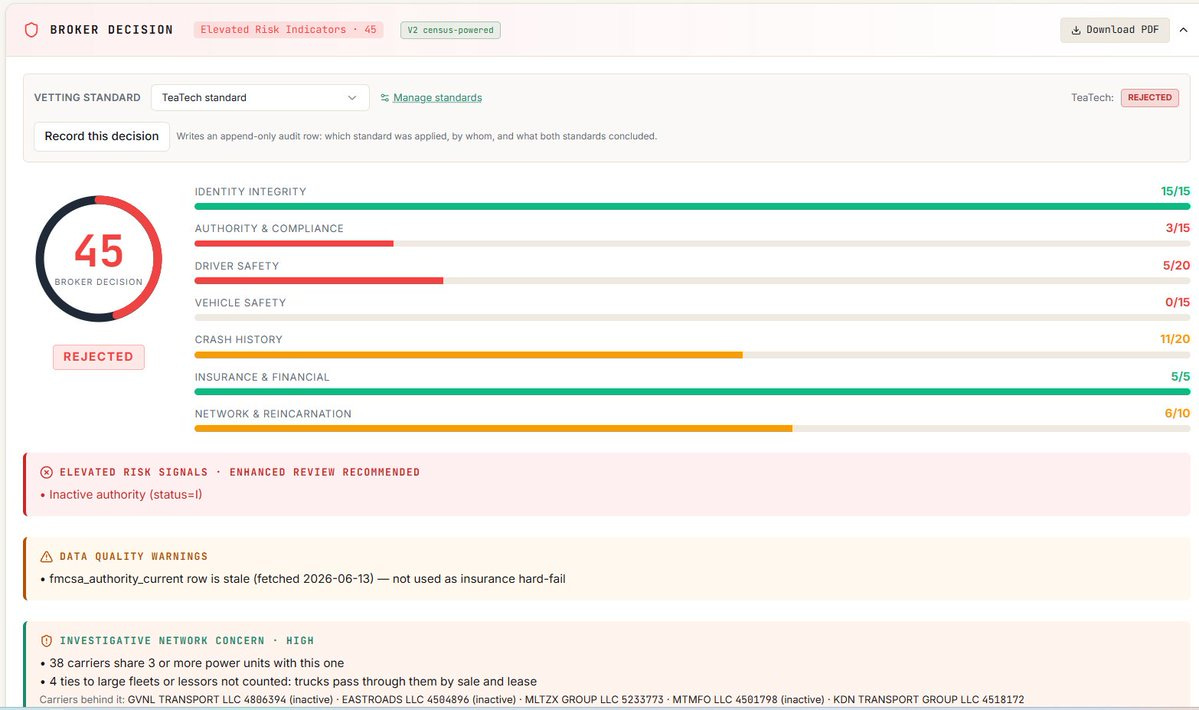
On our platform, YMC was already marked as rejected before the order came. The broker decision score is 45. The vehicle out-of-service rate is 36.7% and the driver out-of-service rate is 27.8%. The network panel shows 38 other carriers sharing three or more power units with it. A broker who ran that check would have walked away from the load.
So where did the trucks go?
www.teatechnologies.com
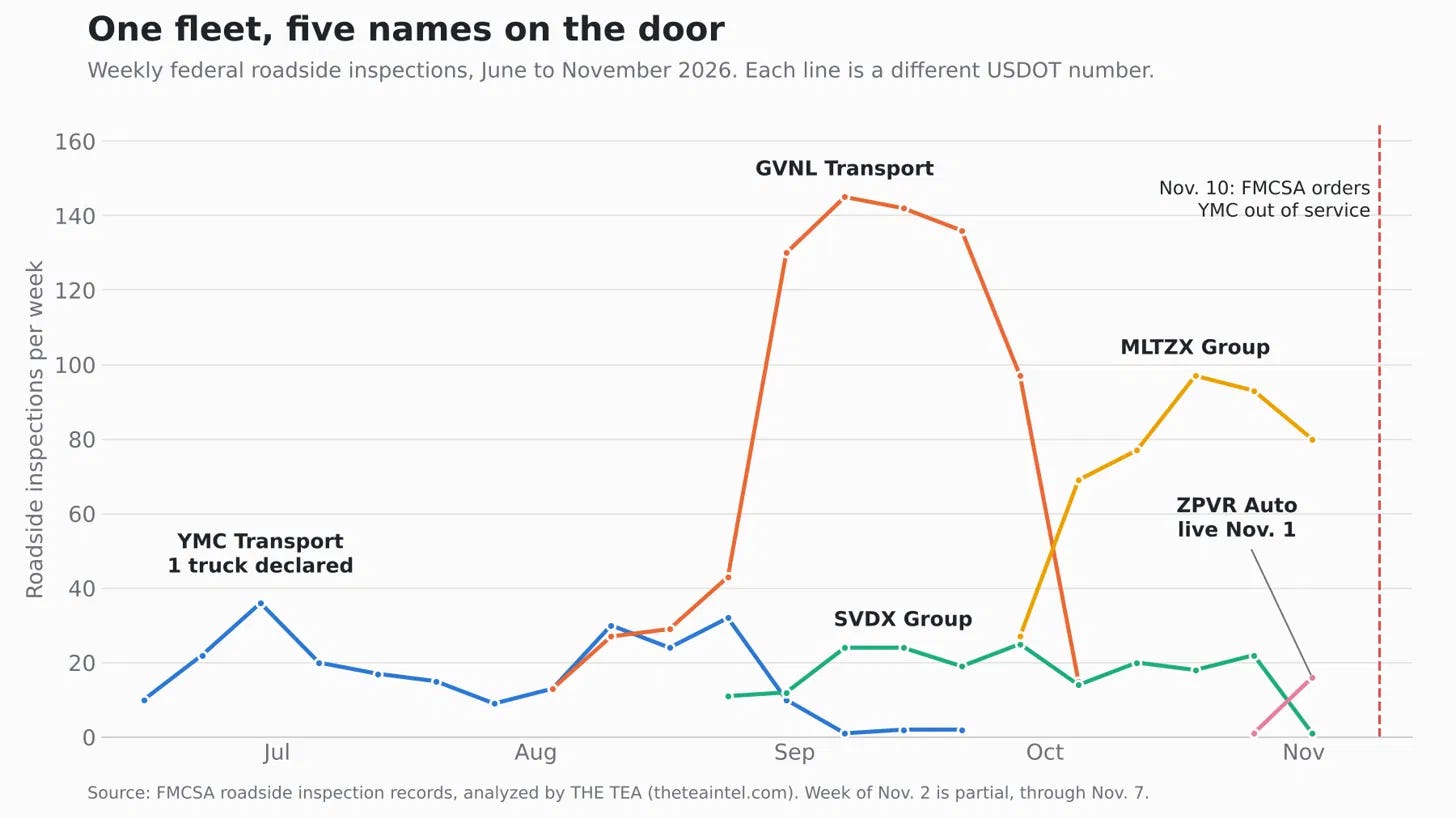
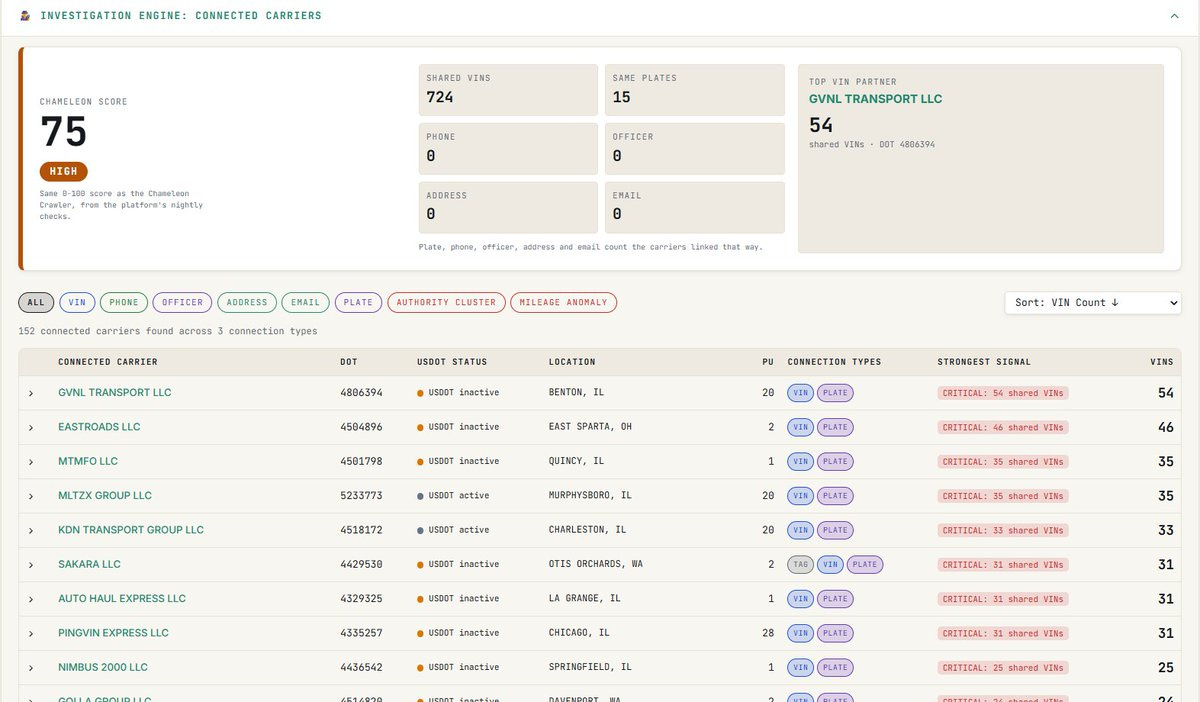
On Aug. 5, a brand-new carrier called GVNL Transport LLC, USDOT 4806394, logged its first roadside inspection. Two days later, the first YMC truck showed up under GVNL’s number. Over the next five weeks, inspectors stopped 50 trucks they had already written up under YMC under GVNL while YMC was still running. That’s not a company shutting down and selling off its equipment. That’s two DOT numbers working the same fleet at the same time, with the trucks sliding from one door to the other.
Most of the move happened in the two weeks starting Aug. 31. YMC’s inspections fell from 32 in the last week of August to 1 the week of Sept. 7. GVNL’s went from 43 to 130 to 145. In all, 52 of YMC’s trucks went straight to GVNL.
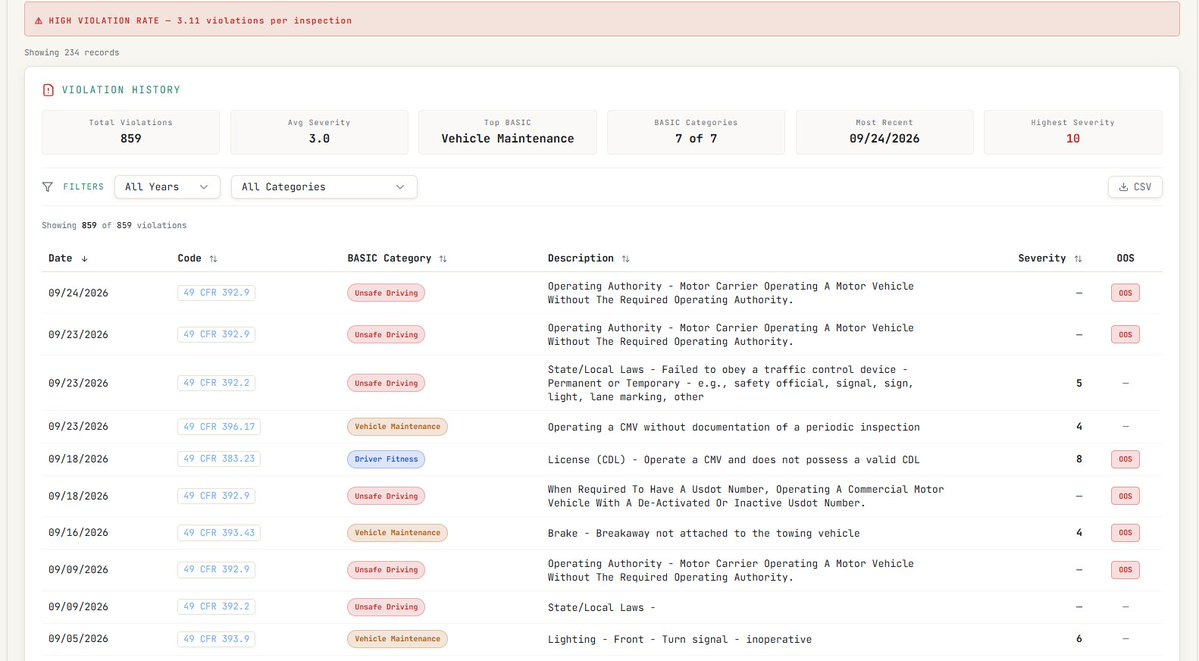
GVNL lasted about as long as YMC did. Its insurance was canceled Oct. 6 and its USDOT number is now inactive. Before it went dark, the trucks had already moved again, this time to MLTZX Group LLC, USDOT 5233773, registered Sept. 2 from an apartment in Murphysboro, Illinois. MLTZX logged its first inspection Sept. 28, nine days before GVNL’s last.
As of this morning, 33 of the trucks that ran under YMC were last seen under MLTZX. Inspectors stopped them as recently as Nov. 5, in Arkansas and Tennessee. MLTZX has been inspected 69 to 97 times a week since Oct. 5. It is active and has no out-of-service order. On Nov. 5, it updated its MCS-150 to declare 20 power units.
The trucks didn’t all go to one place. A handful landed one at a time with other carriers, and some of those are probably ordinary sales or lease-ons. Used pickups change hands every day, and a single shared VIN between two companies proves very little. Another 127 of YMC’s VINs haven’t been stopped by anyone since. That doesn’t mean they’re parked. It means nobody has pulled them over yet.
The trucks didn’t start with YMC, either. They came off the same relay of shells I’ve been writing about since June: Eastroads, KDN Transport Group, QDPT Cargo, Golla Group, Haulfleet and MTMFO, and before them Suplicium, Sakara and Auto Haul Express. Same iron. New door every 60 to 90 days.
The out-of-service order works exactly as written. It lands on the company. It just lands on a company that was finished with its USDOT number weeks before the order came. So we stopped waiting for the order and started watching for the next door.
I’m not going to lay out how we build the forecast. The people running this network read my work too, and I’m not handing them the checklist. What I’ll tell you is that every link in this chain carries a fingerprint, and the fingerprint doesn’t change when the name does. The kind of town. The kind of address. The kind of email. The insurer. The timing. When a new registration matches, it goes on the watch list before it ever turns a wheel.
At the end of October, one name sat at the top of that list: ZPVR Auto LLC, USDOT 6014649, registered Sept. 3 from an apartment in Vandalia, Illinois. One truck declared. A $1 million liability policy from Artisan and Truckers Casualty, a Progressive company, effective Oct. 19. Zero inspections.
On Nov. 1, ZPVR logged its first roadside inspection. In its first six days, inspectors stopped ZPVR trucks 17 times in 13 states, from Arizona to Maryland, and wrote up 15 different VINs. Ten of them had run under earlier links in this network. Seven came straight off SVDX Group LLC, USDOT 8891887, another one-truck registration that inspectors had stopped 190 times since August. SVDX’s last inspection was Nov. 3, and its USDOT number is now inactive. The forecast hit. That’s the good news and the bad news in the same sentence.
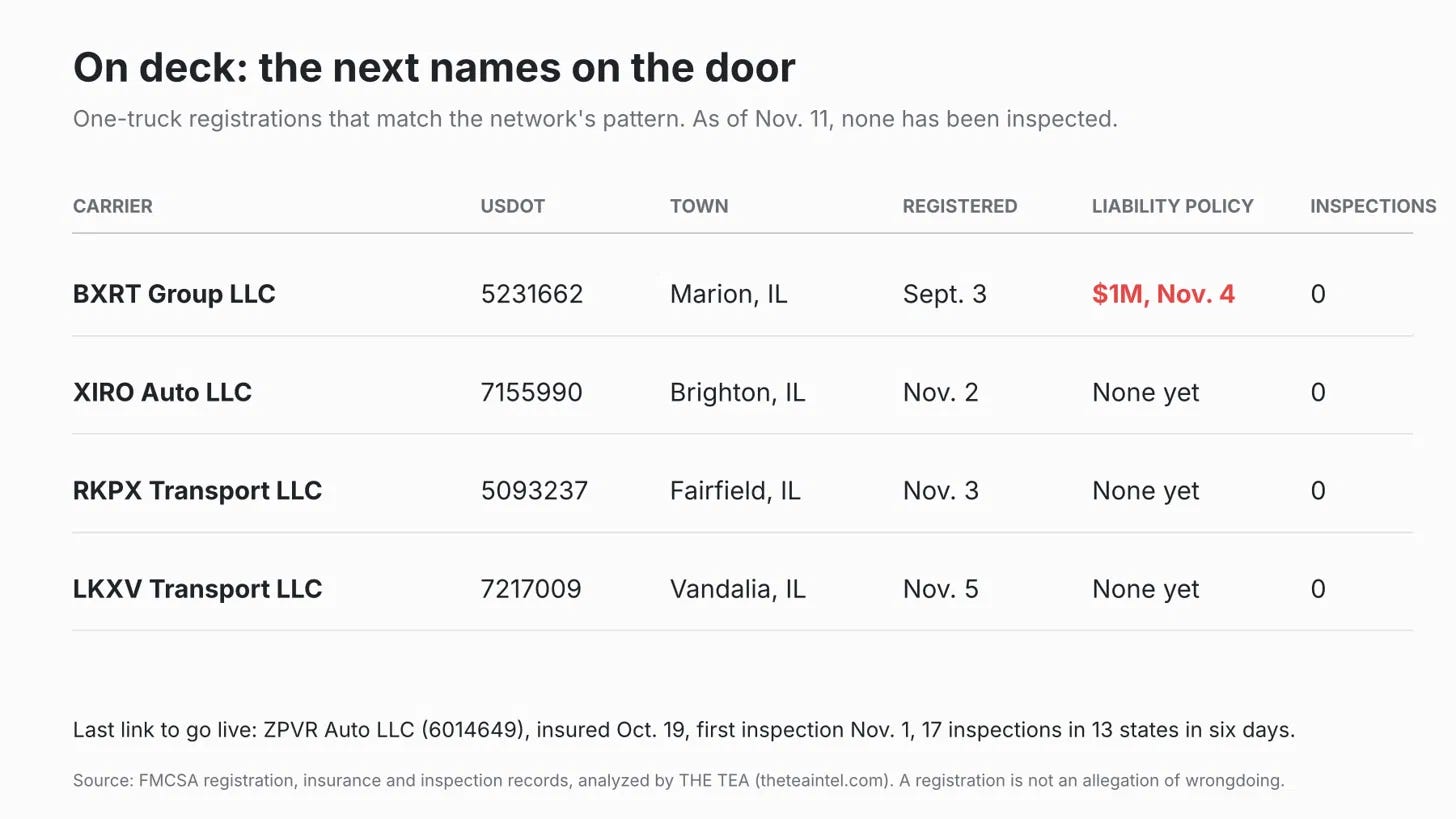
Look at the insurance filings and you can see the calendar. Artisan and Truckers bound SVDX on Aug. 20, policy CA878483137. It bound MLTZX on Sept. 21, policy CA880216102. It bound ZPVR on Oct. 19, policy CA881471156. And on Nov. 4, it bound BXRT Group LLC, USDOT 5231662, registered Sept. 3 from an apartment in Marion, Illinois, policy CA882125084, $1 million. One truck declared. No inspections yet. Four links, four policies, from the same insurer, all about a month apart, every one written for one truck.
BXRT is loaded and waiting. When MLTZX goes down, I expect the trucks to turn up there.
Behind BXRT, the bench is already filling up again. In the last nine days, three more one-truck carriers registered with FMCSA that match the pattern: XIRO Auto LLC, USDOT 7155990, in Brighton, Illinois, on Nov. 2; RKPX Transport LLC, USDOT 5093237, in Fairfield, Illinois, on Nov. 3; and LKXV Transport LLC, USDOT 7217009, in Vandalia, Illinois, the same small town as ZPVR, on Nov. 5. None has insurance on file. None has been inspected. To be clear, none of them has done anything yet, and registration isn’t a crime. But if this network holds to its own schedule, one of them will get a $1 million policy in the next few weeks, and its first inspection will come right around the day the active link’s insurance cancels.
Here is who pays for the gap. If you’re insured by the same book and insurer, well, next year, ask your insurer why your rates increased because of the loss that insurer took for choosing to insure bad actor carriers. Start there.
The driver behind the wheel of one of these pickups, often without a valid CDL, who gets put out of service under a company that’s gone before the citation posts. The broker who sees a fresh authority, a clean record, and an active $1 million certificate, and who, after Montgomery v. Caribe Transport II, can now be sued in state court for picking that carrier. The insurer that priced a premium for one truck and owes the public on the MCS-90 for hundreds. Every honest carrier on that insurer’s book pays for it at renewal. And the family on the shoulder finds a defendant with no history, no assets and nobody at the address.
FMCSA did its job on YMC and they’ve been working this network, but the trucks that order was supposed to stop were inspected under MLTZX on Nov. 5 and under ZPVR on Nov. 6. It’s acting on the next registration before its first inspection, not on the last one after its final inspection. Brokers can do the same thing tomorrow: stop vetting the DOT number and start vetting the truck.
The out-of-service order took YMC’s name off the door. The trucks are still on the road, and the next door is already open.
The hotshot network (Suplicium, Sakara, GVNL, MLTZX)
June 1, FreightWaves: Inside hotshot trucking’s ghost fleets
June 26, FreightWaves: FMCSA says: Less paper, more enforcement (covers the chameleon carrier enforcement push)
Early November, Substack: Your trucking insurance 101 guide: The truck wasn’t on the policy. The insurer still owes you. (has the MLTZX section)
Nov. 3, Substack: 299 trucks on paper. 6,056 on the road. (the follow-up with the list of carriers likely to be used next)
These hotshot chameleons make it impossible for legitimate hot shots to survive. Our repair shop constantly sees local one or 2 unit carriers unable to pay for critical repairs much less routine maintenance. One major breakdown costs them their business
Your work on this topic is incredible. Thank you for the effort.
I often wondered if these hotshot groups were the “training” to prep illegal immigrant drivers for eventual OTR tractor-trailer operations.